
Advertisement


Sections
Bengal tigers in the Sundarbans on a rapid decline, may go extinct by 2070: Study
Sea level rise & climate change are twin threats to Bengal tigers and their last remaining stronghold.

 Representational image. Reuters[/caption]The researchers used detailed simulation models for the two scenarios of climate change that were developed by the Intergovernmental Panel on Climate Change (IPCC), along with projected sea level rise in the region to arrive at an assessment about how sustainable the region is for its tigers."While this is preliminary analysis, we can conclude that the largest population of Bengal tigers is in an area where a combination of actors including climate change and human encroachment could both contribute to the decimation of habitats," William Laurence, co-author of the study from James Cook University, told IndiaSpend.With both temperatures and sea levels on the rise, the amount of salinated seawater flowing into land can change the soil's composition, making it harder for some plants to grow. With choices of available food on the decline, Sunderbans' population of spotted-deer, the foremost prey of the Bengal tiger, will be affected severely as the leaves and trees they feed on gradually disappear. With natural resources on the decline, tigers are also more likely to stray into settlements with people, on the lookout for food. Tiger-human conflict is also predicted to increase in this scenario, according to the study.[caption id="attachment_6252831" align="alignnone" width="1280"]
 Mangrove forests in the Sundarbans. Image: Wikimedia Commons[/caption]The mangroves at the heart of the Sundarbans, themselves, are critically endangered, as per the IUCN Red List. Mangroves are trees that are salt tolerant, with roots that submerged under water and act as a nursery and nest for marine life. These young ones eventually migrate to reefs, which many of these creatures call home for a significant period of their lives.The collective ecosystem of mangroves, seagrass and corals are of huge importance to ocean health for many reasons — they trap and produce food for marine life, protect coasts from the impact of storms, help filter out pollutants in run-off water from land, and make for habitats to turtles, seahorses, manatees, fish and foraging sea life like urchins and sea cucumbers.
As for the Bengal tigers, researchers believe the population could still survive in the region if conservation of tigers and the local ecosystem is made a priority. The study calls on the government of Bangladesh to make accommodations – designate larger areas for tiger conservation, make more corridors for tigers to move around safely, and remain vigilant about poaching and hunting in the area to avoid any further decline in their population.While the study claims that tigers could be wiped out from the Sunderbans in 50 years, not all experts share the same opinion.Sugata Hazra, an oceanographer at Jadavpur University, Kolkata says that she doesn’t subscribe to the same "doomsday view"."When we conducted our 2016 study, we accounted for a 'sediment attrition rate', since mangroves are also building land in the area as they attract sediment," Hazra told Indiaspend. After they adjusted the sea level rise after sedimentation, the land loss was roughly 17 percent.[caption id="attachment_6252871" align="alignnone" width="1280"]
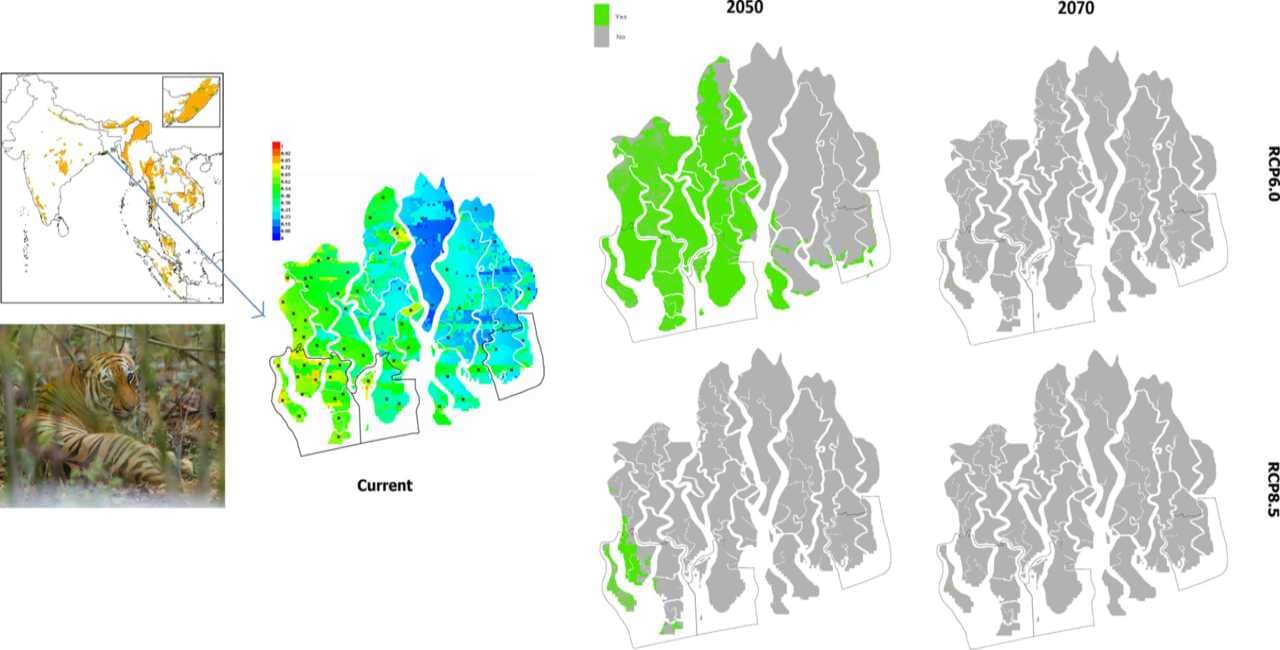 Habitat loss in the Sunderbans is a serious, immediate threat. Image credit: Elsevier/Laurance et al[/caption]The Sunderbans Tiger Reserve was found to be home to at least 103 tigers in the 2013 census. Of its entire land area, around 40 percent – an area the size of Goa – falls under West Bengal. Some conservationists believe that this division of Sunderbans (as well its tiger population) between efforts from both, the Bangladeshi and Indian side, is a hindrance."Tigers can cross easily between India and Bangladesh so the tiger population is not a separate one; they live in a trans-national ecosystem," Hazra told Indiaspend. An approach with closer cooperation on sharing the forest resources, tiger habitat and upkeep of freshwater supply in the area is important, she adds.But any big effort needs time, and there's one thing that the study and Professor Hazra are in agreement about: the fight against habitat loss in the Sunderbans needs to begin immediately. It could take 20 years or more for these efforts to even begin showing results, but there won't be a forest or tigers to save in 50 years if action isn't taken soon.
First Published:Mar 13, 2019, 19:08:50 IST
Advertisement
Advertisement

J&K cop on Amarnath Yatra duty shot dead in Anantnag terror attack; TRF claims responsibility
The Resistance Front (TRF), a shadow outfit of Lashkar-e-Taiba, claimed responsibility for the attack through a social media post
2 min read
Jaishankar meets Canada's Anita Anand, discusses bilateral cooperation and shared interests
External Affairs Minister S Jaishankar on Wednesday held talks on bilateral ties with his Canadian counterpart Anita Anand, focusing on cooperation and common goals.
1 min read
Delhi, Bengaluru, Hyderabad... Neet paper leak protest spreads nationwide even as govt reaches out to CJP, Opposition
Protests over the alleged NEET paper leak intensified across multiple cities, while the Centre signalled talks with the Opposition and the Cockroach Janta Party. The Delhi High Court also stepped in, seeking preservation of CCTV footage related to police action.
3 min read
Why is India seeing 95% cloud cover despite a Super El Niño?
India is witnessing nearly 95 per cent cloud cover despite a Super El Niño, a climate event usually linked to weaker monsoons. Regional weather systems, cyclonic circulations, the monsoon trough and moisture from two seas are temporarily overpowering one of the world's strongest climate phenomena
5 min read
Jaishankar, Rubio review trade, defence, AI cooperation at Manila meeting
Jaishankar and US Secretary of State Marco Rubio reviewed key pillars of the India-US Comprehensive Global Strategic Partnership, including trade, defence, energy, critical minerals and artificial intelligence, while also exchanging views on regional and global developments.
1 min read
Advertisement
Advertisement