


Avian flu outbreak in India brings forth links to environment, animal and human health
Since many wetlands where migratory birds visit are unprotected, involving communities in their management is essential, according to experts.


Demoiselle cranes, one of the many migratory birds that fly down to India, spotted at the Tal Chhapar Sanctuary in Rajasthan. Image courtesy: Wikimedia Commons[/caption]Reports of deaths of over 2000 birds at Pong Lake in Himachal Pradesh were followed by alerts of peacock mortalities in Maharashtra, deaths of lapwings near Kharo Dam in Gujarat’s Junagadh district, and jungle crows in Uttarakhand. Upon confirmation of the avian flu outbreak, a total of 4,49,271 poultry birds were culled till February 12, 2021, to control the disease spread, as per the National Action Plan for Prevention, Control, and Containment of Avian Influenza. India’s poultry sector is valued at about Rs. 80,000 crore and employs over 10 lakh farmers.
Addressing knowledge gaps
Knowledge gaps remain in the nature of the wild waterfowl–poultry interface and the sharing of diverse wetland habitat among these birds.Evolutionary ecologist Farah Ishtiaq underscored the need for a well-designed study to screen poultry and domestic waterfowl for low pathogenic viruses. “We lack such data,” Ishtiaq told Mongabay-India. “High species diversity and low water temperature are known to enhance virus survival in certain parts of the world. However, in the Indian context, poultry plays a huge role in circulating the virus throughout the year. Therefore, there have been reports of outbreaks in nonseason time as well,” added Ishtiaq, senior scientist at Tata Institute for Genetics and Society. She stressed on rapid testing for confirming the cause of death of wild birds. “Viruses are very sensitive to temperature and RNA degrades really fast with an increase in temperature. We need a simplified system to screen such samples in real-time as the cases are reported to ascertain the cause and viral strain,” said Ishtiaq.According to landscape epidemiologist Michael Walsh, co-author of a 2020 study that systematically investigated the extent of the interface between wild waterfowl and poultry and its influence on the risk of HPAI H5N1 outbreaks in India, there was evidence of interaction between poultry and wild waterfowl concerning H5N1 outbreaks.“Our results showed that outbreak risk did increase with increasing poultry density, which is in line with previous studies. However, what we also showed (and what previous studies have not explored) is that when you consider the landscapes where these poultry are held, outbreak risk was actually highest among low-density poultry holdings where poultry were in prime wild waterfowl habitat. Conversely, outbreak risk was higher among high-density poultry holdings only when those holdings were in areas where the poultry were least likely to come into contact with wild waterfowl,” Walsh, at the University of Sydney, told Mongabay-India.The study also found that H5N1 outbreak occurrence was higher with greater proximity specifically to lakes, rivers, and coastal wetlands. These findings provide specific points in the landscape that may be good targets for interrupting the cycling of avian influenza viruses, for example, by blocking the mixed-use of surface water by domestic poultry and wild waterfowl.[caption id="attachment_5938081" align="alignnone" width="1280"]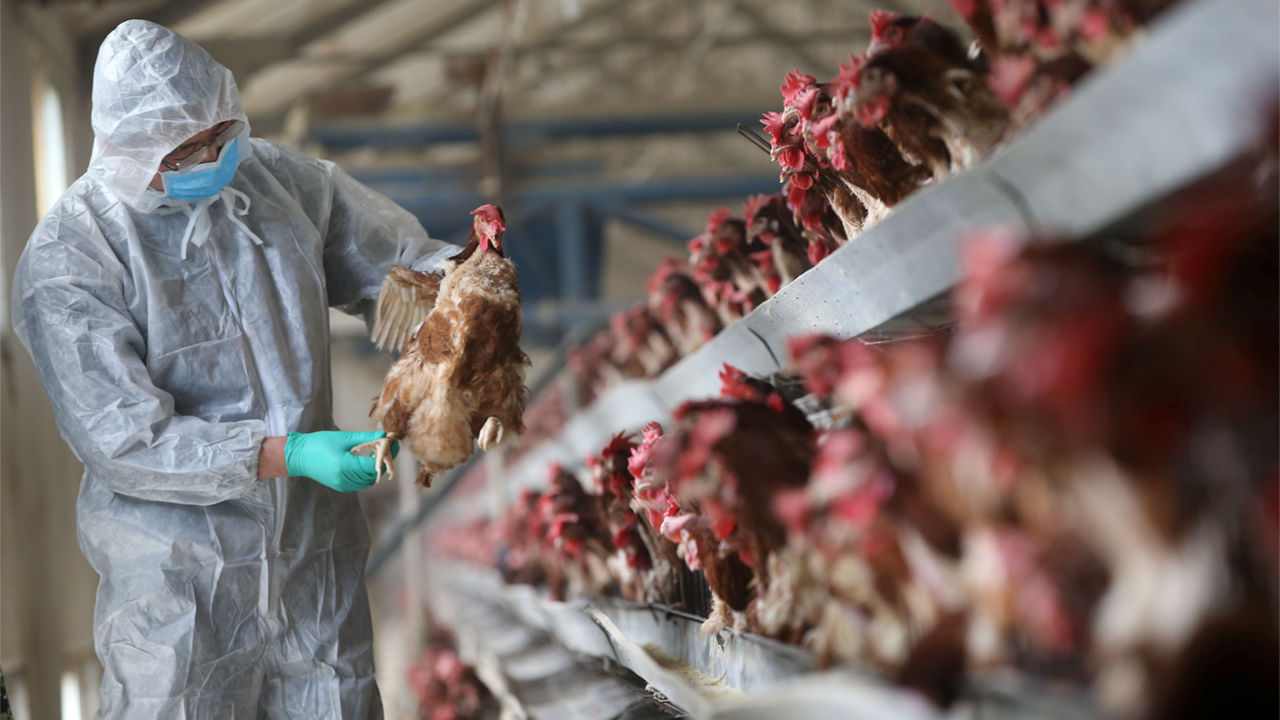
These viruses occur naturally among wild aquatic birds worldwide and can infect domestic poultry and other bird and animal species. Avian flu viruses do not normally infect humans. Image Credit: Science Magazine[/caption]While the emphasis should be on monitoring multiple waterbird sites of local, national, and international importance, surveillance is complicated by the nature of the poultry-wildbird-wetlands interface. “The story is not simple; domestic birds in an infected area are interacting with wild birds and some of these birds may be resident or migratory; the environment can be infected so you have these interactions happening in an area where there is an infection,” explained Mundkur.“As poultry themselves don’t fly around, the virus can be carried in the trade of poultry/poultry products, pet birds, and in equipment (fomites) between farms and from the farms to wetlands and to markets. Once the virus is introduced into a wetland, it can infect migratory or domestic birds, and from where the virus can move to another area through local movements of these birds. This may then reinfect poultry or resident birds. Additionally, the virus may be picked up by predatory birds or raptors if they feed on dead or dying infected wild birds or poultry.”There are many different peculiarities in dealing with the virus, and understanding the situation in an area is particularly important, he observed.Farah Ishtiaq adds that unprotected wetlands are under constant pressure from urbanisation and pollution. With the loss of habitat and increase in poultry, the wildbird and poultry buffer has reduced and increased interaction and exchange of viruses – not just spillover but probably spillback from poultry as well, she said.Kamal Saini, an assistant zoologist at Zoological Survey of India’s High Altitude Regional Centre at Solan, Himachal Pradesh, was part of the team that did an initial survey of Pong Dam wetlands in January following reports of mass death of migratory birds. He observed dead bar-headed geese, pochards, pin-tail, black stilt, sand plovers, mallard, spot-billed duck, coot, common teal, lapwing, among others at Pong.“We saw the bar-headed geese trying to approach the land from the water, fall, squirm for a few minutes, and then drop dead. This was before avian influenza was confirmed. The forest department had put in place restrictions. After the birds die, their carcasses are attacked by predators like stray dogs, black kites, and tawny eagles; they may carry the virus to distant wild and domesticated animals,” Saini told Mongabay-India. So it remains a challenge for the department to bury the carcass before these predators attack them. “Additionally, the bar-headed geese that are unable to reach the bank, and die on the water may pose another threat to humans through consumption of affected fish,” he said.Saini observed that every year thousands of winter migratory birds, such as the bar-headed goose, make a pit stop at Pong Dam and other wetlands on their journey from Central Asia, Tibet, Russia, Siberia, Mongolia and any changes in habitat quality can push them to look for alternative habitats.Bar-headed goose (Anser indicus) is a long-distance migrant to the Indian subcontinent, with its major population breeding in China. There is a small breeding population in Ladakh, Mongolia, and Kyrgyzstan. Migrating bar-headed geese have been reported from many protected and non-protected wetlands of Assam, Himachal Pradesh, Jammu and Kashmir, Uttar Pradesh, Rajasthan, Andhra Pradesh, Odisha, Karnataka, Tamil Nadu, Kerala, and Maharashtra.“This year their stoppages at Sukhna lake in Chandigarh were reduced, but they were seen in good numbers in small ponds in Haryana which means that protecting habitat quality even in these small water bodies is critical,” said Saini.Researchers at Bangor University collaborating with a large international team of researchers, reported in 2011 that bar-headed geese can fly up to 6,000 m in only 8 hours while passing over the Himalayan mountain range – a similar intense climb could kill a human without lengthy acclimatisation. “When the birds arrive here they are subjected to fatigue following their long flight and they are more susceptible to the infection,” suspects Bivash Pandav, director, Bombay Natural History Society (BNHS), adding that the poultry and piggeries are the most susceptible to the virus.“Most of these wetlands where you see migratory birds are unprotected sites, so involving communities in wetland management is essential,” Pandav told Mongabay-India.Pandav reiterates regular health monitoring and sampling of wild birds in selected wetland spots to get a sense of the disease prevalence and the strains. “Otherwise, we try to do all this when the mortalities occur. At BNHS, we have been capturing and ringing birds in different parts of the country. But we are trying to incorporate the disease monitoring component into our ringing programme. We are looking for financial support for the analysis of the samples,” added Pandav.This article was originally published on Mongabay.com.Mongabay-India is an environmental science and conservation news service. This article has been republished under the Creative Commons license.

J&K cop on Amarnath Yatra duty shot dead in Anantnag terror attack; TRF claims responsibility
Jaishankar meets Canada's Anita Anand, discusses bilateral cooperation and shared interests
Delhi, Bengaluru, Hyderabad... Neet paper leak protest spreads nationwide even as govt reaches out to CJP, Opposition
Why is India seeing 95% cloud cover despite a Super El Niño?
Jaishankar, Rubio review trade, defence, AI cooperation at Manila meeting