
Advertisement


Sections
Assam's Lower Subansiri hydel project can learn lessons from Tapovan Vishnugad disaster
From the beginning itself, the Lower Subansiri hydropower project has been engulfed in controversies with serious flaws being pointed out to its design and structure by various experts and panels

It is election time in Assam and the high and roaring waves of the Dhauliganga river that ravaged the Tapovan Vishnugad Hydro Power project at Joshimath in Uttarakhand's Chamoli district on Sunday were too small for the northeastern state's ruling class to bother with. Not that the flash flood in Uttarakhand would have reached Assam, but the state has the perfect recipe for far more severe circumstances in the making right in its own backyard.The NHPC-owned Subansiri Lower Hydro Electric Project, which is the biggest hydroelectric project undertaken in India so far and is a run of river scheme on the Subansiri, located at Gerukamukh in Assam's Dhemaji district on the border of Arunachal Pradesh and Assam, also holds the dubious distinction of having the highest cost overrun among under-construction hydel projects in the country. The cost overrun is at a massive Rs 13,211 crore for a project whose original estimate was pegged at Rs 6,285 crore when it was conceived in 2002 and now the revised estimate puts the total cost at Rs 19,496 crore. Not just the financial cost alone, but time overrun has also been huge for the project as the original schedule of commissioning it was back in September 2010.According to the reasons for time and cost overrun provided to Lok Sabha by the Ministry of Power on 25 July 2019, there are many factors behind slowing down the project. They are:• Delay in the transfer of forest land• Disruption of works by locals in Arunachal Pradesh side• Slope failure in Power House in January 2008• Damage to the bridge on Ranganadi river• Change in design of surge shafts to surge tunnels• Stoppage of works due to agitation launched by anti-dam activists in Assam against the construction of the project. Stoppage of work since 16 December 2011• Issue of D/s Impact• Case in NGTHowever, during a visit to the Subansiri Lower HE Project site by Union power secretary Sanjiv Nandan Sahai on 4 December last year, NHPC CMD AK Singh assured that the project shall be commissioned by March 2022. Contrary to that the Ministry of Power had informed the Lok Sabha that the project will take four more years to be completed from the day work restarts. The work has restarted in the project site in October last year. The company claims that 50 percent work of the project has already been completed.The decks for the resumption of construction works were cleared after the National Green Tribunal did not "find any merit in the applications" seeking the reconstitution of the Committee constituted by the Ministry of Environment, Forest and Climate Change (MoEF&CC) vide order dated 27.11.2017 in pursuance of the order of this Tribunal dated 16.10.2017 and the same were dismissed on 31 July 2019.Genesis of the projectThe Lower Subansiri HEP consists of one Concrete Gravity Dam of 116-metre high above the river bed level and 123-metre high above the deepest foundation level. It will have a surface powerhouse with an installed capacity of 2,000 MW with eight units of 250 MW capacity each. The project received its environment clearance through Letter No. J-12011/40/2001-IA-I dated 16 July, 2003 and the construction work on the project began in January, 2005.Authors Swapnali Barman, RK Bhattacharya, SK Sharma and G Tirkey in their joint study Future flow scenario of Subansiri River and its Impact on Power Potential of Subansiri Lower Hydro Electric Project gave a little introduction to the river itself."The river Subansiri is one of the major north bank tributaries of river Brahmaputra. It flows through Tibet for 170 km, 250 km through Arunachal Pradesh after which it enters Assam at Dulangmukh in Dhemaji district and flows for another 130 km through the plains of Assam before it merges with the River Brahmaputra near Jamugurighat in Assam. The Subansiri river system has its practical importance as it holds high water resources as well as hydropower potential for the country," the paper said.Going back on how the initial thoughts for the project came, senior practicing engineer JN Khataniar said it was the Brahmaputra Board that came up with the idea first."The possibility of hydropower generation using plenty of water of the river Subansiri was initially investigated by the Brahmaputra Board during 1982-84 and finally submitted the detail project report in 1985 as a multi-purpose 2,000 MW single hydropower project having a 275-metre height Rockfill Dam and an underground powerhouse due to high seismicity and land slid sensitivities of the entire region," said Khataniar from Guwahati.He said that in 2000, NHPC took over the findings from Brahmaputra Board and prepared a new project concept for a three-stage hydropower project after conducting its own investigation. The NHPC recommendations were:![Diagram courtesy JN Khataniar]() Diagram courtesy JN Khataniar[/caption]He pointed out a key point that no flood moderation for independent Subansiri Lower HE Project was conceptualised and that the Central Electrical Authority in its Techno-Economic Clearance had made it abundantly clear in 2003 that integrated flood studies including reservoir operation for all three projects — Subansiri upper, middle and lower — shall be done in consultation with the Brahmaputra Board and Central Water Commission before executing the Subansiri Lower Hydro Electric Project."There are possibilities of tremendous upstream impact on the most unhealthy 116-metre Concrete Gravity Dam structure in Lower Subansiri Hydro Power Project for the sudden loads of excess water that may occur due to heavy rains, cloud burst, or massive landslide. In the absence of other two projects over the same river as conceptualised as an integrated project, there are insufficient cushioning provisions above the dam structure to take care of probable floods," Khataniar said.[caption id="attachment_9288921" align="alignnone" width="640"]
Diagram courtesy JN Khataniar[/caption]He pointed out a key point that no flood moderation for independent Subansiri Lower HE Project was conceptualised and that the Central Electrical Authority in its Techno-Economic Clearance had made it abundantly clear in 2003 that integrated flood studies including reservoir operation for all three projects — Subansiri upper, middle and lower — shall be done in consultation with the Brahmaputra Board and Central Water Commission before executing the Subansiri Lower Hydro Electric Project."There are possibilities of tremendous upstream impact on the most unhealthy 116-metre Concrete Gravity Dam structure in Lower Subansiri Hydro Power Project for the sudden loads of excess water that may occur due to heavy rains, cloud burst, or massive landslide. In the absence of other two projects over the same river as conceptualised as an integrated project, there are insufficient cushioning provisions above the dam structure to take care of probable floods," Khataniar said.[caption id="attachment_9288921" align="alignnone" width="640"]![Modified design of Lower Subansiri hydel project concrete dam by expanding the base width up to 271.00 metre with respect to the fixed height 116.00 metre, more than 233% base with against normal 80% with respect to height. Diagram courtesy JN Khataniar]() Modified design of Lower Subansiri hydel project concrete dam by expanding the base width up to 271.00 metre with respect to the fixed height 116.00 metre, more than 233% base with against normal 80% with respect to height. Diagram courtesy JN Khataniar[/caption]"We have already seen what environmental disasters can do in the recent catastrophic event in Uttarakhand despite the dams being made as per the recommendations. In the case of Lower Subansiri HEP, who will take responsibility for the retrofitting processes at the dam and guarantee the safety of the people living downstream? Who will take accountability for the inadequacies in concepts and design of the dam structure for which we are losing a huge amount of public money and destroying a natural water resource?" he asked.Water resources engineer Pradip Pujari said that although one dam was completely lost in Uttarakhand, another dam downstream actually prevented a far bigger catastrophe by arresting the massive flow of water."The first dam could not absorb the immediate thrust but the second one managed to neutralise the threat because the force of the water had also gone down by then," Pujari said.This makes the dams in the Upper and Middle Subansiri even more critical but they are yet to be constructed thus exposing the Lower Subansiri dam to grave threats.[caption id="attachment_9293441" align="alignnone" width="640"]
Modified design of Lower Subansiri hydel project concrete dam by expanding the base width up to 271.00 metre with respect to the fixed height 116.00 metre, more than 233% base with against normal 80% with respect to height. Diagram courtesy JN Khataniar[/caption]"We have already seen what environmental disasters can do in the recent catastrophic event in Uttarakhand despite the dams being made as per the recommendations. In the case of Lower Subansiri HEP, who will take responsibility for the retrofitting processes at the dam and guarantee the safety of the people living downstream? Who will take accountability for the inadequacies in concepts and design of the dam structure for which we are losing a huge amount of public money and destroying a natural water resource?" he asked.Water resources engineer Pradip Pujari said that although one dam was completely lost in Uttarakhand, another dam downstream actually prevented a far bigger catastrophe by arresting the massive flow of water."The first dam could not absorb the immediate thrust but the second one managed to neutralise the threat because the force of the water had also gone down by then," Pujari said.This makes the dams in the Upper and Middle Subansiri even more critical but they are yet to be constructed thus exposing the Lower Subansiri dam to grave threats.[caption id="attachment_9293441" align="alignnone" width="640"]![Lower Subansiri HEP dam site. Image courtesy JN Khataniar]() Lower Subansiri HEP dam site. Image courtesy JN Khataniar[/caption]In a study, titled Lower Subansiri Hydroelectric Power Project and future of the Subansiri River Ecosystem, the shoddy survey of the environmental impact of the project has also come under severe criticism."It becomes evident that no sufficient and detailed study was done in the entire downstream during the preparation of the report. Detailed mention about the probable impacts upon the downstream river health, rare and endangered species, physical resource, people’s livelihood and the options for mitigation etc. did not find place in the report. The EIA report contains insufficient records on terrestrial and aquatic flora, phytoplanktons, fish diversity, riparian flora, zooplanktons, avian fauna, floodplain crops, people’s lively hood etc. besides healthy habitats controlled by the unregulated Subansiri river," the report said.What is worrisome is that despite the investment of such a huge amount of time and money, there will be a gradual reduction of power generation capacity of the plant and its prime production period is perhaps already over even though not an ounce of electricity has been produced yet."Compared to the historical period 1990-2014, where power obtained during this period was 3,72,982 MW, the future power obtained for SLHEP will gradually decrease from 2020-99. Power obtained for 2020-39, 2040-59, 2060-79 and 2080-99 are 29,94,14 MW, 2,83,533 MW, 2,64,851 MW and 2,64,590 MW respectively. From this analysis, it can be said that, as compared to 1990-2014, the power potential during 2020-39, 2040-59, 2060-79 and 2080-99 will decrease by 19.72 percent, 23.98 percent, 28.99 percent and 29.06 percent respectively," the authors claimed in their research.Prevent the apocalypseWhat happened in the Tapovan Vishnugad Hydro Power project was unprecedented and a rare incident that occurred due to natural causes. However, the problem with the Lower Subansiri HEP is that there are many flaws which the scientific community have themselves pointed out raising serious concerns about the safety aspect of the dam. Unless they are fixed, the chase for cheap power may prove disastrous with many lives and a huge amount of public money at stake. NHPC cannot be lackadaisical when it is making the country's largest hydropower project. It must shoulder responsibility, show accountability.
Lower Subansiri HEP dam site. Image courtesy JN Khataniar[/caption]In a study, titled Lower Subansiri Hydroelectric Power Project and future of the Subansiri River Ecosystem, the shoddy survey of the environmental impact of the project has also come under severe criticism."It becomes evident that no sufficient and detailed study was done in the entire downstream during the preparation of the report. Detailed mention about the probable impacts upon the downstream river health, rare and endangered species, physical resource, people’s livelihood and the options for mitigation etc. did not find place in the report. The EIA report contains insufficient records on terrestrial and aquatic flora, phytoplanktons, fish diversity, riparian flora, zooplanktons, avian fauna, floodplain crops, people’s lively hood etc. besides healthy habitats controlled by the unregulated Subansiri river," the report said.What is worrisome is that despite the investment of such a huge amount of time and money, there will be a gradual reduction of power generation capacity of the plant and its prime production period is perhaps already over even though not an ounce of electricity has been produced yet."Compared to the historical period 1990-2014, where power obtained during this period was 3,72,982 MW, the future power obtained for SLHEP will gradually decrease from 2020-99. Power obtained for 2020-39, 2040-59, 2060-79 and 2080-99 are 29,94,14 MW, 2,83,533 MW, 2,64,851 MW and 2,64,590 MW respectively. From this analysis, it can be said that, as compared to 1990-2014, the power potential during 2020-39, 2040-59, 2060-79 and 2080-99 will decrease by 19.72 percent, 23.98 percent, 28.99 percent and 29.06 percent respectively," the authors claimed in their research.Prevent the apocalypseWhat happened in the Tapovan Vishnugad Hydro Power project was unprecedented and a rare incident that occurred due to natural causes. However, the problem with the Lower Subansiri HEP is that there are many flaws which the scientific community have themselves pointed out raising serious concerns about the safety aspect of the dam. Unless they are fixed, the chase for cheap power may prove disastrous with many lives and a huge amount of public money at stake. NHPC cannot be lackadaisical when it is making the country's largest hydropower project. It must shoulder responsibility, show accountability.
- The upper stage: 2,000 MW with a dam height 214m from bed level and flood cushioning 10.00m
- The middle stage: 1,600 MW with a dam height 203 m from bed level with flood cushioning 15.00m
- The lower stage: 2,000 MW with a dam height 116m from bed level without having any flood cushioning as upper and middle stage flood cushioning are enough
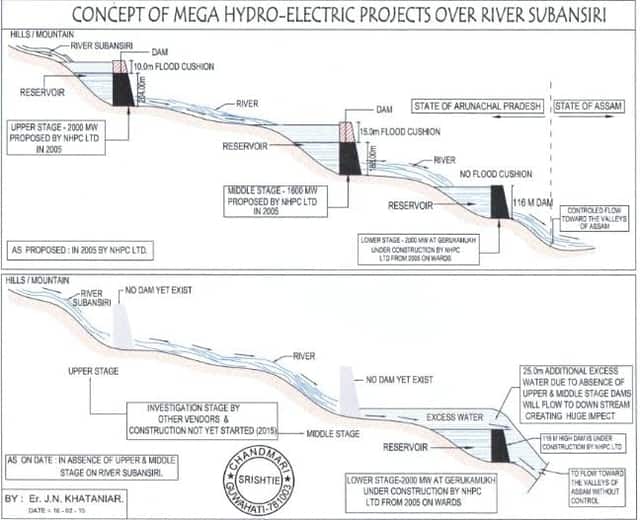 Diagram courtesy JN Khataniar[/caption]He pointed out a key point that no flood moderation for independent Subansiri Lower HE Project was conceptualised and that the Central Electrical Authority in its Techno-Economic Clearance had made it abundantly clear in 2003 that integrated flood studies including reservoir operation for all three projects — Subansiri upper, middle and lower — shall be done in consultation with the Brahmaputra Board and Central Water Commission before executing the Subansiri Lower Hydro Electric Project."There are possibilities of tremendous upstream impact on the most unhealthy 116-metre Concrete Gravity Dam structure in Lower Subansiri Hydro Power Project for the sudden loads of excess water that may occur due to heavy rains, cloud burst, or massive landslide. In the absence of other two projects over the same river as conceptualised as an integrated project, there are insufficient cushioning provisions above the dam structure to take care of probable floods," Khataniar said.[caption id="attachment_9288921" align="alignnone" width="640"]
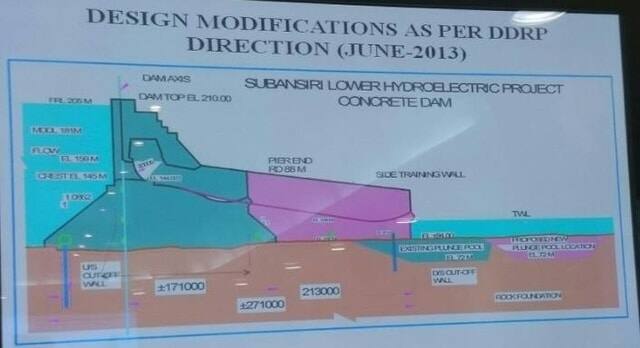 Modified design of Lower Subansiri hydel project concrete dam by expanding the base width up to 271.00 metre with respect to the fixed height 116.00 metre, more than 233% base with against normal 80% with respect to height. Diagram courtesy JN Khataniar[/caption]"We have already seen what environmental disasters can do in the recent catastrophic event in Uttarakhand despite the dams being made as per the recommendations. In the case of Lower Subansiri HEP, who will take responsibility for the retrofitting processes at the dam and guarantee the safety of the people living downstream? Who will take accountability for the inadequacies in concepts and design of the dam structure for which we are losing a huge amount of public money and destroying a natural water resource?" he asked.Water resources engineer Pradip Pujari said that although one dam was completely lost in Uttarakhand, another dam downstream actually prevented a far bigger catastrophe by arresting the massive flow of water."The first dam could not absorb the immediate thrust but the second one managed to neutralise the threat because the force of the water had also gone down by then," Pujari said.This makes the dams in the Upper and Middle Subansiri even more critical but they are yet to be constructed thus exposing the Lower Subansiri dam to grave threats.[caption id="attachment_9293441" align="alignnone" width="640"]
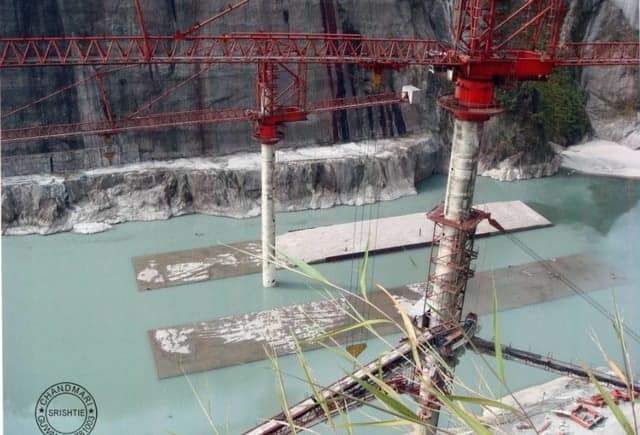 Lower Subansiri HEP dam site. Image courtesy JN Khataniar[/caption]In a study, titled Lower Subansiri Hydroelectric Power Project and future of the Subansiri River Ecosystem, the shoddy survey of the environmental impact of the project has also come under severe criticism."It becomes evident that no sufficient and detailed study was done in the entire downstream during the preparation of the report. Detailed mention about the probable impacts upon the downstream river health, rare and endangered species, physical resource, people’s livelihood and the options for mitigation etc. did not find place in the report. The EIA report contains insufficient records on terrestrial and aquatic flora, phytoplanktons, fish diversity, riparian flora, zooplanktons, avian fauna, floodplain crops, people’s lively hood etc. besides healthy habitats controlled by the unregulated Subansiri river," the report said.What is worrisome is that despite the investment of such a huge amount of time and money, there will be a gradual reduction of power generation capacity of the plant and its prime production period is perhaps already over even though not an ounce of electricity has been produced yet."Compared to the historical period 1990-2014, where power obtained during this period was 3,72,982 MW, the future power obtained for SLHEP will gradually decrease from 2020-99. Power obtained for 2020-39, 2040-59, 2060-79 and 2080-99 are 29,94,14 MW, 2,83,533 MW, 2,64,851 MW and 2,64,590 MW respectively. From this analysis, it can be said that, as compared to 1990-2014, the power potential during 2020-39, 2040-59, 2060-79 and 2080-99 will decrease by 19.72 percent, 23.98 percent, 28.99 percent and 29.06 percent respectively," the authors claimed in their research.Prevent the apocalypseWhat happened in the Tapovan Vishnugad Hydro Power project was unprecedented and a rare incident that occurred due to natural causes. However, the problem with the Lower Subansiri HEP is that there are many flaws which the scientific community have themselves pointed out raising serious concerns about the safety aspect of the dam. Unless they are fixed, the chase for cheap power may prove disastrous with many lives and a huge amount of public money at stake. NHPC cannot be lackadaisical when it is making the country's largest hydropower project. It must shoulder responsibility, show accountability.
First Published:Feb 11, 2021, 08:59:55 IST
Advertisement
Advertisement

China has dominated Myanmar’s rare earth mines — now India eyes deal to harness country’s critical minerals
India is deepening rare earth cooperation with Myanmar as New Delhi seeks alternative sources of critical minerals dominated by China, including dysprosium and terbium used in EVs, defence systems and clean energy technologies
6 min read
CJP protest in Delhi: New videos of stone pelting, violence emerge as police, agitators trade charges
Fresh videos of violence that broke out during the Cockroach Janta Party's (CJP) protest in Delhi have surfaced, with the police releasing footage showing alleged stone pelting, vandalism and attacks on security personnel
3 min read
'From make in India to launch from India': Skyroot COO on why Vikram-1 could change India’s space sector
Skyroot Aerospace’s successful Vikram-1 mission marks a major milestone for India’s private space sector, as the country seeks to shift from “Make in India” to “Launch from India” and compete in the global commercial satellite launch market
8 min read
Choke terror funding, keep international shipping lanes safe: Jaishankar at Asean Regional Forum
Jaishankar's remarks came against the backdrop of recent terror attacks targeting India and growing threats to commercial shipping amid conflicts in West Asia and Europe
2 min read
PM Modi announces fast-track courts for paper leak cases; CJP responds ‘Dharmendra Pradhan must go’
Amid protests demanding accountability for the leak of medical entrance test Neet and other irregularities in the education system, Prime Minister Narendra Modi has announced that the government has decided to set up fast-track courts to ensure swift and stringent punishment for those involved in paper leaks.
3 min read
Advertisement
Advertisement