
Advertisement


Sections
Aseem Trivedi's arrest: Blame the law, state... and ourselves
The issue here is the Indian state’s interest in retaining and creating laws that enable the willful and arbitrary exercise of brute force. And they remain unchallenged because most of us don't care as much about a core democratic principle: equal protection under the law.

“How can one issue orders to Dhoble to stop his crackdown. He is only going by the book and cracking down on those who have actually flouted rules. If someone has a problem with the laws being archaic, then they should ask for amendments to the rules rather than targeting the officer who is doing his job,” claimed a top Mumbai Police officer in response to the public outcry over Vasanth Dhoble's anti-revelry drive.The police is now trotting out the same "just following the law" excuse for the arrest of cartoonist Aseem Trivedi: Aseem Trivedi. PTI.[/caption]"I want to first see how a British-era law like sedition is going to be applied against a cartoonist in free India," Trivedi told Rediff. But 124(A) is applied -- all the time, and to all sorts of people from celebrity activists like Binayak Sen and Arundhati Roy to no-name citizens. The provision was used to arrest journalist Seema Azad and her husband Vishwa Vijay and sentence them to life imprisonment. Their real crime: exposing corruption and illegal mining in UP. They join the ranks of Prakash Ram, a farmer in Uttarakhand, environmental activist Piyush Sethia in Salem, Srinagar-based lecturer Noor Mohammed Bhatt, Sudhir Dhawale, a Dalit rights activist from Mumbai, 73-year old adivasi activist Gananath Patra in Orissa, and nearly 3,500 protesters at Koodankulam.The Trivedi arrest has brought with it a media circus. He can count on popular outrage to remain defiant and unbowed. But countless and nameless others can and are being targeted with impunity for a non-bailable offence that carries life imprisonment and is described in these vague terms: “Whoever by words, either spoken or written, or by signs, or by visible representation, or otherwise, brings or attempts to bring into hatred or contempt, or excites or attempts to excite disaffection towards the government established by law in India."It’s absurdly easy in modern, cosmopolitan, 21st century India to be accused of “anti-national” activity. All you have to do is make enough noise – be it about mining, corruption, police encounters, or land grab policies – to piss off the government. “The sedition law is a weapon in the hand of the State which evokes doubts, suspicion and hatred in the mind of the people against whom the charges are made. Such an undemocratic and anti-people law must be repealed immediately. In fact, it should have been done many years back,” Kuldip Nayar tells Outlook.But are our "modern" laws any better? Trivedi has also been charge for violations under Section 66(A) of the Information Technology (Amendment) Act, 2008, and the Prevention of Insults of National Honour Act, 1971. Shivam Vij notes on Rediff.com:
The Mumbai police has said the arrest is a procedural formality and that it has acted on a complaint. "He has shown disrespect to the National emblem and therefore he has been arrested under section 124(A)," said Chandrakant Bhosale a senior inspector of the Mumbai Police said. The First Information Report states that the accused had put "ugly and obscene content" on his website.Blame the law, not the police.[caption id="attachment_449876" align="alignleft" width="380"]
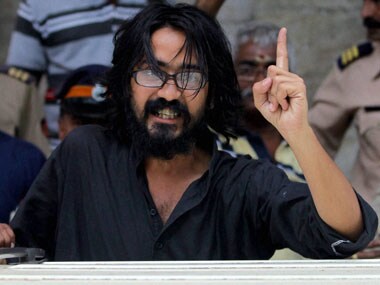 Aseem Trivedi. PTI.[/caption]"I want to first see how a British-era law like sedition is going to be applied against a cartoonist in free India," Trivedi told Rediff. But 124(A) is applied -- all the time, and to all sorts of people from celebrity activists like Binayak Sen and Arundhati Roy to no-name citizens. The provision was used to arrest journalist Seema Azad and her husband Vishwa Vijay and sentence them to life imprisonment. Their real crime: exposing corruption and illegal mining in UP. They join the ranks of Prakash Ram, a farmer in Uttarakhand, environmental activist Piyush Sethia in Salem, Srinagar-based lecturer Noor Mohammed Bhatt, Sudhir Dhawale, a Dalit rights activist from Mumbai, 73-year old adivasi activist Gananath Patra in Orissa, and nearly 3,500 protesters at Koodankulam.The Trivedi arrest has brought with it a media circus. He can count on popular outrage to remain defiant and unbowed. But countless and nameless others can and are being targeted with impunity for a non-bailable offence that carries life imprisonment and is described in these vague terms: “Whoever by words, either spoken or written, or by signs, or by visible representation, or otherwise, brings or attempts to bring into hatred or contempt, or excites or attempts to excite disaffection towards the government established by law in India."It’s absurdly easy in modern, cosmopolitan, 21st century India to be accused of “anti-national” activity. All you have to do is make enough noise – be it about mining, corruption, police encounters, or land grab policies – to piss off the government. “The sedition law is a weapon in the hand of the State which evokes doubts, suspicion and hatred in the mind of the people against whom the charges are made. Such an undemocratic and anti-people law must be repealed immediately. In fact, it should have been done many years back,” Kuldip Nayar tells Outlook.But are our "modern" laws any better? Trivedi has also been charge for violations under Section 66(A) of the Information Technology (Amendment) Act, 2008, and the Prevention of Insults of National Honour Act, 1971. Shivam Vij notes on Rediff.com:
[Amit] Katarnawre has also charged Trivedi with Section 66A of the Information Technology (Amendment) Act, 2008, which punishes persons for "sending messages" online that are "grossly offensive" or have a "menacing character". A third law used against Trivedi is the Prevention of Insults to National Honour Act,1971, which provides for punishment up to three years in jail and a fine for insulting or defacing the Indian flag and the Indian Constitution. It adds, however, 'Comments expressing disapprobation or criticism of the Constitution or of the Indian National Flag or of any measures of the government with a view to obtain an amendment of the Constitution of India or an alteration of the Indian National Flag by lawful means do not constitute an offence under this section.'Such legal qualifiers are, however, moot in a nation where a Shahrukh Khan or Sushma Swaraj can be hauled into court for merely holding the flag upside down. Our national symbols are as fragile as our politicians' easily bruised egos -- as compared to, say, the American red-white-and-blue which has long endured despite being burned by protesters of various stripes. And never mind that we're busy hunting that other national emblem -- the tiger -- into extinction.The problem isn’t one law that requires us to carry a liquor permit. Or another that allows the police to arrest you for distributing anti-mining pamphlets or emailing a cartoon. The issue here is the Indian state’s interest in retaining and creating laws that enable the willful and arbitrary exercise of brute force. The “archaic" laws exist -- as do their modern avatars -- because they are immensely useful. They allow the police – and the politicians who control them – to harass, arrest, or jail a citizen on one pretext or another. They are also, therefore, helpfully vague and broadly worded. Anything can get you in trouble – having a drink, selling chocolates, possessing Maoist literature, making a speech on Kashmir, drawing a cartoon…A less-acknowledged reason why these laws remain unchallenged -- apart from the occasional media brouhaha -- is a debased political discourse hamstrung by toxic partisanship and narrow ideological loyalty. Any debate on these issues devolves into the usual partisan name-calling, blithely ignoring the fact that these laws could not exist without the active collusion of all politicians, irrespective of party membership. Moreover, the level of our outrage is often dictated by our politics. The same people who are furious about Aseem Trivedi are often only too happy to call for Arundhati Roy's head. Others are furious at Dhoble for pissing on their party parade, but look the other way when the same police harass streetside vendors and mow down slum dwellers.We uphold freedom not as a principle, but as a privilege that we demand for causes and individuals we like. Lost in the shuffle is that pesky democratic principle: equal protection under the law. Without it, we remain as we are: a 'free' democracy ruled by draconian law.
First Published:Sep 10, 2012, 12:40:13 IST
Advertisement
Advertisement

China has dominated Myanmar’s rare earth mines — now India eyes deal to harness country’s critical minerals
India is deepening rare earth cooperation with Myanmar as New Delhi seeks alternative sources of critical minerals dominated by China, including dysprosium and terbium used in EVs, defence systems and clean energy technologies
6 min read
CJP protest in Delhi: New videos of stone pelting, violence emerge as police, agitators trade charges
Fresh videos of violence that broke out during the Cockroach Janta Party's (CJP) protest in Delhi have surfaced, with the police releasing footage showing alleged stone pelting, vandalism and attacks on security personnel
3 min read
'From make in India to launch from India': Skyroot COO on why Vikram-1 could change India’s space sector
Skyroot Aerospace’s successful Vikram-1 mission marks a major milestone for India’s private space sector, as the country seeks to shift from “Make in India” to “Launch from India” and compete in the global commercial satellite launch market
8 min read
Choke terror funding, keep international shipping lanes safe: Jaishankar at Asean Regional Forum
Jaishankar's remarks came against the backdrop of recent terror attacks targeting India and growing threats to commercial shipping amid conflicts in West Asia and Europe
2 min read
PM Modi announces fast-track courts for paper leak cases; CJP responds ‘Dharmendra Pradhan must go’
Amid protests demanding accountability for the leak of medical entrance test Neet and other irregularities in the education system, Prime Minister Narendra Modi has announced that the government has decided to set up fast-track courts to ensure swift and stringent punishment for those involved in paper leaks.
3 min read
Advertisement
Advertisement