


What’s Keytruda, the best-selling drug that treats 22 cancers, but is unaffordable for most?
Keytruda, manufactured by the US-based Merck & Co, is an immunotherapy drug that has become one of the world’s best-selling drugs. It is being used to treat several cancers, including those in the lung, breast and skin. However, the life-saving drug remains out of bounds for several thousand cancer patients in India, as it is priced over Rs 1.5 lakh for a 100 mg vial

A key cancer drug has taken over the world. Keytruda, an immunotherapy drug, is being used to treat at least 19 types of tumours.
However, the drug remains unaffordable for most, given its sky-high cost. In India, a 100 mg vial has a market price above Rs 1.5 lakh. Now, a yearlong international investigation has found how pricing systems and patent protections have kept Keytruda out of bounds for hundreds of thousands of cancer patients across the globe.
But what is this drug? How does it work? We take a deep dive.
What is Keytruda?
Pembrolizumab, sold under the brand name Keytruda, is an immunotherapy drug manufactured by the United States-based global pharma company Merck & Co (MSD).
It was first approved by the US Food and Drug Administration (FDA) in 2014 for advanced skin cancer. Today, Keytruda is being used for the treatment of certain lung cancers, cervical cancer, renal cell cancer and aggressive breast cancer, among others, globally.
 More from Health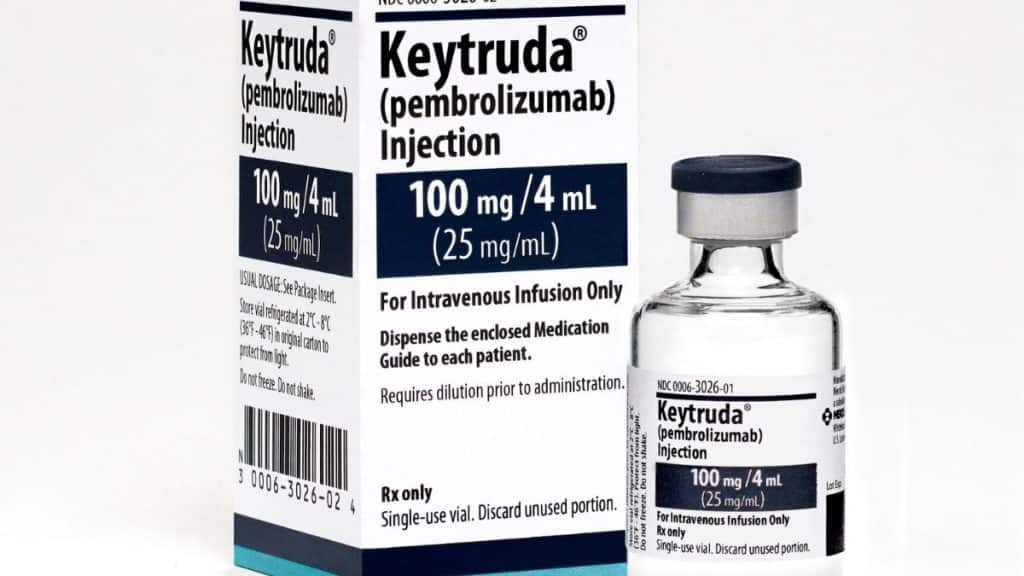
In fact, it has become one of the best-selling drugs in pharmaceutical history, as per Deutsche Welle (DW).
Keytruda generated $31.7 billion (nearly Rs 3 lakh crore) revenue in 2025, roughly half of Merck's total sales.
How does Keytruda work?
Keytruda belongs to the class of immunotherapy drugs that train the body’s immune system to attack cancer cells. It enables the body’s T cells to attack cancerous cells by attaching to receptors called PD-1 on the T cells.
Usually, cancer cells use special proteins called PD-1 and PD-L1 to prevent being detected and attacked by T cells. This results in the cancer cells growing and spreading.
Keytruda stops T cells from connecting with PD-L1 receptors on cancer cells. This helps these T cells to spot the abnormal cells and cause an immune response.
The drug is recommended as part of the cancer treatment that also includes radiotherapy, chemotherapy and surgery, if needed. The drug is administered through an IV drip every few weeks.
How much does the cancer drug cost?
Keytruda's list prices differ across countries, ranging from $850 (Rs 79,179.6) per 100 mg vial in Indonesia to over $6,000 (Rs 558,915) in the United States, reported DW.
Merck recommends 200 mg of the drug every three weeks. In India, people would have to spend more than Rs 3 lakh per month in the absence of health coverage or assistance schemes, noted Indian Express.
According to The Cancer Calculus, an investigation by the International Consortium of Investigative Journalists (ICIJ), the drug is less affordable for people with median incomes in the US than those in some Western European countries, such as France and Belgium. Keytruda is more difficult to afford for people in lower-income Eastern European countries like Bulgaria and Hungary.
In India, treatment costs can surpass a patient's annual income, effectively limiting access to a small share of the population. Many patients get the drug through the US-based company’s Patient Access Programme, under which they get 30 free vials after buying five initially for a total cost of around Rs 10 lakh.
How effective is Keytruda?
Keytruda slows down the progression of cancer and extends life for patients with melanoma, non-small cell lung cancer (NSCLC), and kidney cancer.
Speaking to Moneycontrol, Dr Puneet Gupta, Chairman, Oncology Services, Asian Hospital, said the drug is not 100 per cent effective. "It is a highly effective medicine; however, not everyone responds to its effects equally well. There are those who benefit greatly from taking this drug, and there are those who hardly notice any change. It all depends on a particular case of cancer," he explained.
"It is already helping many patients, and its role will grow in the future. It’s a different kind of treatment that uses the body’s own immunity. But right now, because of high cost and limited access, not everyone can benefit from it," Dr Gupta added.
Does Keytruda have side effects?
Cancer patients can experience some side effects, including fatigue, nausea and loss of appetite. However, these are usually manageable and are likely to get better with time.
"Patients can feel tired and get skin issues, and in some cases, the immune system may affect healthy organs. In view of these problems, we monitor patients closely during treatment to manage any problems that may arise," Dr Gupta told Moneycontrol.
It may also overactivate the immune system, leading to immune-related adverse events, such as triggering inflammation in organs like lungs (pneumonitis), liver (hepatitis), thyroid (hypo/hyperthyroidism), or intestines (colitis), reported NDTV.
What has Keytruda probe revealed?
According to the ICIJ investigation, Merck employed strategies to spike the volume of prescriptions and keep the price of the cancer drug high through lobbying. It also made efforts to delay cheaper versions of the drug from reaching cancer patients around the world.
Keytruda’s primary patent expires in 2028, with many companies already working on generic versions. This could sharply bring down the costs by up to 70 per cent of the cancer drug.
However, follow-on patents could extend Keytruda's protected monopoly until at least 2042, as per DW. This would further delay cheaper alternatives from hitting the markets for more than a decade.
In India, there is a growing black market of counterfeit Keytruda, as per an Indian Express report. Investigators found that empty vials of the cancer drug were collected, refilled with other injectable substances, mainly antifungal medications, and resealed for sale at costs as low as Rs 90,000 for a 100 mg vial, a 40 per cent reduction from the market price.
Police uncovered the role of hospital staff in the racket and glaring loopholes in the system that allowed the black market of Keytruda to flourish.
With inputs from agencies
Tags

Stroke in young adults, silent symptoms and late diagnosis: India's growing brain health challenge
Brain tumours aren't always fatal, but delayed diagnosis can be: Experts explain the key warning signs
Spices, health and the Indian plate: Why chilli can be good for you—but moderation is still key
Organ donation: 5 myths you need to stop believing, according to a transplant specialist
Fish over meat: Why a pescatarian diet may help people with obesity live longer