


Can AI transform ICU training? Inside India’s shift beyond static mannequins
As post-pandemic healthcare systems prioritise ICU readiness and patient safety, India’s hospitals are increasingly turning to AI-powered simulation labs that let doctors experience life-and-death emergencies before facing them in real wards.

For decades, the standard training ground for medical students, interns, and nurses looked remarkably unchanged: rows of rigid, plastic manikins. Trainees would repeatedly practice chest compressions or intubation on these static models, but the plastic figures never fought back. They didn’t gasp for air if an airway was blocked, their blood pressure didn’t plummet if an injection was delayed, and their lungs didn’t collapse under a poorly calibrated ventilator.
In a real Intensive Care Unit (ICU), however, medicine is a high-stakes game of seconds where every decision triggers an immediate chain reaction.
Today, India's medical education ecosystem is undergoing a profound paradigm shift. Driven by post-pandemic demands for heightened ICU readiness and fewer errors in real patient care, hospitals are moving away from procedural repetition and toward intelligent, AI-powered immersive environments.
 More from Health
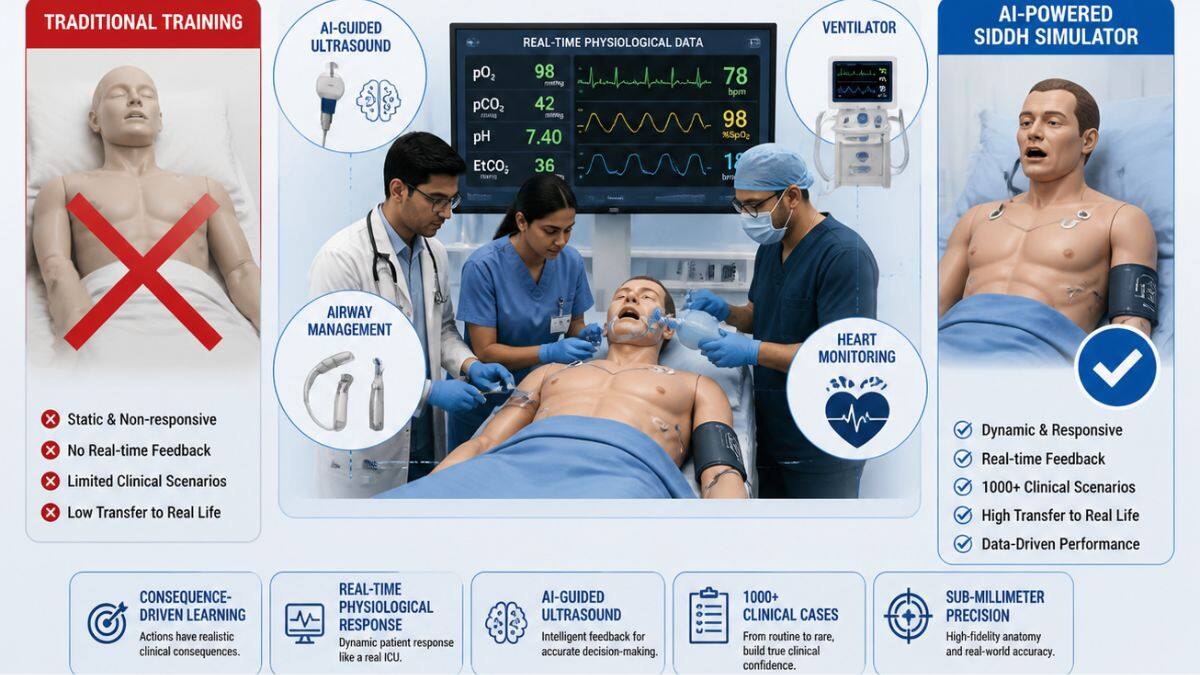
At the forefront of this revolution is SIDDH, a homegrown, high-fidelity adult patient simulator that acts as a "flight simulator" for healthcare professionals, replicating the chaotic, evolving nature of real emergency rooms.
The Shift to Consequence-Driven Learning
Developed by Maverick Simulation Solutions, SIDDH is a full-body adult simulator designed specifically for critical care, emergency medicine, anesthesia, nursing education and paramedical studies. It is already quietly altering the training ecosystem across some of India’s most premier medical institutions, including multiple All India Institute of Medical Sciences (AIIMS) campuses and a major central government hospital in New Delhi.
Unlike traditional training tools, SIDDH operates on a philosophy of "consequence-driven medical learning." If a trainee makes an error, the machine doesn't just buzz; the "patient" actively deteriorates.
For instance, inputting incorrect ventilator settings will dynamically alter the simulator's lung mechanics and worsen its respiratory parameters. Failing to clear an airway or delivering poor-quality CPR will instantly reflect on the live ICU bedside monitors as a drop in oxygen levels or an erratic cardiac rhythm.
"Traditional medical training has largely depended on observation and limited exposure to real emergencies, but critical care medicine today requires clinicians to repeatedly experience high-pressure situations before they encounter them in real life," said Anuj Chahal, Founder & CEO of Maverick Simulation Solutions.
"The idea behind SIDDH was to move beyond static mannequins and create a responsive simulation environment where medical decisions have physiological consequences... That consequence-driven learning is what strengthens preparedness," said Chahal.
Under the Hood: Precision Engineering and AI Ultrasound
From a technological standpoint, SIDDH is incredibly sophisticated, packing advanced internal mechanics to mimic human pathologies with startling realism. To replicate complex lung conditions, instructors can customize advanced parameters like chest wall compliance, airway dead space, breath patterns, and upper and lower inflection points.
The simulator even autonomously generates realistic arterial blood gas (ABG) readouts—such as $pO_2$, $pCO_2$, and $pH$ which recalculate themselves automatically based on how well the trainee manages the patient's breathing.
Advanced Capabilities of the SIDDH Simulator
| Category | Key Capabilities & Simulated Procedures |
| Airway Management | Difficult airway navigation, nasal/orotracheal intubation, left/right main stem intubation, and full procedural logging. |
| Physiological Feedback | Autonomous Arterial Blood Gas ($pO_2$, $pCO_2$, $pH$), $EtCO_2$, and real-time live monitor adjustments. |
| Pulmonary Customization | Chest wall compliance, recruitment factors, airway dead space, and custom breath patterns. |
Perhaps the most cutting-edge feature of the platform is its integrated, AI-enabled ultrasound training module. Ultrasound has become a vital "point-of-care" diagnostic tool in modern emergency rooms, but interpreting grainy images under pressure takes years to master.
The SIDDH platform addresses this by supporting more than 1,000 distinct clinical cases including advanced emergency ultrasound protocols like the RUSH (Rapid Ultrasound for Shock and Hypotension) protocol alongside transabdominal and transvaginal simulations.
The system tracks the trainee’s transducer (the ultrasound probe) movement with sub-millimeter precision across six degrees of freedom. This allows doctors to practice highly realistic movements like sliding, tilting, and rotating. Meanwhile, an AI-driven voice guidance system and adaptive scoring mechanism provide real-time, objective feedback on the accuracy of their scans.
Bridging the Gap in Crisis Coordination
Medical errors in the ICU rarely happen because a doctor lacks textbook knowledge; they happen because of communication gaps, delayed interventions and overwhelming stress.
Dr. Sunil Tomar, Director at Maverick Simulation Solutions, said that hospitals are completely changing their expectations for training infrastructure in the wake of global health crises.
"Critical care medicine today is becoming increasingly complex and time-sensitive, which is fundamentally changing how healthcare professionals need to be trained," Dr. Tomar added. "One of the biggest gaps in traditional medical training has been the limited ability to recreate dynamic ICU deterioration scenarios in a controlled setting."
He emphasised that intelligent simulation helps teams experience exactly how critical situations evolve. "Simulation-based healthcare training is expected to play an increasingly important role in improving clinical confidence, multidisciplinary coordination, and patient safety across critical-care environments."
This sentiment is echoed on the ground by academic leaders who are incorporating the technology into daily medical curricula. Dr. Achint Juneja, Principal at IDST Modinagar, has watched first-hand how students react to a responsive AI environment versus an inert model.
"Traditional systems often focus primarily on procedural repetition, whereas AI-enabled simulation introduces the element of clinical consequence and decision-making," says Dr. Juneja. "With SIDDH, physiological responses evolve according to the interventions performed... Such environments encourage not only procedural competency but also communication, teamwork, and situational awareness under pressure."
Entering the Global Curve
While fully autonomous robotic surgery or AI doctors remain a distant reality for daily care, the concept of "augmented training" using AI to build a smarter, safer safety net for human doctors, is happening right now.
By allowing medical professionals to make mistakes, fail, and witness the direct consequences of their actions in a controlled, simulated environment, India is steadily building a zero-fault culture for its most critical care environments. As these advanced units become standard across the country, patients can rest assured that before their doctor ever managed an emergency at their bedside, they survived it hundreds of times in the simulator.
Chandan Prakash is a Chief Sub-Editor with Firstpost. He writes on politics, international affairs, business and economy. He can be contacted at Chandan.Prakash@nw18.com
Tags

Stroke in young adults, silent symptoms and late diagnosis: India's growing brain health challenge
Brain tumours aren't always fatal, but delayed diagnosis can be: Experts explain the key warning signs
Spices, health and the Indian plate: Why chilli can be good for you—but moderation is still key
Organ donation: 5 myths you need to stop believing, according to a transplant specialist
Fish over meat: Why a pescatarian diet may help people with obesity live longer