
Advertisement


Sections
Coronavirus Outbreak: In Kolkata, doctors on the frontline forced to make do with used gloves, raincoats for gowns
What entails without a proper PPE and shared by different medical professionals across the globe on social media has only triggered fear among healthcare professionals.

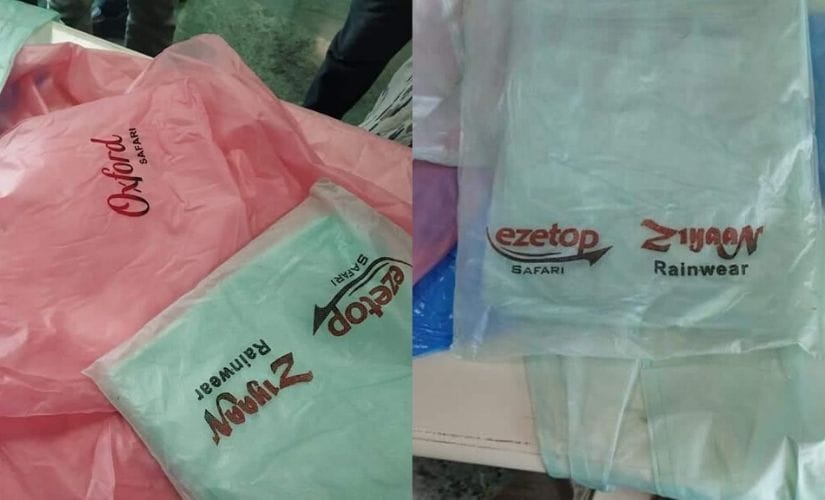 Rainwear given to healthcare professionals in Kolkata to be used as PPE while dealing with COVID-19 patients.[/caption]The WHO interim guidance issued on 19 March, 2020 on the Rational use of personal protective equipment (PPE) for coronavirus disease (COVID-19) states: "Health care workers involved in the direct care of patients should use the following PPE: gowns, gloves, medical mask, and eye protection (goggles or face shield). Specifically, for aerosol-generating procedures (e.g. tracheal intubation, non-invasive ventilation, tracheostomy, cardiopulmonary resuscitation, manual ventilation before intubation, bronchoscopy) health care workers should use respirators, eye protection, gloves and gowns; aprons should also be used if gowns are not fluid resistant."Shockingly at these times of such grave medical threat, doctors in Kolkata are made to beg for prescribed PPE."We have only one concern. We need proper protective kits. More so because we don’t want to affect ourselves and spread the disease more. We are staying in the hostel for many days and not going home just because we don’t want to affect our families too. But if we get infected, the hostel residents might get infected too. And everyone is a doctor," said a medical intern from IPGMER and SSKM Hospital who has been posted at the Infectious Diseases & Beliaghata General Hospital (ID & BG Hospital) in Kolkata. The intern preferred to remain anonymous and will be referred to as Doctor A in further references."What we were given instead of proper PPE was rainwear and some of it was even torn. In some cases, the gloves were also torn. We can't work in these conditions. We are more conscious because if we get infected we might end up spreading the disease to people who come to us for check-ups and are already immunocompromised. If we the healthcare workers or the doctors get affected, the chances of transmission are more and it will spread like wildfire," the doctor said.[caption id="attachment_8203311" align="alignnone" width="825"]
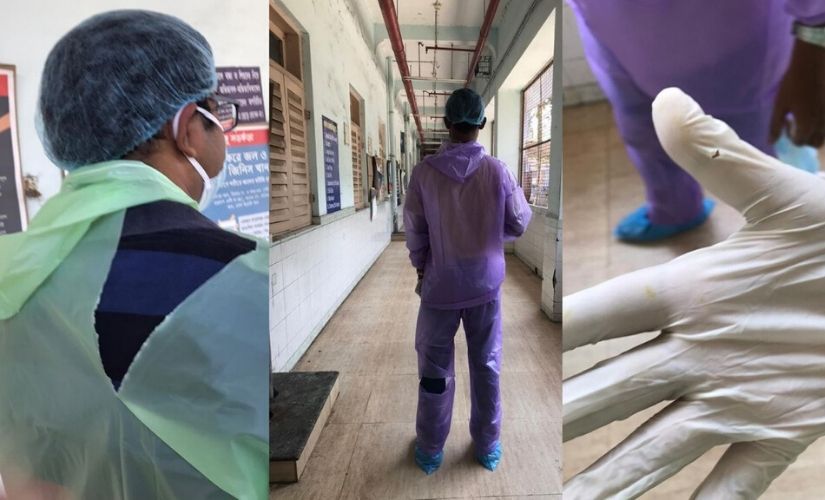 Even the rainwear that was provided with to be used as PPEs was of poor quality.[/caption]At the ID & BG Hospital, the duty hours are long, with those posted in the Emergency Room (ER) working for 12 hours at a stretch. Their counterparts in indoor duties also have to work for 12 hours. Those in round duties work from 9 am to 2 pm. Doctors dealing with the novel coronavirus have not encountered this particular strain of virus before, making their task even more challenging, not only dangerous.Whatever on the job training the doctors are getting at the ID & BG Hospital is also quite basic.On Tuesday (24 March, 2020), a few interns from the Kolkata Medical College & Hospital who were posted at the COVID-19 ward in ID & BG Hospital, approached the medical superintendent cum vice-principal (MSVP) complaining about the absence of surgical masks only to be rudely told, "Dogs don’t need a mask. Why do you?"Defining PPE, the Hospital Infection Control Guidelines of the Indian Council of Medical Research say that "PPE refers to a variety of barriers, used alone or in combination, to protect mucous membranes, airways, skin and clothing from contact with infectious agents. PPE used as part of standard precautions includes aprons, gowns, gloves, surgical masks, protective eyewear and face shields."The document also clearly states the purpose of the use of PPE by health care professionals.It says, "Using personal protective equipment provides a physical barrier between micro-organisms and the wearer. It offers protection by helping to prevent micro-organisms from contaminating hands, eyes, clothing, hair and shoes and being transmitted to other patients and staff."The document also says, "The sole aim of universal precautions is to prevent transmission of infections from the patient to the health care provider."The table below, which is sourced from the Indian Council of Medical Research, gives the summary of precautions to prevent the spreading and transmission of infections.
 | Purpose | Contact | Droplet | Airborne |
| Organism based precaution | MRSA, Clostridium difficile, lice, scabies | N. meningitidis, mumps, Pertussis, norovirus, influenza invasive group A Streptococcus | Pulmonary tuberculosis, measles, chicken pox, disseminated zoster |
| Syndromic precaution | Draining wound Diarrhea (not yet diagnosed) Infestation | Toxic shock | Fever, weight loss, cough, high TB risk |
| Private room | Preferred | Preferred | Yes |
| Negative pressure room | No | No | Yes |
| PPE- Staff | Gown + gloves | Gown + gloves + surgical grade fluid resistant mask | Gown + gloves + N95 mask |
| Visitor – PPE | Gown + gloves | Gown + gloves + surgical grade fluid resistant mask | Surgical grade mask |
| Transporting patient | Patient – No Staff – No | Patient – Yes Staff – Yes | Patient – Yes Staff – No |
| Cleaning | Precaution clean | Precaution clean | Precaution clean |
Response from the administrationSoumitra Ghosh, head of Department of General Medicine, IPGMER and SSKM Hospital, who is also part of the 12-member committee of experts formed by the West Bengal government to combat the epidemic spread of COVID-19, said that the problem is not just limited to West Bengal."This is a problem across the globe and not just West Bengal or the Indian sub-continent. It is not the time to blame anybody. The issue should be raised that the healthcare providers are the biggest warriors against this pandemic and they should be protected. In New York also, they are reusing PPEs. Human resources are the most precious resources. Blaming will not solve the problem. However, it is also a fact that the biggest warriors are not being provided with adequate protection," Ghosh said."Wuhan was the hub from where the medical masks were supplied and 90 percent of the globe depended on them. Money is not an issue but the scarcity of the product is," he said.Kolkata Medical College & Hospital, MSVP, Indranil Biswas accepted that there has been a problem with PPE but expressed optimism that things will change."The government is going to change that. They have initially ordered to one firm which has provided with these kits. We have conveyed it to the government that these are not ideal PPEs and are very difficult to use. So from Monday, we are supposed to get the ideal PPEs," Biswas told Firstpost.Despite the shortcomings, the Kolkata Medical College & Hospital MSVP sounded positive that the institution will be functional from Monday.
"We have not started functioning as yet. All the doctors are post-graduate and they are very much interested in the effort. They have already familiarised themselves with the standard operating procedures on how to run this hospital for the novel coronavirus patients. These are the basic things and it will be changed. Government is trying hard to change things," he said.The institution has not reached out to any corporates for support yet."Actually at present, it is not required. The thing is that even if you have the money to procure proper PPEs in such a large quantity is very difficult. The government has ordered for those. We are hoping for the best. Let's see on Monday," said Biswas.He also sought to allay fears over the alleged lack of negative pressure wards where infected patients will be kept in the facility."This has changed. Now the entire building has been converted into negative pressure wards where only infected patients will be kept," the Kolkata Medical College & Hospital MSVP said.He further assured that adequate steps are being taken to handle the biomedical waste in the facility."The handling of the biomedical waste will be as per WHO guidelines. We already have a proper biomedical wastage handling team. That should not be a problem," he said.The Kolkata Medical College & Hospital MSVP did accept that they are "facing a lot of problems"."Everything depends on the number of patients ultimately infected. If the lockdown is properly maintained then I think the problem will be minimum. We can only hope for the best," said Biswas.Amrita Bhattacharya, who is a medical officer at the ID & BG Hospital, agreed that there were hiccups initially."There were a few packets of PPEs which were raincoats and other inappropriate gloves. Now this issue has been addressed at the ID & BG Hospital," said Chakrabarty.Emails and WhatsApp messages were sent to West Bengal Health and Family Welfare department, Principal Secretary Vivek Kumar and Trinamool Congress MP Derek O'Brien seeking their response. The copy will be updated accordingly if they choose to respond.Unique circumstances force replacement of standard PPEBefore anyone cites how healthcare professionals in Spain are using garbage bags as PPE, let this also be remembered that these are being used as the last resort "in hopes of protecting themselves against contracting the novel coronavirus".The grim situation is visible according to a story by The Associated Press and published on The New York Times: "He (Kious Kelly) worked at the same hospital where three nurses, frustrated at the scarcity of supplies, posted pictures of themselves on social media wearing makeshift garbage bag protective gowns, an image splashed on Thursday’s New York Post cover with the headline: “TREATED LIKE TRASH".""If we don't have proper PPEs just at the beginning whereas other states like Kerala, Maharashtra do, I don't know how the state thinks it can combat the disease till the end," said Doctor C.What extensive use of proper PPE can do is also another story which was depicted by Alessia Bonari, an Italian nurse at a Milan hospital, with bruises all over her face.Low number of tests sparks anxiety Doctor B also expressed concerns about the relatively low number of testing in India unlike other countries like the US, South Korea or China which have focussed highly on testing. "The testing should cover a wider base of patients. It is very restricted now. It is giving us a false sense of security. I know India has a relatively low number of patients compared to other countries like Spain, Italy, China or the US. We can't say for sure whether we are in stage 2 or 3. How do you expect to get the actual number if you are testing such a low number of patients," said Doctor B. This is what WHO also suggested as well. According to the India State-Level Estimates study conducted by The Center For Disease Dynamics, Economics & Policy, an organisation involved in multidisciplinary research to advance the health and wellbeing of human populations, "delays in testing are seriously reducing the ability of the population to self—protect.""At baseline (without interventions), between 300 and 400 million Indians are likely to be infected by July. Most of these cases will be mild. At the peak (somewhere between April and May 2020), 100 million individuals will be infected. Of these, approximately 10 million will be severe and about 2-4 million will require hospitalization. This is the most critical period," the report said.The way aheadIt is the medical fraternity which is the final frontier between the novel coronavirus and the apocalypse that threatens even as many corners of the planet have been filled up with legions of sick humans. For them, I dare say, contra spem spero (I hope against hope).Red Cross comes throughThe ministry of health took to Twitter on Monday to announce that 10,000 PPE coveralls donated by the Red Cross had been received and are being distributed. The ministry, in a long Twitter thread, said two domestic manufacturers are producing 50,000 N95 masks per day, which is expected to increase to 1 lakh per day within the next week.The ministry also stated that 11.95 lakh N94 masks are in stock, that an addition 5 lakh masks were distributed over the past two days and 1.40 lakh masks are being distributed today. The DRDO will begin manufacturing 20,000 N99 masks per day within the next week, the ministry further said and that Agva Healthcare, Noida has been given an order to manufacture 10,000 ventilators within a month, the supplies of which are expected to commence in the second week of April.Over 14,000 ventilators are earmarked for COVID-19 patients in various hospitals across the country. Bharat Electronics has been asked to manufacture 30,000 ventilators over the next two months in collaboration with local manufacturers. Automobile manufacturers have been asked to manufacture ventilators and are working towards this end, the ministry said.
First Published:Mar 29, 2020, 18:39:17 IST
Advertisement
Advertisement

Stroke in young adults, silent symptoms and late diagnosis: India's growing brain health challenge
Neurologists warn that stroke is increasingly affecting people in their 30s and 40s, while many brain disorders progress silently before symptoms appear. They say early diagnosis, timely referrals and healthier lifestyles are key to reducing India's growing neurological disease burden.
5 min read
Brain tumours aren't always fatal, but delayed diagnosis can be: Experts explain the key warning signs
Brain tumours are frequently mistaken for common headaches, stress or age-related cognitive changes. Doctors say recognising warning signs early and adopting a brain-healthy lifestyle can improve outcomes and reduce the risk of long-term neurological complications.
2 min read
Spices, health and the Indian plate: Why chilli can be good for you—but moderation is still key
From boosting metabolism to supporting heart health, chillies offer several surprising health benefits. But experts say the amount you eat matters, and too much spice can do more harm than good.
4 min read
Organ donation: 5 myths you need to stop believing, according to a transplant specialist
Organ donation has the power to transform and save lives, but this can happen only when myths are replaced with facts. Building awareness, having open conversations and understanding the process can help families make informed decisions.
2 min read
Fish over meat: Why a pescatarian diet may help people with obesity live longer
A large UK study tracking over 150,000 adults with clinical obesity found pescatarians outlived regular meat-eaters, while vegetarians and vegans saw no similar benefit, but experts say the findings don't translate simply to Indian diets.
4 min read
Advertisement
Advertisement