


‘Will go to Kargil’: What’s going on in Gilgit-Baltistan?
Massive protests have broken out in the Pakistan-occupied region of Gilgit-Baltistan with people chanting ‘chalo Kargil chalo’ and threatening to merge with India. The demonstrations against Pakistan authorities come after the arrest of a known Shia cleric on blasphemy charges

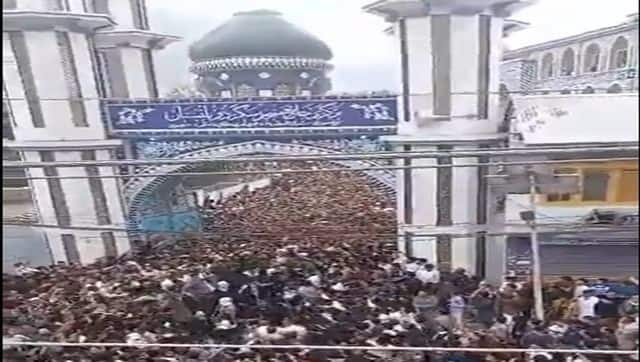
Locals of Gilgit-Baltistan carry out a mass protest in Skardu to express their anger against Pakistani government. Image Courtesy: Twitter[/caption]Pakistan’s blasphemy lawsEarlier in the year, Pakistan strengthened its blasphemy laws, extending them to punish anybody who offended people connected to Prophet Muhammad. Critics say the blasphemy law is often misused against Pakistan’s tiny minority groups and even against Muslims to settle personal scores.Critics argue that blasphemy convictions are common in the nation and at least 85 people have been murdered since 1990 in relation to blasphemy allegations.“Religious hatred is deeply intoxicated in the social structures due to lack of education, and for students, it is injected through the curriculum. Masses who may not be aware of their basic rights guaranteed by the constitution are fully acquainted with the use of blasphemy laws to settle their personal vendetta,” Ruth Stephen, a minority rights activist, told Deutsche Welle.About Gilgit-BaltistanGilgit-Baltistan is a Shia-majority region, located in Pakistan’s northernmost territory. It provides the only to China, meeting the Xinjiang Autonomous Region. To Gilgit-Baltistan’s west is Afghanistan, to its south is Pakistan-occupied Kashmir, and to the east, is Jammu and Kashmir.India considers Gilgit-Baltistan as its own territory, a part of the former princely state of Jammu and Kashmir that acceded to India in full after Independence, and which has been under illegal Pakistani occupation.In 2020, the government told Parliament that India’s “consistent and principled position, as also enunciated in the Parliament resolution adopted unanimously by both Houses on 22 February 1994, is that the entire Union Territories of Jammu & Kashmir and Ladakh have been, are and shall be an integral part of India”.It said that the “Government monitors all developments taking place in the territories of India including in territories that are under illegal and forcible occupation of Pakistan.”Also read: Twitter relocates Gilgit-Baltistan users to India, sends digital shockwaves across PakistanTwo years later, on the occasion of Shurya Diwas (27 October), Defence Minister Rajnath Singh had said in Srinagar that India had “only just begun walking north”, and the journey would end when “we… reach the remaining parts (of PoK), Gilgit and Baltistan”.The people of Gilgit-Baltistan are physically and culturally far removed from India, and have very little connect with India. Some have in the past demanded a merger with Pakistan-occupied Kashmir, but they have no real connect with Kashmir either.However, the blasphemy laws and violence against the Shia community is changing the perception of the people in the region. Recently, there have been calls for independence amongst its people.With inputs from agencies

Why India may not witness a medal rush at 2026 Commonwealth Games
Delhi Police asks personnel to wear uniform: What the law says on cops in plainclothes during protests
Military drones & police check-ups: How Sri Lanka is fighting against worst dengue outbreak in a decade
How Facebook job ad lured 2 Karnataka men into Myanmar cyber scam camp
Why is India seeing 95% cloud cover despite a Super El Niño?