
Advertisement


Sections
Why the first kill of two cheetahs in Madhya Pradesh’s Kuno is significant
The two cheetahs – Freddie and Elton – killed a spotted deer within 24 hours of being moved from a quarantine area to a larger enclosure in Madhya Pradesh’s Kuno National Park. Experts believe that the cheetahs hunting easily indicate they are doing well in their new surroundings

Two Namibian male cheetahs relocated to India have made their first hunt within 24 hours of being shifted from a quarantine area to a larger enclosure in Madhya Pradesh’s Kuno National Park.They are among the eight Namibian felines reintroduced in India under 'Project Cheetah' after the species went extinct here in 1952.The brothers named Freddie and Elton killed a cheetal (spotted deer) either on Sunday night or in the wee hours of Monday (7 November), Chief Conservator of Forest, Uttam Kumar Sharma, told PTI. The forest monitoring team learnt about the hunt in the morning today.The brothers are the first cheetahs to enter the bigger enclosure after being in quarantine since 17 September like the other six felines.Why is the hunt significant for cheetahs? Why did they not prey earlier? We explain.Why is their first kill significant?These cheetahs making their first hunt is important as they have travelled a long distance – over 8,000 km– from Namibia to India, and hence, there have been concerns about their acclimatisation to the new and unknown territory.This was the first time in the world that a large carnivore has been relocated from one continent to another, Indian Express.![cheetahs]() The cheetahs making their first kill is significant, says expert. PTI[/caption]“The cheetahs making their first kill within 24 hours is beyond expectations. This signifies that the big cats are absolutely fit and the worries of these cheetahs losing any muscle strength owing to the time they spend in quarantine is unfounded,” a senior forest official told Indian Express.Why had cheetahs not preyed till now?These cheetahs have been living in quarantine enclosures till now because of the rules that wild animals must be quarantined for a month before and after being shifted to a different country to prevent them from catching infections.Since their relocation in September, these eight cheetahs were housed in six 'bomas' (enclosures), two of which are 50 metres x 30 metres while the other four are 25 square metre in area.During their quarantine, the felines were fed buffalo meat.Almost two months later, these big cats are being released in larger enclosures in a phased manner.
The cheetahs making their first kill is significant, says expert. PTI[/caption]“The cheetahs making their first kill within 24 hours is beyond expectations. This signifies that the big cats are absolutely fit and the worries of these cheetahs losing any muscle strength owing to the time they spend in quarantine is unfounded,” a senior forest official told Indian Express.Why had cheetahs not preyed till now?These cheetahs have been living in quarantine enclosures till now because of the rules that wild animals must be quarantined for a month before and after being shifted to a different country to prevent them from catching infections.Since their relocation in September, these eight cheetahs were housed in six 'bomas' (enclosures), two of which are 50 metres x 30 metres while the other four are 25 square metre in area.During their quarantine, the felines were fed buffalo meat.Almost two months later, these big cats are being released in larger enclosures in a phased manner.![Kuno National Park]() These eight cheetahs will eventually be released into Kuno National Park. PTI File Photo[/caption]Challenges for relocated cheetahsExperts have pointed out several worries about the relocation of these big cats from Namibia.ALSO READ: Cheetahs are back in India: Know the world’s fastest predator that constantly lives in fearValmik Thapar, a leading conservationist in India, told NDTV in September that cheetahs– who chase their prey for long distances- due to the varied terrain in Namibia and India would face obstructions in outrunning their attackers.Ullas Karanth, tiger conservationist and Emeritus Director of Centre of Wildlife Studies, told The Hindu in October that “in the absence of large space devoid of humans and domestic dogs, it will be difficult to restore the extinct cheetahs in Kuno National Park in Madhya Pradesh using the eight cheetahs brought from Namibia”.He also said that the relocation programme does not have the scope to furnish a “large amount of open space required to have a meaningful population of 50 cheetahs”.“With first setbacks, these cheetahs would be pushed back into the fenced areas, and there will be a glorified form of safari that will attract tourists,” Karanth was quoted as saying by The Hindu. With inputs from agenciesRead all the Latest News, Trending News, Cricket News, Bollywood News,India News and Entertainment News here. Follow us on Facebook, Twitter and Instagram.
These eight cheetahs will eventually be released into Kuno National Park. PTI File Photo[/caption]Challenges for relocated cheetahsExperts have pointed out several worries about the relocation of these big cats from Namibia.ALSO READ: Cheetahs are back in India: Know the world’s fastest predator that constantly lives in fearValmik Thapar, a leading conservationist in India, told NDTV in September that cheetahs– who chase their prey for long distances- due to the varied terrain in Namibia and India would face obstructions in outrunning their attackers.Ullas Karanth, tiger conservationist and Emeritus Director of Centre of Wildlife Studies, told The Hindu in October that “in the absence of large space devoid of humans and domestic dogs, it will be difficult to restore the extinct cheetahs in Kuno National Park in Madhya Pradesh using the eight cheetahs brought from Namibia”.He also said that the relocation programme does not have the scope to furnish a “large amount of open space required to have a meaningful population of 50 cheetahs”.“With first setbacks, these cheetahs would be pushed back into the fenced areas, and there will be a glorified form of safari that will attract tourists,” Karanth was quoted as saying by The Hindu. With inputs from agenciesRead all the Latest News, Trending News, Cricket News, Bollywood News,India News and Entertainment News here. Follow us on Facebook, Twitter and Instagram.
With their first kill, these cheetahs have dismissed the park management's concerns about their prey-hunting ability.JS Chauhan, chief wildlife warden, Madhya Pradesh, told India Today about the hunt, “Soon after they were released [into their new enclosure] on 5 November, the cheetahs made an attempt to hunt down a cheetal. That failed, but they successfully killed another cheetal during the intervening night of 6-7 November. This marks a significant step in the cheetah reintroduction process in India.”Experts believe that the cheetahs hunting easily indicate they are doing well in their new homes.[caption id="attachment_11587081" align="alignnone" width="640"]
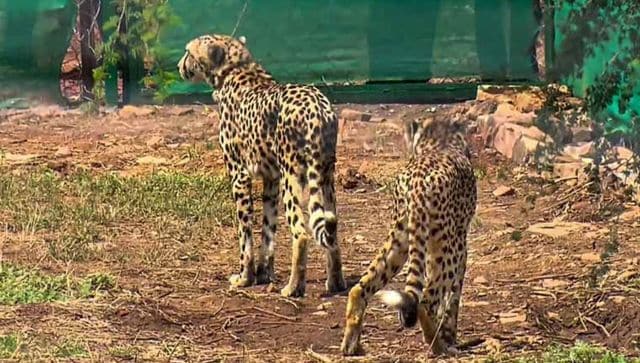 The cheetahs making their first kill is significant, says expert. PTI[/caption]“The cheetahs making their first kill within 24 hours is beyond expectations. This signifies that the big cats are absolutely fit and the worries of these cheetahs losing any muscle strength owing to the time they spend in quarantine is unfounded,” a senior forest official told Indian Express.Why had cheetahs not preyed till now?These cheetahs have been living in quarantine enclosures till now because of the rules that wild animals must be quarantined for a month before and after being shifted to a different country to prevent them from catching infections.Since their relocation in September, these eight cheetahs were housed in six 'bomas' (enclosures), two of which are 50 metres x 30 metres while the other four are 25 square metre in area.During their quarantine, the felines were fed buffalo meat.Almost two months later, these big cats are being released in larger enclosures in a phased manner.
On Saturday (5 November), Freddie and Elton were let out from the quarantine zones into an enclosure spread over 98 hectares.Sharing the video of these two wild cats being shifted to a larger enclosure, Prime Minister Narendra Modi had tweeted on Sunday, "Great news! Am told that after mandatory quarantine, two cheetahs released to a bigger enclosure for further adaptation to Kuno habitat. Others will be released soon. Also glad to know that all cheetahs are healthy, active & adjusting well.”These larger enclosures have nine interlinked compartments spanning five square kilometre. As per Indian Express, separate compartments have been set up so an animal can be removed smoothly if the need arises.The other six cheetahs will be let out in the big enclosures by 10 November as per media reports. The five female cheetahs are Asha (which means hope in English), Savannah, Tbilisi, Siyaya and Sasha, while the remaining male is called Oban.As many as 4,000 cheetals along with blue bull, four-horned antelope, wild boar and Indian gazelle have been released in the compartments for cheetahs to prey.Once all the cheetahs adjust to these bigger enclosures, they will be finally released into the 748-sqkm Kuno National Park.[caption id="attachment_11587091" align="alignnone" width="640"]
 These eight cheetahs will eventually be released into Kuno National Park. PTI File Photo[/caption]Challenges for relocated cheetahsExperts have pointed out several worries about the relocation of these big cats from Namibia.ALSO READ: Cheetahs are back in India: Know the world’s fastest predator that constantly lives in fearValmik Thapar, a leading conservationist in India, told NDTV in September that cheetahs– who chase their prey for long distances- due to the varied terrain in Namibia and India would face obstructions in outrunning their attackers.Ullas Karanth, tiger conservationist and Emeritus Director of Centre of Wildlife Studies, told The Hindu in October that “in the absence of large space devoid of humans and domestic dogs, it will be difficult to restore the extinct cheetahs in Kuno National Park in Madhya Pradesh using the eight cheetahs brought from Namibia”.He also said that the relocation programme does not have the scope to furnish a “large amount of open space required to have a meaningful population of 50 cheetahs”.“With first setbacks, these cheetahs would be pushed back into the fenced areas, and there will be a glorified form of safari that will attract tourists,” Karanth was quoted as saying by The Hindu. With inputs from agenciesRead all the Latest News, Trending News, Cricket News, Bollywood News,India News and Entertainment News here. Follow us on Facebook, Twitter and Instagram.
First Published:Nov 07, 2022, 20:37:17 IST
Advertisement
Advertisement

Military drones & police check-ups: How Sri Lanka is fighting against worst dengue outbreak in a decade
Sri Lanka is fighting its most severe dengue outbreak in nearly a decade, with infections rising sharply across the nation. Military drones have been deployed to tackle the outbreak, which has claimed 56 lives. Health officials said the outbreak is being driven primarily by the DENV-2 variant of the virus
3 min read
How Facebook job ad lured 2 Karnataka men into Myanmar cyber scam camp
The Karnataka Cyber Command has rescued two youths from a scam compound in Myanmar operated by Chinese fraudsters. The duo from Karnataka were lured on the pretext of data-entry jobs. They were asked to work for 16 hours a day and were expected to sleep for six hours daily
4 min read
Why is India seeing 95% cloud cover despite a Super El Niño?
India is witnessing nearly 95 per cent cloud cover despite a Super El Niño, a climate event usually linked to weaker monsoons. Regional weather systems, cyclonic circulations, the monsoon trough and moisture from two seas are temporarily overpowering one of the world's strongest climate phenomena
5 min read
What is CJP’s fourth demand to the government as protests in Delhi intensify?
The protest by the Cockroach Janta Party at Delhi’s Jantar Mantar refuses to die down. The group have made a fourth demand to the Centre, asking that no FIRs are filed against the agitators and that no legal action be taken. The government has expressed willingness to speak to the protesters, but refused to accede on the resignation of Education Minister Dharmandra Pradhan
5 min read
The new geography of war: Why the Houthis can no longer be ignored
The rise of the Houthis marks the emergence of a new geography of war — one in which influence flows not only from capitals and conventional armies, but also from rugged mountains overlooking vital sea lanes
6 min read
Advertisement
Advertisement