


Why SpaceX called off the launch of Starship, the most powerful rocket ever built
The lift-off for the nearly 400-foot unmanned vehicle was cancelled just minutes before launch due to an issue with a valve in the booster’s pressurisation system. SpaceX kept the countdown going as a ‘wet dress rehearsal’ but the company said the inaugural flight would be delayed by 48 hours

SpaceX on Monday called off the launch of its Starship vehicle.
The lift-off for the nearly 400-foot unmanned vehicle had been planned for 8:20 am Central Time from Starbase, the SpaceX spaceport in Texas’s Boca Chica.
So what happened?
Let’s take a closer look:
As per The New York Times, there was seemingly an issue with a valve in the booster’s pressurisation system.
CNBC quoted SpaceX principal integration engineer John Insprucker as saying that the team was “working a pressurisation issue"
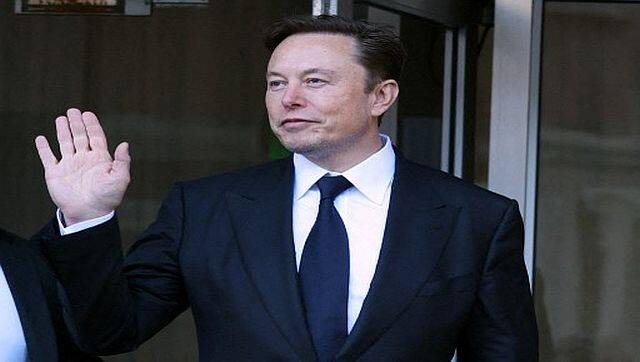
That news was confirmed by Space X CEO Elon Musk on Twitter.
SpaceX engineers kept the countdown going as a “wet dress rehearsal” to ensure that everything else was in order.
The countdown was halted at 10 seconds, as per the newspaper.
 More from Explainers
There won’t be another try until at least Wednesday.
SpaceX said the inaugural flight would be delayed for at least 48 hours to recycle the liquid methane and liquid oxygen that fuels the rocket.
CNBC quoted SpaceX’s Kate Tice as saying, “We’re not quite sure what that timing will be.”
Tice added that it depends on the data gathered today.
Musk tweeted:
Musk had warned ahead of the launch that a delay was likely.
"It's a very risky flight," he said earlier. "It's the first launch of a very complicated, gigantic rocket.
"There's a million ways this rocket could fail," Musk said. "We're going to be very careful and if we see anything that gives us concern, we'll postpone."
The US space agency NASA has picked the Starship spacecraft to ferry astronauts to the Moon in late 2025 -- a mission known as Artemis III -- for the first time since the Apollo program ended in 1972.
Starship consists of a 164-foot (50-meter) tall spacecraft designed to carry crew and cargo that sits atop a 230-foot tall first-stage Super Heavy booster rocket.
Both the lower-stage Super Heavy booster and the upper-stage Starship cruise vessel it would carry to space are designed as reusable components, capable of flying back to Earth for soft landings - a maneuver that has become routine for SpaceX's smaller Falcon 9 rocket.
But neither stage would be recovered for the expendable first test flight to space. Instead, both parts of the spacecraft would end their inaugural flight with crash landings at sea - the upper-stage of the Starship coming down in the Pacific after achieving nearly one full orbit of the Earth.
Prototypes of the Starship cruise vessel have made five sub-space flights up to 6 miles (10 km) above Earth in recent years, but the Super Heavy booster has never left the ground.
SpaceX conducted a successful test-firing of the 33 Raptor engines on the first-stage booster in February but the Starship spacecraft and the Super Heavy rocket have never flown together.
The integrated test flight is intended to assess their performance in combination.
NASA will take astronauts to lunar orbit itself in November 2024 using its own heavy rocket called the Space Launch System (SLS), which has been in development for more than a decade.
Starship is both bigger and more powerful than SLS and capable of lifting a payload of more than 100 metric tonnes into orbit.
A successful debut flight would also instantly rank the Starship system as the most powerful launch vehicle on Earth.
It generates 17 million pounds of thrust, more than twice that of the Saturn V rockets used to send Apollo astronauts to the Moon.
The plan for the integrated test flight is for the Super Heavy booster to separate from Starship about three minutes after launch and splash down in the Gulf of Mexico.
Starship, which has six engines of its own, will continue to an altitude of nearly 150 miles, completing a near-circle of the Earth before splashing down in the Pacific Ocean about 90 minutes after launch.
"If it gets to orbit, that's a massive success," Musk said.
"If we get far enough away from the launchpad before something goes wrong then I think I would consider that to be a success," he said. "Just don't blow up the launchpad."
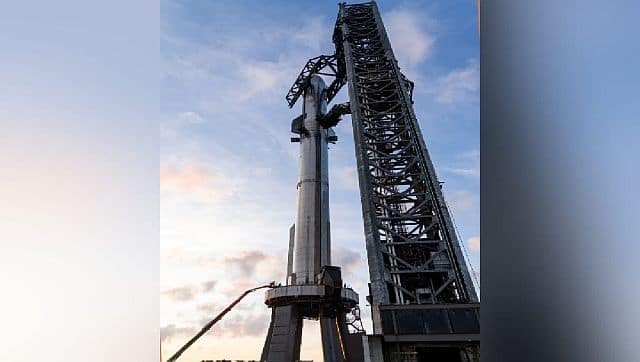
SpaceX foresees eventually putting a Starship into orbit, and then refueling it with another Starship so it can continue on a journey to Mars or beyond.
Musk said the goal is to make Starship reusable and bring down the price to a few million dollars per flight.
"In the long run -- long run meaning, I don't know, two or three years -- we should achieve full and rapid reusability," he said.
"We are at this brief moment in civilization where it is possible to become a multi-planet species," he said.
"That's our goal. I think we've got a chance."
On the eve of the launch attempt, cars, campers, RVs and even bicycles and horses jammed the only road leading to the launch pad, where the stainless steel rocket towered above the flat scrubland and prairie. Enthusiasts posed in front of the giant letters that spelled out Starbase at the entrance of the SpaceX complex, and in front of the rocket two miles farther down the road, which ended at the gulf.
On Monday, spectators were barred from the area, and instead packed a beach about six miles away on South Padre Island.
Ernesto and Maria Carreon drove two hours from Mission, Texas, with their two daughters, 5 and 7, to watch.
“I got sad. They got sad,” when the launch attempt was canceled, Maria Carreon said.
They can’t return for the next try but planned to have fun on the beach Monday.
Michelle Vancampenhout, on vacation from Green Bay, Wisconsin, said she’ll be back.
“It’s a once-in-a-lifetime experience to see it,” she said.
With inputs from agencies
Read all the Latest News, Trending News, Cricket News, Bollywood News, India News and Entertainment News here. Follow us on Facebook, Twitter and Instagram.

Delhi Police asks personnel to wear uniform: What the law says on cops in plainclothes during protests
Military drones & police check-ups: How Sri Lanka is fighting against worst dengue outbreak in a decade
How Facebook job ad lured 2 Karnataka men into Myanmar cyber scam camp
Why is India seeing 95% cloud cover despite a Super El Niño?
What is CJP’s fourth demand to the government as protests in Delhi intensify?