


Why has a Californian city banned balloons? No, it has nothing to do with spying
Laguna Beach is banning the sale and public use of balloons to curtail the risk of devastating wildfires and eliminate a major source of trash floating near the community’s scenic shores

Balloons may be used for celebratory purposes, but what if they come at a cost to the planet?Laguna Beach – the hilly seaside California city known for stunning ocean views and rolling bluffs, is banning the sale and public use of balloons to curtail the risk of devastating wildfires and eliminate a major source of trash floating near the community’s scenic shores, reported Associated Press.The move is part of a rising trend in which numerous cities, including Maryland, Virginia, and Hawaii, have imposed similar bans, and where New York and Florida are considering doing the same.According to environmental experts, measures like banning balloons could spread widely as people become more aware of the harmful effects that the small festive item can have on the ecosystem, reported The Guardian.Let’s take a closer look at how balloons can harm the environment.Also read: The Way of Water: The wonderful world that lives under the deep, blue seasLaguna Beach bans balloonsThe Laguna Beach City Council voted on 21 February to prohibit the sale, distribution, or usage of balloons on public land or during official city events, according to The Los Angeles Times.The new regulation states that balloons are also prohibited from being released into the air and may only be disposed of in areas where they will be covered by a lid, making them less likely to blow away and end up as litter.[caption id="attachment_12202412" align="alignnone" width="640"] Coastal cities are at the forefront of passing laws that are even tighter than Laguna Beach’s ban on balloons. Reuters[/caption]The restriction will apply to all balloon varieties, whether they are inflated or not, including those made of synthetic or compostable materials, reported AP.As per the report, the ban will come into effect in 2024, so local individuals and businesses who love balloons will have time to switch to another party décor.Also read: How traces of microplastics were found in breast milkBalloons are bad for the environmentBalloons put the environment and wildlife at constant risk.They are typically constructed of plastic, and when they are released into the air, they eventually fall back to earth, frequently ending up as pollution on the ground, on beaches, or in the water.The Guardian cited Kara Wiggin, a doctoral researcher at the Scripps Institution of Oceanography who studies microplastics in the marine, as saying that balloons are a “double-whammy for the environment: first there’s the latex itself, which can be eaten by marine mammals and sea turtles. When ingested, latex balloons are 32 times more likely to kill seabirds than hard plastic, making them the deadliest type of marine debris for seabirds.”Lara O’Brien, a geospatial analyst at Noaa’s Office for Coastal Management, told the outlet, “This is because latex balloons are made from a soft, malleable material that can easily conform to a bird’s stomach cavity or digestive tract causing obstruction, starvation, and death.”Although some latex balloons' producers claim that they are biodegradable, O'Brien says there are no safe latex balloons to release since they have plasticisers added that slow down the biodegradation process and can take decades or longer to decompose.Additionally, the string on the balloon also causes greater harm as they are often found inside the bellies of birds."Balloon debris can tangle wildlife or be ingested by animals that mistake it for food, and more than 3,000 pieces of balloon litter were picked up on ocean beaches by volunteers in Virginia over a five-year period," according to the NOAA Office of Response and Restoration.[caption id="attachment_12202402" align="alignnone" width="640"]
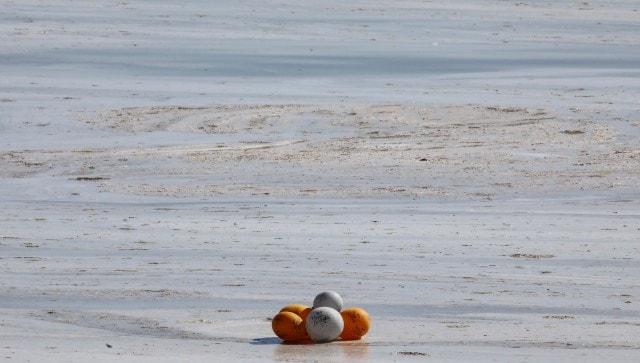 Although there are few balloons on beaches than plastic bags, they are particularly harmful and people are also less careful with them. Reuters[/caption]The AP report says that in California, fire officials have long warned against foil balloons that can tangle with power lines, causing a power outage and potential fire hazard. Southern California Edison, one of the state’s major utilities, reported more than 1,000 foil balloon-related power outages in 2017, affecting more than 1 million customers, according to a state legislative analysis.According to Anja Brandon, associate director of US plastics policy at the non-profit environmental group Ocean Conservancy, coastal cities are at the forefront of passing laws that are even tighter than Laguna Beach’s ban on balloons.It's because they are experiencing the environmental effects first-hand and also paying for it. She told The Guardian, “Many of these cities use taxpayers’ dollars to pay for beach cleanup, especially where tourism is important.”Also read: Why tobacco companies in Spain are being forced to pay for cleaning up cigarette buttsBalloons in comparison to plasticsAccording to Wiggin, everything takes longer in the sea because it mixes with the plastic soup that floats across the oceans. Even if something is labelled as biodegradable, it could not be marine biodegradable because a lot of things that can degrade in soil can't degrade at all in the ocean.Although there are few balloons on beaches than plastic bags, they are particularly harmful and people are also less careful with them.Wiggin explained to The Guardian, “People actively release balloons but they don’t actively toss plastic bags into the ocean. So that’s a good low-hanging fruit, especially in Laguna Beach, where the parks are along the water. It’s a great easy answer to manage with legislation.”With inputs from agenciesRead all the Latest News, Trending News, Cricket News, Bollywood News,India News and Entertainment News here. Follow us on Facebook, Twitter and Instagram.

Delhi Police asks personnel to wear uniform: What the law says on cops in plainclothes during protests
Military drones & police check-ups: How Sri Lanka is fighting against worst dengue outbreak in a decade
How Facebook job ad lured 2 Karnataka men into Myanmar cyber scam camp
Why is India seeing 95% cloud cover despite a Super El Niño?
What is CJP’s fourth demand to the government as protests in Delhi intensify?