
Advertisement


Sections
What is Gaganyaan Mission? Why is its first flight test so significant?
ISRO is slated to conduct the Gaganyaan mission’s first flight test on Saturday from Satish Dhawan Space Centre in Sriharikota. The unmanned launch will test the Crew Module – which will hold the astronauts in a pressurised Earth-like atmosphere during the Gaganyaan mission – and the abort system

The Indian Space Research Organisation (ISRO) is slated to conduct the Gaganyaan mission’s first flight test on 21 October.The test flight is slated to be launched from the Satish Dhawan Space Centre in Sriharikota at 8 am on Saturday.In a message on social media platform X, the national space agency headquartered, said, “Mission Gaganyaan: The TV-D1 test flight is scheduled for 21 October, 2023 between 7 am and 9 am from SDSC-SHAR, Sriharikota.”“…it will be a short duration mission and the visibility from the launch view gallery will be limited,” ISRO said in a statement.But what is the Gaganyaan mission? And why is the first test flight so significant?What is the Gaganyaan mission?The Gaganyaan project looks to demonstrate India’s ability to send manned space missions.![Gaganyaan’s first test flight to start on October 21, says India’s Science and Technology Minister]() The launch of the Test Vehicle Development Flight (TV-D1), will take place at Satish Dhawan Space Centre in Sriharikota, Andhra Pradesh[/caption]The ISRO in a statement said, “The prerequisites for Gaganyaan mission include development of many critical technologies including human rated launch vehicle for carrying crew safely to space, life support system to provide an earth like environment to crew in space, crew emergency escape provision and evolving crew management aspects for training, recovery and rehabilitation of crew.”“Various precursor missions are planned for demonstrating the Technology Preparedness Levels before carrying out the actual Human Space Flight mission. These demonstrator missions include Integrated Air Drop Test (IADT), Pad Abort Test (PAT) and Test Vehicle (TV) flights. Safety and reliability of all systems will be proven in unmanned missions preceding manned mission,” the ISRO website states.Why is this test flight so important? The test flight is important to put the Crew Module – which will hold the astronauts in a pressurised Earth-like atmosphere during the Gaganyaan mission – through its paces as well as see how well the abort system works.The Crew Module (CM) for the Gaganyaan mission is under different stages of development.For the TV-D1, the CM is an unpressurised version that has completed its integration and testing.
The launch of the Test Vehicle Development Flight (TV-D1), will take place at Satish Dhawan Space Centre in Sriharikota, Andhra Pradesh[/caption]The ISRO in a statement said, “The prerequisites for Gaganyaan mission include development of many critical technologies including human rated launch vehicle for carrying crew safely to space, life support system to provide an earth like environment to crew in space, crew emergency escape provision and evolving crew management aspects for training, recovery and rehabilitation of crew.”“Various precursor missions are planned for demonstrating the Technology Preparedness Levels before carrying out the actual Human Space Flight mission. These demonstrator missions include Integrated Air Drop Test (IADT), Pad Abort Test (PAT) and Test Vehicle (TV) flights. Safety and reliability of all systems will be proven in unmanned missions preceding manned mission,” the ISRO website states.Why is this test flight so important? The test flight is important to put the Crew Module – which will hold the astronauts in a pressurised Earth-like atmosphere during the Gaganyaan mission – through its paces as well as see how well the abort system works.The Crew Module (CM) for the Gaganyaan mission is under different stages of development.For the TV-D1, the CM is an unpressurised version that has completed its integration and testing.![Not just Gaganyaan, ISRO busy with various exploration missions in pipeline, says Chairman Somanath]() ISRO's Chairman S Somanath has revealed that India's space organisation is working on several exploration missions and has several launches lined up for the next few years.[/caption]Space expert Girish Linganna told The Week, “Within the CM, all the components necessary for deceleration and recovery are housed. This includes a comprehensive array of parachutes, Recovery Aids Actuation Systems and pyrotechnic devices. Recovery Aids Actuation Systems are mechanisms that control and deploy different kinds of devices, such as parachutes or flotation equipment, during the spacecraft’s descent phase to ensure safe and controlled landing. The CM is also equipped with an extensive array of instruments to record flight data, allowing for assessment of various system performances."The Crew Module will be recovered after touchdown in the Bay of Bengal using a dedicated vessel and diving team from the Indian Navy.Indian Space Station by 2035, PM tells ISROBuoyed by the success of the Chandrayaan mission, Prime Minister Narendra Modi on Tuesday set ambitious goals for ISRO, asking them to set up an Indian Space Station by 2035 and send the first Indian to the moon by 2040.Modi’s directions came during a briefing by ISRO Chairman S Somanath on the progress of the Gaganyaan mission, which is to have its first demonstration flight of the crew escape system on 21 October, and other initiatives.During the meeting, the Prime Minister outlined the future of India’s space exploration endeavours and urged scientists to work towards interplanetary missions, including a Venus Orbiter Mission and a Mars Lander and also explore the moon in greater detail.“Building on the success of Indian space initiatives, including the recent Chandrayaan-3 and Aditya L1 missions, the Prime Minister directed that India should now aim for new and ambitious goals, including setting up the ‘Bharatiya Antariksha Station’ (Indian space station) by 2035 and sending first Indian to the Moon by 2040,” the statement said.
ISRO's Chairman S Somanath has revealed that India's space organisation is working on several exploration missions and has several launches lined up for the next few years.[/caption]Space expert Girish Linganna told The Week, “Within the CM, all the components necessary for deceleration and recovery are housed. This includes a comprehensive array of parachutes, Recovery Aids Actuation Systems and pyrotechnic devices. Recovery Aids Actuation Systems are mechanisms that control and deploy different kinds of devices, such as parachutes or flotation equipment, during the spacecraft’s descent phase to ensure safe and controlled landing. The CM is also equipped with an extensive array of instruments to record flight data, allowing for assessment of various system performances."The Crew Module will be recovered after touchdown in the Bay of Bengal using a dedicated vessel and diving team from the Indian Navy.Indian Space Station by 2035, PM tells ISROBuoyed by the success of the Chandrayaan mission, Prime Minister Narendra Modi on Tuesday set ambitious goals for ISRO, asking them to set up an Indian Space Station by 2035 and send the first Indian to the moon by 2040.Modi’s directions came during a briefing by ISRO Chairman S Somanath on the progress of the Gaganyaan mission, which is to have its first demonstration flight of the crew escape system on 21 October, and other initiatives.During the meeting, the Prime Minister outlined the future of India’s space exploration endeavours and urged scientists to work towards interplanetary missions, including a Venus Orbiter Mission and a Mars Lander and also explore the moon in greater detail.“Building on the success of Indian space initiatives, including the recent Chandrayaan-3 and Aditya L1 missions, the Prime Minister directed that India should now aim for new and ambitious goals, including setting up the ‘Bharatiya Antariksha Station’ (Indian space station) by 2035 and sending first Indian to the Moon by 2040,” the statement said.
It aims to send a human crew to a Low-Earth Orbit (LEO) of 400 kilometres and bring them back safely by landing in the Indian Ocean.The project was announced in 2018 by Prime Minister Narendra Modi during his Republic Day speech from the Red Fort.The Gaganyaan mission was slated to launch in 2022. However, the COVID pandemic and the complexity of the mission led to delays.If successful, it will make India just the fourth nation – after the erstwhile Soviet Union, the United States and China – to carry out manned spaceflights.As per India Today, the Gaganyaan project is important because countries are now looking to conquer the final frontier of space, explore the cosmos and find new resources on the Moon and on other planets.“An indigenous crew mission will put India at the centre of this race, shaping the already changing geopolitics,” the piece added.[caption id="attachment_13233932" align="alignnone" width="750"]
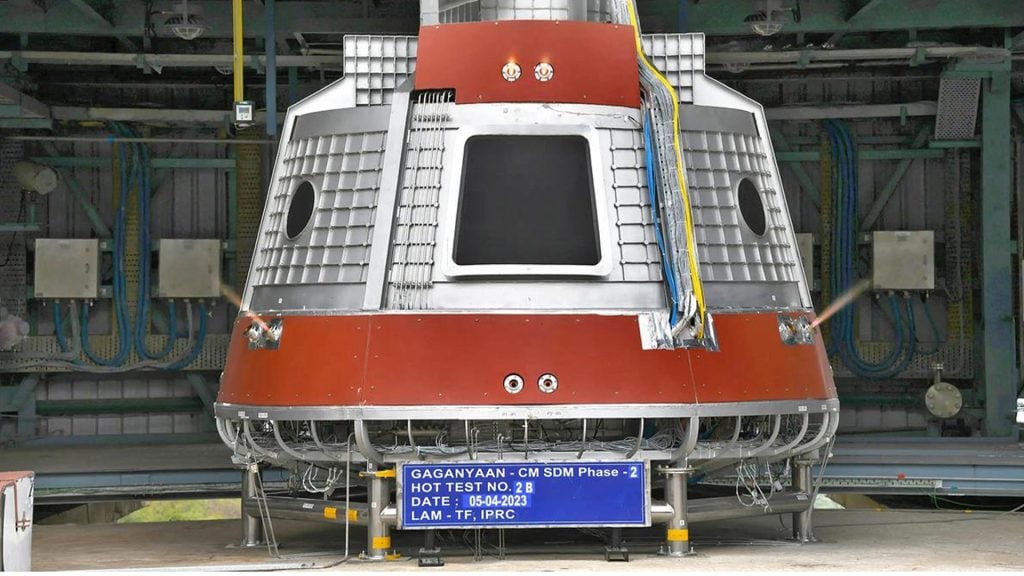 The launch of the Test Vehicle Development Flight (TV-D1), will take place at Satish Dhawan Space Centre in Sriharikota, Andhra Pradesh[/caption]The ISRO in a statement said, “The prerequisites for Gaganyaan mission include development of many critical technologies including human rated launch vehicle for carrying crew safely to space, life support system to provide an earth like environment to crew in space, crew emergency escape provision and evolving crew management aspects for training, recovery and rehabilitation of crew.”“Various precursor missions are planned for demonstrating the Technology Preparedness Levels before carrying out the actual Human Space Flight mission. These demonstrator missions include Integrated Air Drop Test (IADT), Pad Abort Test (PAT) and Test Vehicle (TV) flights. Safety and reliability of all systems will be proven in unmanned missions preceding manned mission,” the ISRO website states.Why is this test flight so important? The test flight is important to put the Crew Module – which will hold the astronauts in a pressurised Earth-like atmosphere during the Gaganyaan mission – through its paces as well as see how well the abort system works.The Crew Module (CM) for the Gaganyaan mission is under different stages of development.For the TV-D1, the CM is an unpressurised version that has completed its integration and testing.
This unmanned test flight will also serve as a launching pad for other vehicle tests – which will culminate in India’s first manned space mission slated for 2025.ISRO chairman S Somanath on Saturday told reporters three more test vehicle missions would be launched under the Gaganyaan programme after the TV-D1 test flight.“The first test vehicle flight (of the Gaganyaan mission) will be conducted on October 21. After that, we have planned for three more test missions, D2, D3, D4. We will hold thorough tests during the test flight sequence,” Somanath, who is also the secretary, Department of Space, told reporters in Rameswaram.In short, this mission will test the how the Crew Module performs as well how effectively the Crew Escape System works to save astronauts during an emergency.How will the test flight work?The TV-D1 test flight involves launching the unmanned crew module to outer space, bringing it back to earth and recovering it after touchdown in the Bay of Bengal.According to ISRO, the test vehicle is a single-stage liquid rocket. The payloads comprise
- The Crew Module (CM)
- Crew Escape System (CES)
- CM fairing (CMF)
- Interface Adapters.
Then, the Crew Escape System will safely touch down in the sea.“The Crew Escape System with Crew Module will be separated from the Test Vehicle at an altitude of about 17 km. Subsequently, the abort sequence will be executed autonomously commencing with the separation of the CES and deployment of the series of parachutes, finally culminating in the safe touchdown of CM in the sea, about 10 km from the coast of Sriharikota,” ISRO explained.“With its complete set of parachutes, recovery aids actuation systems and pyros (pyrotechnic device used to separate spacecraft from rocket), the avionics systems in CM are in a dual redundant mode configuration for navigation, sequencing, telemetry, instrumentation and power. The CM in this mission is extensively instrumented to capture the flight data for evaluation of the performance of various systems,” it added.[caption id="attachment_13253982" align="alignnone" width="645"]
 ISRO's Chairman S Somanath has revealed that India's space organisation is working on several exploration missions and has several launches lined up for the next few years.[/caption]Space expert Girish Linganna told The Week, “Within the CM, all the components necessary for deceleration and recovery are housed. This includes a comprehensive array of parachutes, Recovery Aids Actuation Systems and pyrotechnic devices. Recovery Aids Actuation Systems are mechanisms that control and deploy different kinds of devices, such as parachutes or flotation equipment, during the spacecraft’s descent phase to ensure safe and controlled landing. The CM is also equipped with an extensive array of instruments to record flight data, allowing for assessment of various system performances."The Crew Module will be recovered after touchdown in the Bay of Bengal using a dedicated vessel and diving team from the Indian Navy.Indian Space Station by 2035, PM tells ISROBuoyed by the success of the Chandrayaan mission, Prime Minister Narendra Modi on Tuesday set ambitious goals for ISRO, asking them to set up an Indian Space Station by 2035 and send the first Indian to the moon by 2040.Modi’s directions came during a briefing by ISRO Chairman S Somanath on the progress of the Gaganyaan mission, which is to have its first demonstration flight of the crew escape system on 21 October, and other initiatives.During the meeting, the Prime Minister outlined the future of India’s space exploration endeavours and urged scientists to work towards interplanetary missions, including a Venus Orbiter Mission and a Mars Lander and also explore the moon in greater detail.“Building on the success of Indian space initiatives, including the recent Chandrayaan-3 and Aditya L1 missions, the Prime Minister directed that India should now aim for new and ambitious goals, including setting up the ‘Bharatiya Antariksha Station’ (Indian space station) by 2035 and sending first Indian to the Moon by 2040,” the statement said.
To realise this vision, the Department of Space will develop a roadmap for Moon exploration, it said.ISRO’s moon exploration plans will comprise a series of Chandrayaan missions, developing a new rocket – the Next Generation Launch Vehicle (NGLV), building a new launchpad and setting up human-centric Laboratories and associated technologies.The Department of Space presented a comprehensive overview of the Gaganyaan Mission, including various technologies developed so far such as human-rated launch vehicles and system qualification.It was noted that around 20 major tests, including three uncrewed missions of the Human Rated Launch Vehicle (HLVM3) are planned.Prime Minister Modi expressed confidence in India’s capabilities and affirmed the nation’s commitment to scaling new heights in space exploration.Besides Somanath, Minister of State in the Prime Minister’s Office Jitendra Singh, Principal Secretary to the Prime Minister P K Mishra and other officials were present during the meeting.The meeting chaired by the Prime Minister came after India’s successful soft landing near the unexplored south pole of the moon on 23 August.Within 10 days of the lunar landing on September 2, India launched a spacecraft to study the Sun from a place called the Lagrange Point (L1), situated about 1.5 million kilometers from the Earth.The Aditya L-1 mission will study the solar atmosphere, solar magnetic storms, and their impact on the environment around the Earth.With inputs from agencies
First Published:Oct 18, 2023, 18:00:53 IST
Advertisement
Advertisement

Delhi Police asks personnel to wear uniform: What the law says on cops in plainclothes during protests
The Delhi Police has instructed all its personnel to wear uniforms when they report for duty at Jantar Mantar for crowd control. This comes after outrage grew over videos of men in civilian clothes or without name tags hitting protesters in the Capital. Is it legal for the police to ditch uniforms during protests?
4 min read
Military drones & police check-ups: How Sri Lanka is fighting against worst dengue outbreak in a decade
Sri Lanka is fighting its most severe dengue outbreak in nearly a decade, with infections rising sharply across the nation. Military drones have been deployed to tackle the outbreak, which has claimed 56 lives. Health officials said the outbreak is being driven primarily by the DENV-2 variant of the virus
3 min read
How Facebook job ad lured 2 Karnataka men into Myanmar cyber scam camp
The Karnataka Cyber Command has rescued two youths from a scam compound in Myanmar operated by Chinese fraudsters. The duo from Karnataka were lured on the pretext of data-entry jobs. They were asked to work for 16 hours a day and were expected to sleep for six hours daily
4 min read
Why is India seeing 95% cloud cover despite a Super El Niño?
India is witnessing nearly 95 per cent cloud cover despite a Super El Niño, a climate event usually linked to weaker monsoons. Regional weather systems, cyclonic circulations, the monsoon trough and moisture from two seas are temporarily overpowering one of the world's strongest climate phenomena
5 min read
What is CJP’s fourth demand to the government as protests in Delhi intensify?
The protest by the Cockroach Janta Party at Delhi’s Jantar Mantar refuses to die down. The group have made a fourth demand to the Centre, asking that no FIRs are filed against the agitators and that no legal action be taken. The government has expressed willingness to speak to the protesters, but refused to accede on the resignation of Education Minister Dharmandra Pradhan
5 min read
Advertisement
Advertisement