


What is Beaver Blood Moon? Will India witness the last total lunar eclipse until 2025?
A Beaver Blood Moon occurs when the moon passes directly through the Earth’s innermost shadow. During a lunar eclipse, sunlight hitting the Earth’s atmosphere is scattered out. When this happens, the atmosphere filters out most of the blue light. What’s left is a red hue, giving the moon its colour

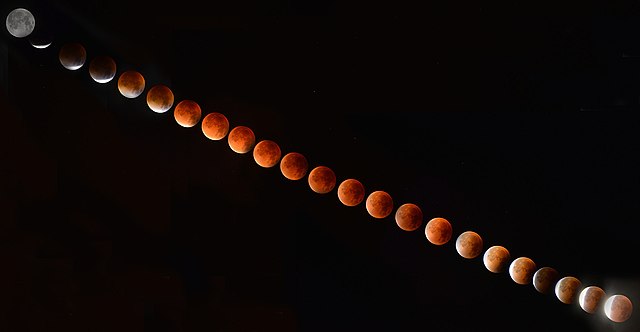
The next total lunar eclipse will only be visible in March 2025. Wikimedia Commons[/caption]The frequency of lunar tetrads depends on a century. Giovanni Schiaparelli, the Italian astronomer, calculated that lunar tetrads vary over centuries. Some centuries see many, while others don’t. For instance, the years between 1582 and 1908 did not have any tetrads whereas the period between 1909 to 2156 will have 17 tetrads.Why is it called ‘Beaver’ Blood Moon?For a long time, the Old Farmer’s Almanac has referred to monthly full Moons based on Native and Colonial and European folklore. Earlier, the full Moon names were used to denote the entire lunar month in which it occurred and through all the Moon's phases and not just the full Moon.The lunar eclipse of November is called the ‘Beaver’ Moon because this is when beavers start to take shelter in their lodges with sufficient stores of food for the long winter season ahead.In North America, this was also the season when fur traders used to trap beavers for their thick pelts.Will India be able to see it?Yes, but not as prominently as people in other parts of the world will be able to see it.While eastern parts of the country like Kolkata, Kohima, Agartala and Guwahati will be able to witness the total phase of the eclipse, other cities like Delhi, Mumbai, Chennai and Bengaluru will only be able to see a partial eclipse because totality will end by the Moonrise in these areas.A statement released by the Ministry of Earth Sciences said, “A total lunar eclipse will occur on 8 November 2022 (17 Kartika, 1944 Saka Era). The eclipse is visible from all places of India at the time of Moonrise. However, the beginning of the partial and total phases of the eclipse is not visible from any places in India as the phenomena will be in progress before Moonrise. The ending of both the total and the partial phases is visible from the eastern parts of the country. Only the ending of the partial phase is visible from the rest parts of the country.”The statement further mentions that the total lunar eclipse will begin at 2:39 pm Indian Standard Time (IST) and the end time of its totality is 5:12 pm IST. Meanwhile, the ending time of the partial phase is 6:19 pm IST.The entirety of an eclipse takes six hours to unfold but the main phase will last for a duration of about 90 minutes. On United States’ West Coast, the whole display will take place from 12:01 am Pacific Time to 6 am and the total eclipse will be peaking at 3 am.With inputs from agenciesRead all the Latest News, Trending News, Cricket News, Bollywood News,India News and Entertainment News here. Follow us on Facebook, Twitter and Instagram.

Military drones & police check-ups: How Sri Lanka is fighting against worst dengue outbreak in a decade
How Facebook job ad lured 2 Karnataka men into Myanmar cyber scam camp
Why is India seeing 95% cloud cover despite a Super El Niño?
What is CJP’s fourth demand to the government as protests in Delhi intensify?
The new geography of war: Why the Houthis can no longer be ignored