
Advertisement


Sections
What do Gazans really think about Hamas?
If read over time, polls of Gazans from 2007 to 2023 tell a story. They help make clear that Gazan support for armed resistance grew alongside increasing frustration, anger and a sense of hopelessness with any political solution to their suffering

Amid the escalation of the Israel-Hamas war, observers in the region and internationally continue to make assumptions about Gazan public support for Hamas.Mistaken assumptions such as those by US presidential candidate Ron DeSantis, claiming that all Gazans are “antisemitic,” or those that blame Gazans for “electing Hamas” may shape debates not only on how the war is perceived, but also over relief plans for Gazans in the months ahead.Any reconstruction efforts or aid distribution might be weighed against fears of Hamas insurgents within the Gazan population.In my own research into Jihadi-Salafism and Islamism, I found that militant movements provoked military interventions to exploit the chaos that ensues. Moreover, such groups often claim to govern in the “legitimate” interests of those they dominate even if those populations reject their rule.As several commentators have observed, Hamas likely hopes to not just encourage a disproportionate response from Israel, but also to use the violent aftermath of intervention to cultivate continued Gazan dependence upon it and to distract from its own domestic policy failures.What are the politicos saying?Leaders on both sides of the conflict have tried to make justifications for their actions. Often, they use their own perception of Gazan public opinion to support their own policy objectives.For example, Ismail Haniyeh, chief of Hamas’ political bureau, claimed that Hamas’ actions represented Gazans and “the entire Arab Muslim community.”For Haniyeh, Hamas’ usage of violence was on behalf of Palestinians who had been assaulted in the Al-Aqsa Mosque compound in September 2023, or have suffered at the hands of Israeli security forces, or for the settlers in the West Bank.![]() Israel president Isaac Herzog with British prime minister Rishi Sunak.[/caption]The Biden administration, careful not to condemn the Israeli bombardment, has sought a broader approach toward the escalation. In an interview and on social media, US president Joseph Biden observed that “the overwhelming majority of Palestinians had nothing to do with Hamas’ appalling attacks, and [instead] are suffering as a result of them.” Such suffering, Biden noted, required the eventual lifting of the “complete siege” implemented by Israel against Gaza.In each example, politicians used their assumptions about Gazans to support their policies. But the people in Gaza experience these policies far differently.What do Gazans think about Hamas?Reviewing Gazan public opinion over time reveals an ongoing sense of hopelessness living under the Israeli blockade.A June 2023 poll conducted by Khalil Shikaki, professor of political science and director of the Palestinian Center for Policy and Survey Research, indicated that 79 per cent of Gazans supported armed opposition to Israeli occupation of Palestinian territory. A Washington Institute poll from July 2023 found that only 57 per cent of Gazans held a “somewhat positive” opinion of Hamas.Further reading of those polls suggests a more nuanced story. Consider that in 2018, some 25 per cent of women in Gaza risked death in childbirth, 53 per cent of Gazans lived in poverty, and essential health care supplies were stretched thin. That same year, Shikaki found an increasing number of Gazans dissatisfied with Hamas’ government, with almost 50 per cent hoping to leave Gaza entirely.In the June 2023 Washington Institute poll, 64 per cent of Gazans demanded improved health care, employment, education and some sense of normalcy instead of Hamas’ claimed “resistance.”
Israel president Isaac Herzog with British prime minister Rishi Sunak.[/caption]The Biden administration, careful not to condemn the Israeli bombardment, has sought a broader approach toward the escalation. In an interview and on social media, US president Joseph Biden observed that “the overwhelming majority of Palestinians had nothing to do with Hamas’ appalling attacks, and [instead] are suffering as a result of them.” Such suffering, Biden noted, required the eventual lifting of the “complete siege” implemented by Israel against Gaza.In each example, politicians used their assumptions about Gazans to support their policies. But the people in Gaza experience these policies far differently.What do Gazans think about Hamas?Reviewing Gazan public opinion over time reveals an ongoing sense of hopelessness living under the Israeli blockade.A June 2023 poll conducted by Khalil Shikaki, professor of political science and director of the Palestinian Center for Policy and Survey Research, indicated that 79 per cent of Gazans supported armed opposition to Israeli occupation of Palestinian territory. A Washington Institute poll from July 2023 found that only 57 per cent of Gazans held a “somewhat positive” opinion of Hamas.Further reading of those polls suggests a more nuanced story. Consider that in 2018, some 25 per cent of women in Gaza risked death in childbirth, 53 per cent of Gazans lived in poverty, and essential health care supplies were stretched thin. That same year, Shikaki found an increasing number of Gazans dissatisfied with Hamas’ government, with almost 50 per cent hoping to leave Gaza entirely.In the June 2023 Washington Institute poll, 64 per cent of Gazans demanded improved health care, employment, education and some sense of normalcy instead of Hamas’ claimed “resistance.”![]() Humanitarian aid convoy for the Gaza Strip is parked at the Rafah crossing port, in Egypt. AP[/caption]By 2023, when Gazans polled by Shikaki expressed their support for armed resistance, they did so in the belief that only such resistance – not electoral politics – would provide relief from the Israeli blockade and siege.At the same time, however, those polled expressed exhaustion with the corruption of Hamas and the ongoing unemployment and poverty of Gaza.'There is death everywhere'Any chance for a simple return to normalcy seems lost for many Gazans, as Hamas claims to act as their “legitimate resistance.”With peace negotiations stalled in Gaza since 2001, elections postponed, movement out of Gaza impossible, and now an escalating humanitarian crisis, an entire generation of Gazans is left with few options.
Humanitarian aid convoy for the Gaza Strip is parked at the Rafah crossing port, in Egypt. AP[/caption]By 2023, when Gazans polled by Shikaki expressed their support for armed resistance, they did so in the belief that only such resistance – not electoral politics – would provide relief from the Israeli blockade and siege.At the same time, however, those polled expressed exhaustion with the corruption of Hamas and the ongoing unemployment and poverty of Gaza.'There is death everywhere'Any chance for a simple return to normalcy seems lost for many Gazans, as Hamas claims to act as their “legitimate resistance.”With peace negotiations stalled in Gaza since 2001, elections postponed, movement out of Gaza impossible, and now an escalating humanitarian crisis, an entire generation of Gazans is left with few options.
Israeli president Isaac Herzog, meanwhile, suggested that all Gazans bore collective responsibility for Hamas.As a result, he concluded, Israel would act to preserve its own self-interest against Gaza and its people.[caption id="attachment_13271652" align="alignnone" width="640"]
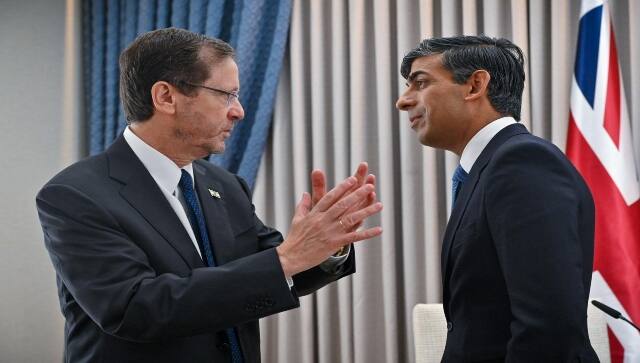 Israel president Isaac Herzog with British prime minister Rishi Sunak.[/caption]The Biden administration, careful not to condemn the Israeli bombardment, has sought a broader approach toward the escalation. In an interview and on social media, US president Joseph Biden observed that “the overwhelming majority of Palestinians had nothing to do with Hamas’ appalling attacks, and [instead] are suffering as a result of them.” Such suffering, Biden noted, required the eventual lifting of the “complete siege” implemented by Israel against Gaza.In each example, politicians used their assumptions about Gazans to support their policies. But the people in Gaza experience these policies far differently.What do Gazans think about Hamas?Reviewing Gazan public opinion over time reveals an ongoing sense of hopelessness living under the Israeli blockade.A June 2023 poll conducted by Khalil Shikaki, professor of political science and director of the Palestinian Center for Policy and Survey Research, indicated that 79 per cent of Gazans supported armed opposition to Israeli occupation of Palestinian territory. A Washington Institute poll from July 2023 found that only 57 per cent of Gazans held a “somewhat positive” opinion of Hamas.Further reading of those polls suggests a more nuanced story. Consider that in 2018, some 25 per cent of women in Gaza risked death in childbirth, 53 per cent of Gazans lived in poverty, and essential health care supplies were stretched thin. That same year, Shikaki found an increasing number of Gazans dissatisfied with Hamas’ government, with almost 50 per cent hoping to leave Gaza entirely.In the June 2023 Washington Institute poll, 64 per cent of Gazans demanded improved health care, employment, education and some sense of normalcy instead of Hamas’ claimed “resistance.”
Over 92 per cent of Gazans expressed outright anger at their living conditions.Additionally, as Shikaki reported, over 73 per cent believed the Hamas government to be corrupt. Yet, Gazans saw little hope for electoral change. With no election since 2006, a majority of Gazans alive today were not old enough to have voted for Hamas.Support of armed resistance was not always present. When Hamas openly fought the Palestinian Authority – which governs the West Bank and questioned the legitimacy of Hamas’ victory – and seized control over the Gaza Strip in 2007, over 73 per cent of Palestinians opposed that seizure and any further armed conflict.At that time, fewer than one-third of Gazans supported any military action against Israel. Over 80 per cent condemned kidnapping, arson and indiscriminate violence.'Sense of desperation'If read over time, polls of Gazans from 2007 to 2023 tell a story.They help make clear that Gazan support for armed resistance grew alongside increasing frustration, anger and a sense of hopelessness with any political solution to their suffering.In 2017, scholar Sara Roy, studying the Palestinian economy and Islamism, explored Gazan tolerance of Hamas, noting “what is new is the sense of desperation, which can be felt in the boundaries people are now willing to cross, boundaries that were once inviolable.”Gazans, Roy argued, particularly the 75 per cent under the age of 30, felt widely varying affinities toward Hamas’ ideology or claims to Islamic legitimacy. Hamas, they noted, paid salaries when few others could. Risking targeting by Israeli soldiers was a calculated and tolerable hazard of hire if it meant a paycheque.
In 2019, 27 per cent of Gazans blamed Hamas for their living conditions.In that same poll, 55 per cent supported any peace plan that would include a Palestinian state with East Jerusalem as a capital and an Israeli withdrawal from all occupied territories.[caption id="attachment_13273092" align="alignnone" width="640"]
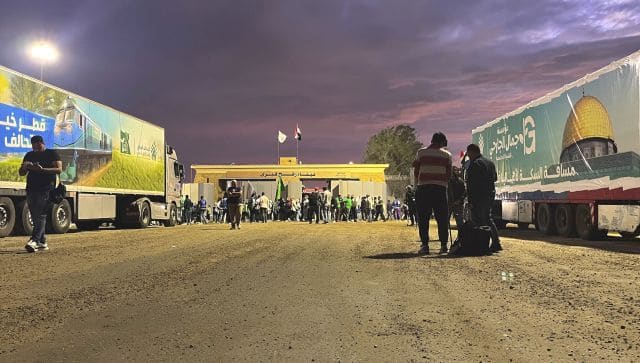 Humanitarian aid convoy for the Gaza Strip is parked at the Rafah crossing port, in Egypt. AP[/caption]By 2023, when Gazans polled by Shikaki expressed their support for armed resistance, they did so in the belief that only such resistance – not electoral politics – would provide relief from the Israeli blockade and siege.At the same time, however, those polled expressed exhaustion with the corruption of Hamas and the ongoing unemployment and poverty of Gaza.'There is death everywhere'Any chance for a simple return to normalcy seems lost for many Gazans, as Hamas claims to act as their “legitimate resistance.”With peace negotiations stalled in Gaza since 2001, elections postponed, movement out of Gaza impossible, and now an escalating humanitarian crisis, an entire generation of Gazans is left with few options.
“There is death everywhere,” said 33-year-old Omar El Qattaa, a photographer based in Gaza, “and memories erased.”Though 2023 polling indicated that a majority of Gazans were opposed to breaking the ceasefire with Israel, Hamas moved forward with its October attacks against their popular will. The sense of desperation felt by El Qatta, and millions of other Gazans, risks becoming instrumentalised by Hamas.As Matthew Leavitt, a scholar and researcher of Hamas writes, Hamas sees politics, charity, political violence and terrorism as complementary and legitimate tools to pursue its policy goals.As Khaldoun Barghouti, a Ramallah-based Palestinian researcher, notes, the ongoing bombardment by Israel has softened Gazan frustration with Hamas – at least in the short term.Such attacks “turned blame to Hamas (over the attacks in Israel) into more anger toward Israel.”How this will translate into support for alternatives to Hamas in the months ahead remains to be seen. Much will depend on how international stakeholders regain the trust of Gazans while assisting them with finding meaningful alternatives to a government and militant movement they once considered corrupt and unable to meet their basic needs.This article is republished from The Conversation under a Creative Commons license. Read the original article.
First Published:Oct 21, 2023, 09:06:45 IST
Advertisement
Advertisement

Military drones & police check-ups: How Sri Lanka is fighting against worst dengue outbreak in a decade
Sri Lanka is fighting its most severe dengue outbreak in nearly a decade, with infections rising sharply across the nation. Military drones have been deployed to tackle the outbreak, which has claimed 56 lives. Health officials said the outbreak is being driven primarily by the DENV-2 variant of the virus
3 min read
How Facebook job ad lured 2 Karnataka men into Myanmar cyber scam camp
The Karnataka Cyber Command has rescued two youths from a scam compound in Myanmar operated by Chinese fraudsters. The duo from Karnataka were lured on the pretext of data-entry jobs. They were asked to work for 16 hours a day and were expected to sleep for six hours daily
4 min read
Why is India seeing 95% cloud cover despite a Super El Niño?
India is witnessing nearly 95 per cent cloud cover despite a Super El Niño, a climate event usually linked to weaker monsoons. Regional weather systems, cyclonic circulations, the monsoon trough and moisture from two seas are temporarily overpowering one of the world's strongest climate phenomena
5 min read
What is CJP’s fourth demand to the government as protests in Delhi intensify?
The protest by the Cockroach Janta Party at Delhi’s Jantar Mantar refuses to die down. The group have made a fourth demand to the Centre, asking that no FIRs are filed against the agitators and that no legal action be taken. The government has expressed willingness to speak to the protesters, but refused to accede on the resignation of Education Minister Dharmandra Pradhan
5 min read
The new geography of war: Why the Houthis can no longer be ignored
The rise of the Houthis marks the emergence of a new geography of war — one in which influence flows not only from capitals and conventional armies, but also from rugged mountains overlooking vital sea lanes
6 min read
Advertisement
Advertisement