


USS Gerald R. Ford arrives near Israel: What to know about mammoth US carrier
The US has deployed its newest and the world’s largest aircraft carrier in the Eastern Mediterranean Sea near Israel. Named after president Gerald Ford, the ship spans 1,106 feet and has a displacement of a massive 112,000 tonnes. Washington deployed the ship to show support for Israel and to warn e

The USS Gerald R. Ford has arrived in the Eastern Mediterranean Sea near Israel.
Washington deployed the carrier, among a slew of other ships, in the backdrop of the conflict between Israel and the Palestinians.
The move is meant to be a statement of support for its staunch ally Israel – and a warning to enemies in the region not to get involved.
CENTCOM in a statement said “The United States has begun moving USS Gerald R. Ford Carrier Strike Group to the Eastern Mediterranean. This includes the US Navy aircraft carrier USS Gerald R. Ford (CVN-78), the Ticonderoga-class guided-missile cruiser USS Normandy (CG 60), as well as the Arleigh-Burke-class guided missile destroyers USS Thomas Hudner (DDG 116), USS Ramage (DDG 61), USS Carney (DDG 64), and USS Roosevelt (DDG 80).”
 More from Explainers
“The arrival of these highly capable forces to the region is a strong signal of deterrence should any actor hostile to Israel consider trying to take advantage of this situation,” General Michael “Erik” Kurilla, commander, US Central Command, was quoted as saying in the press release.
But what do we know about the USS Gerald R. Ford named after the 38th President of the United States?
Let’s take a closer look:
Origins
The ship was named in tribute to Ford, who was president from 1974 to 1977, giving a ‘lifetime of service’ to the United States.
Ford fought for his country during World War II.
He attained the rank of lieutenant commander in the US Navy and served on the light carrier USS Monterey (CVL 26).
The ship, designated CVN 78, is the lead ship in the Ford-class of aircraft carrier.
It is the US’ newest and the world’s largest aircraft carrier.
The ship began being built in September 2008 by the Northrop Grumman Corporation, as per Navsource.org.
The company was initially awarded $5.1-billion, seven-year contract plus an incentive fee.
It was meant to replace the USS Enterprise (CVN-65) – which was decommissioned in 2012 after five decades of service.
It also kicked off the US replacing its Nimitz-class carriers.
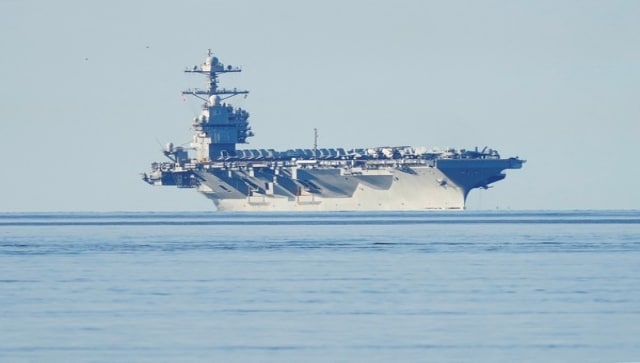
While construction started in 2009 and was to be completed by September 2015 at a cost of $10.5 billion, its price tag ended up being $12.9 billion.
The US Navy blamed the delays and budget overruns on the ship’s state-of-the-art systems.
The ship was commissioned in 2017.
Then president Donald Trump, speaking at the carrier’s commissioning, called it “a 100,000-ton message to the world” of American military might.
“Wherever this vessel cuts through the horizon our allies will rest easy and our enemies will shake with fear because everyone will know that America is coming and America is coming strong,” Trump said.
Its commissioning was also attended by ex-defence secretaries Donald Rumsfeld and Dick Cheney and a host of other officials.
As per Indian Express, it was Rumseld in 2007 who announced that the carrier would be named after president Ford.
Specifications
The USS Gerald R. Ford spans 1,106 feet and has a displacement of a whopping 112,000 tonnes.
It has the capacity to hold around 4,660 crew, as per Navsource.org.
India’s INS Vikrant, in comparison, can hold just 1,700 crew.
It can reach a speed in excess of 30 knots.
It is 333 metres long, has a beam of 78 meters at its flight deck and is 76 meters tall, as per Eurasian Times.
It dwarfs India’s INS Vikrant which is 262 metres long, 62 metres wide and has a displacement of 43,000 tonnes.
As per the US Navy website, while it is similar to a Nimitz class carrier in appearance, it has many special features including
- First-in-class technology including a new nuclear plant
- Can produce nearly three times the amount of electrical power
- Innovative advanced arresting gear
- Electromagnetic aircraft launch system (EMALS).
As per the website, “EMALS replaces the steam catapult system traditionally used to launch aircraft and will expand the aircraft launch envelope, paving the way for innovations in manned/unmanned aircraft as well as providing the opportunity for other technological advancements in the future.”
The USS Gerald R. Ford comes with a slew of surface-to-air missiles including the RIM-7 Sea Sparrow and the RIM-116, and M2 machine guns.
It can carry more than 75 aircraft including the Lockheed Martin F-35 and Boeing F/A-18E/F Super Hornet fighter jets, and Sikorsky MH-60R helicopters.
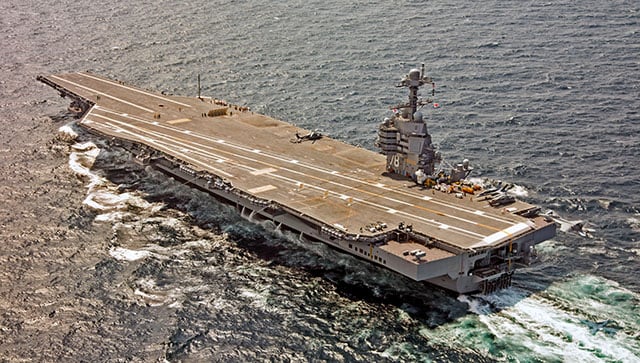
It has two nuclear reactors and four shafts, as per Navsource.org.
As per Indian Express, these reactors generate 250 per cent more power than the previous Nimitz class.
These reactors last for around 25 years.
The United States may also be considering also another aircraft carrier to the Mediterranean Sea.
The Wall Street Journal and ABC News quoted officials as saying that the USS Dwight D. Eisenhower may also be deployed.
As per Indian Express, aircraft carriers, due to their prohibitive cost and their status as a symbol of pride of their country, usually travel with a carrier strike group (CSG).
US Central Command said in a press release said USS Gerald R. Ford had eight squadrons of attack and support aircraft, and the Ticonderoga class guided missile cruiser USS Normandy (CG 60), as well as the Arleigh Burke class guided missile destroyers USS Thomas Hudner (DDG 116), USS Ramage (DDG 61), USS Carney (DDG 64), and USS Roosevelt (DDG 80).
With inputs from agencies

Military drones & police check-ups: How Sri Lanka is fighting against worst dengue outbreak in a decade
How Facebook job ad lured 2 Karnataka men into Myanmar cyber scam camp
Why is India seeing 95% cloud cover despite a Super El Niño?
What is CJP’s fourth demand to the government as protests in Delhi intensify?
The new geography of war: Why the Houthis can no longer be ignored