
Advertisement


Sections
US, Russia bicker over New START nuclear treaty: Why this is dangerous
The New START treaty is the last remaining arms control deal between the US and Russia. Signed by Barack Obama in 2010 and extended by Joe Biden till 2026, it restricts both countries to a maximum of 1,550 deployed strategic nuclear warheads each and limits launchers and heavy bombers to 800

The United States has accused Russia of not complying with the New START treaty.The news comes amid growing tensions between the two nations in the backdrop of the Ukraine war.The state department said Russia suspended inspections and cancelled talks but stopped short of accusing Moscow of expanding nuclear warheads beyond agreed limits.“Russia is not complying with its obligation under the New START Treaty to facilitate inspection activities on its territory,” a state department spokesperson said.The spokesperson added that Moscow's refusal "threatens the viability of US-Russian nuclear arms control."“Russia has a clear path for returning to full compliance. All Russia needs to do is allow inspection activities on its territory, just as it did for years under the New START Treaty, and meet in a session of the Bilateral Consultative Commission,” he said, referring to the formal talks set up under the treaty.Russia said on Wednesday that the United States had destroyed the legal basis for the New START arms control treaty between the two countries, but that the agreement remained "very important" for Russia, regardless of the present situation.But what do we know about the New START treaty?Let’s take a closer look:The New START treaty is formally known as the Measures for the Further Reduction and Limitation of Strategic Offensive Arms, according to the US state department website.It is the last remaining arms control deal between the United States and Russia.It was signed 2010, at a time when relations were much friendlier between the two nations, by then-president Barack Obama.It took effect in February 2011.According to the state department website, both Russia and the United States have stayed at or under certain limits including:![]()
- 700 deployed intercontinental ballistic missiles (ICBMs), deployed submarine-launched ballistic missiles (SLBMs), and deployed heavy bombers equipped for nuclear armaments
- 1,550 nuclear warheads on deployed ICBMs, deployed SLBMs, and deployed heavy bombers equipped for nuclear armaments (each such heavy bomber is counted as one warhead toward this limit)
- 800 deployed and non-deployed ICBM launchers, SLBM launchers, and heavy bombers equipped for nuclear armaments.
The treaty will remain in force till 4 February, 2026.President Joe Biden had extended it to 2026 shortly after taking office – a move that gives him time to negotiate with Russia while preserving what the Democratic administration sees as an important existing treaty.The previous administration of Donald Trump had ripped up previous arms control agreements and had been hesitant to preserve New START in its current form, saying that any nuclear treaty must also include China, whose arsenal is rapidly growing but still significantly below those of Russia and the United States.The Biden administration indicated that it wanted to preserve New START.The state department has said the treaty was meant "to make the world safer."Republican lawmakers, who took control of the House of Representatives in January, had asked Secretary of State Antony Blinken to report by Tuesday whether Russia was in violation.A group of Republicans active on defense policy responded that Biden had "naively" extended New START and said that Russia "cannot be trusted to abide by any international agreement.""We urge President Biden to direct the Department of Defense to prepare for a future where Russia may deploy large numbers of warheads, well in excess of New START treaty limits," said a statement by Republicans including Representative Mike Rogers, chairman of the House Armed Services Committee.Moscow announced in early August that it was suspending US inspections of its military sites under New START. It said it was responding to American obstruction of inspections by Russia, a charge denied by Washington.Diplomacy between the two powers has ground to a bare minimum over the past year as the United States leads a drive to punish Russia economically for its war against Ukraine and arm Kyiv with billions of dollars in weapons.President Vladimir Putin has issued thinly veiled threats to use nuclear weapons in Ukraine, reviving Cold War-era fears of an apocalyptic war.Russia indefinitely postponed talks under New START that had been due to start on 29 November in Cairo, accusing the United States of "toxicity and animosity."ABM TreatyThe Anti-Ballistic Missile Treaty was made between the United States and the Soviet Union.It was signed on 26 May, 1972 and came into force on 3 October, 1972.According to ArmsControl.org, the treaty halted the US and the Soviet Union from deploying nationwide defences against strategic ballistic missiles.The preamble of the treaty stated that placing limits on such anti-missile systems would be a “substantial factor in curbing the race in strategic offensive arms.”The theory behind it was mutually assured destruction – neither side would not launch an attack knowing that a similar response would wipe them out.The treaty originally allowed both sides two fixed, ground-based defence sites with 100 missile interceptors, as per the website.One site would safeguard the national capital, while the other would protect an intercontinental ballistic missile (ICBM) field.On 3 July, 1974, the United States and SSoviet Union brought the number of defences down by half.While the Soviets chose to station its system around Moscow, the United States picked an ICBM base near North Dakota.Though Moscow’s system still exists, experts have questioned its efficacy.
The US disbanded its system due to operational costs exceeding the protection it guaranteed.The United States withdrew from the treaty in 2002 under then-president George W Bush after months of haggling with Russia.That marked the first time in recent history that the US had abandoned a major international arms accord.Russia at the time warned that the US doing so would undermine national security.Making the decision, Bush said the 11 September terrorist attacks had shown that the US needed an effective defence.He said he could not allow an outdated treaty to stand in the way of effective protection for the American people. INF TreatyThis bilateral treaty between the United States and Soviet Russia was formally known as Intermediate-Range Nuclear Forces Treaty.According to NTI.org, this was the first agreement to reduce the actual number of weapons instead of creating a ceiling.It was signed on 8 December, 1987 at a summit meeting in Washington between then US president Ronald Reagan and Soviet general secretary Mikhail Gorbachev.[caption id="attachment_12094242" align="alignnone" width="640"]
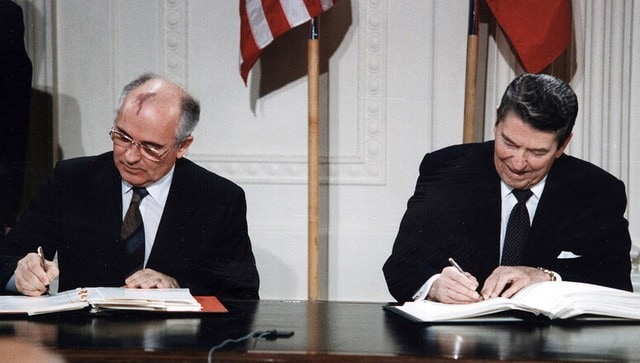
Mikhail Gorbachev and Ronald Reagan sign the INF Treaty at the White House, Washington, DC, in 1987. Image courtesy: NATO[/caption]It is considered to be a forerunner of other arms control treaties such as START I.
- It made history by among other things by
- Abolishing an entire category of nuclear weapons
- For the first time introducing extensive verification
- Data exchange mechanisms
- On-site inspections.
At the time, the treaty was criticised as it did not cover China or account for new missile technology.The central issue with the INF was that both Russia and the US had long accused the other of cheating on the treaty, which banned land-based missiles of ranges between 500 and 5,500 kilometers.The US said the noncompliant missile systems the Russians fielded gave Moscow an advantage over NATO forces in Europe.The Trump administration, which gave its six-month notice on 2 February, 2019, of its withdrawal from the INF, had repeatedly said Russia was violating its provisions.That was an accusation former president Barack Obama made as well during his time at the helm.The Obama administration in 2014 first publicly accused Moscow of violating the INF by testing a treaty-busting cruise missile.Russia had denied it has cheated, and countered with the contention that America’s armed drones and missile defence system in Europe are violations.US military officials said at the time that 95 per cent of China’s ballistic and cruise missiles would have violated the treaty.“The United States will not remain party to a treaty that is deliberately violated by Russia,” then secretary of state Mike Pompeo announcing the formal withdrawal, calling a Russian missile system prohibited under the agreement a “direct threat to the United States and our allies.”The end of the INF was yet another milestone in the deterioration of relations between the US and Russia.With inputs from agenciesRead all the Latest News, Trending News, Cricket News, Bollywood News,India News and Entertainment News here. Follow us on Facebook, Twitter and Instagram.
First Published:Feb 03, 2023, 08:16:18 IST
Advertisement
Advertisement

Delhi Police asks personnel to wear uniform: What the law says on cops in plainclothes during protests
The Delhi Police has instructed all its personnel to wear uniforms when they report for duty at Jantar Mantar for crowd control. This comes after outrage grew over videos of men in civilian clothes or without name tags hitting protesters in the Capital. Is it legal for the police to ditch uniforms during protests?
4 min read
Military drones & police check-ups: How Sri Lanka is fighting against worst dengue outbreak in a decade
Sri Lanka is fighting its most severe dengue outbreak in nearly a decade, with infections rising sharply across the nation. Military drones have been deployed to tackle the outbreak, which has claimed 56 lives. Health officials said the outbreak is being driven primarily by the DENV-2 variant of the virus
3 min read
How Facebook job ad lured 2 Karnataka men into Myanmar cyber scam camp
The Karnataka Cyber Command has rescued two youths from a scam compound in Myanmar operated by Chinese fraudsters. The duo from Karnataka were lured on the pretext of data-entry jobs. They were asked to work for 16 hours a day and were expected to sleep for six hours daily
4 min read
Why is India seeing 95% cloud cover despite a Super El Niño?
India is witnessing nearly 95 per cent cloud cover despite a Super El Niño, a climate event usually linked to weaker monsoons. Regional weather systems, cyclonic circulations, the monsoon trough and moisture from two seas are temporarily overpowering one of the world's strongest climate phenomena
5 min read
What is CJP’s fourth demand to the government as protests in Delhi intensify?
The protest by the Cockroach Janta Party at Delhi’s Jantar Mantar refuses to die down. The group have made a fourth demand to the Centre, asking that no FIRs are filed against the agitators and that no legal action be taken. The government has expressed willingness to speak to the protesters, but refused to accede on the resignation of Education Minister Dharmandra Pradhan
5 min read
Advertisement
Advertisement