


Why is Trump mockingly called ‘Chuan Jianguo’, China's ‘nation builder’?
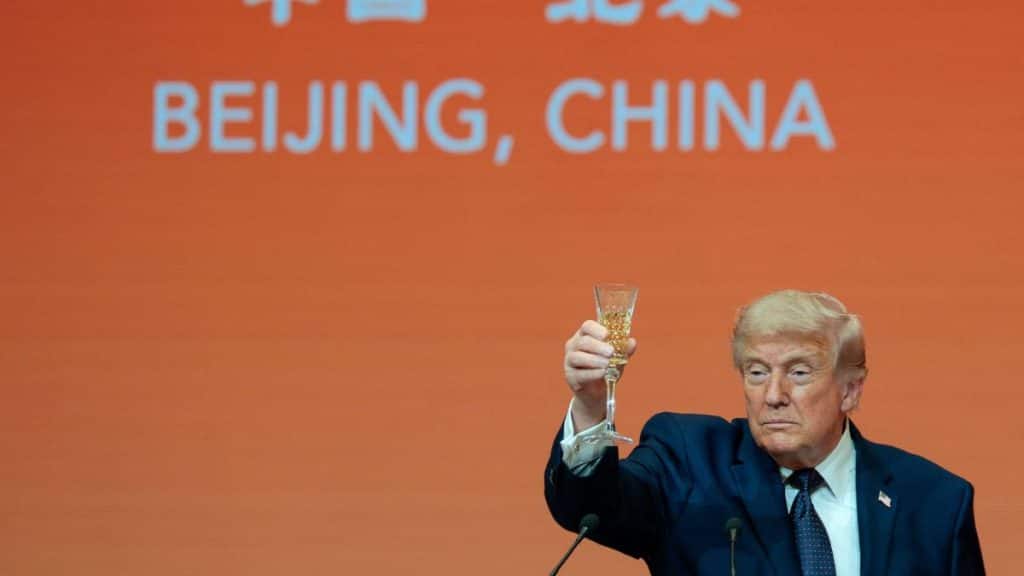
US President Donald Trump is in China on a high-stakes trip. Ahead of the visit, the mocking phrase ‘Chuan Jianguo’ began trending on Chinese social media. It means ‘Trump the national builder’. But how has the American leader helped make China great again?

United States President Donald Trump’s visit to Beijing has brought attention to a satirical nickname given to him by the Chinese. In the Asian country, the American leader is called “Chuan Jianguo”.
Ahead of Trump’s trip, the moniker began trending across Chinese social media platforms. The nickname reflects how Trump is making China great again.
We take a look.
How Chuan Jianguo came to be
US President Trump is China’s beloved Chuan Jianguo, a nickname that emerged in 2017.
Jianguo means “to build the nation”, while Chuan is Trump’s Sinicised surname. The phrase basically means "Trump the nation builder".
The moniker first surfaced nine years ago when, in an interview with The Wall Street Journal, Trump recalled a history lesson from Chinese President Xi Jinping: “He then went into the history of China and Korea. Not North Korea, Korea. And you know, you’re talking about thousands of years … And Korea actually used to be a part of China.”
 More from Explainers
These remarks by Trump generated a huge uproar in South Korea.
At the time, Trump also withdrew the US from multilateral organisations and launched a trade war with China.
These actions sparked Chinese self-reliance, especially in high tech. The US’ steep and unpredictable tariffs on China have helped drive domestic innovation across key sectors, including technology, energy, and food security.
Thus, Trump's nickname was developed as a joke. No one in China actually believes that Trump wants to benefit their country, but ends up doing it anyway.
How Trump has ‘built’ China
Many netizens in China are of the view that Trump’s divisive policies and trade wars have worked in Beijing’s favour while weakening Washington’s global stature.
The nickname for Trump suggests that the US president's foreign and domestic policies are pushing countries away from Washington and into China’s embrace.
His global tariff war strained America’s relations with many countries around the globe. Trump’s actions in Venezuela, talks of acquiring Greenland and repeatedly calling Canada the US’ “51st state” have upset and angered traditional American allies.
In January, Canada’s Prime Minister Mark Carney visited Beijing — the first by a Canadian leader in almost a decade. At the time, Carney commented that Canada's relationship with China had become "more predictable" than with the US.
Trump's "America First" approach has led to allies and rivals grappling with on-again, off-again tariffs.
Many leaders from the West, including the UK and Germany, have visited China in recent months as Trump’s foreign policy spooked the US allies. The message this sends is that world leaders are no longer interested in giving the cold shoulder to Beijing at a time of an unpredictable US under Trump.
Last year, polling showed that America’s popularity had plunged while China’s improved.
A global study by the European Council on Foreign Relations released in January this year found Beijing was seen as an ally or necessary partner by an increasing number of countries.
Whereas, in most countries, expectations of Trump were reported to be lower than 12 months ago.
"Even before Trump's dramatic intervention in Venezuela, his aggressive 'America First' approach was driving people closer to China," the study concluded.
"Paradoxically, his disavowal of the liberal international order may have given people license to build stronger links to Beijing, since they no longer feel the need to fall in line with a US-led alliance system.
"America's traditional enemies fear it less than they once did — while allies now worry about falling victim to a predatory US."
As China seeks to rival America, the Asian country has enhanced its soft power and started offering foreign tourists visa-free entry.
When Trump last visited China in 2017, he was wooed hard by Beijing, including hosting a dinner for him inside the Forbidden City. This time, Xi has the upper hand as the US president returns to a stronger and more assertive China.
"He doesn't care about the consequences at all," a middle-aged man on holiday in Chongqing told BBC about Trump. "He should know that we share the same world. It is a global village. He should not always put America first."
With inputs from agencies

Delhi Police asks personnel to wear uniform: What the law says on cops in plainclothes during protests
Military drones & police check-ups: How Sri Lanka is fighting against worst dengue outbreak in a decade
How Facebook job ad lured 2 Karnataka men into Myanmar cyber scam camp
Why is India seeing 95% cloud cover despite a Super El Niño?
What is CJP’s fourth demand to the government as protests in Delhi intensify?