


Union Budget 2023-2024: What are the new income tax slabs and how much tax will you pay?
Finance Minister Nirmala Sitharaman in her Budget 2023 speech announced changes to the tax slabs in the new regime, providing relief to the middle class. She also announced that there would be no tax on an annual income of Rs 7 lakh under this

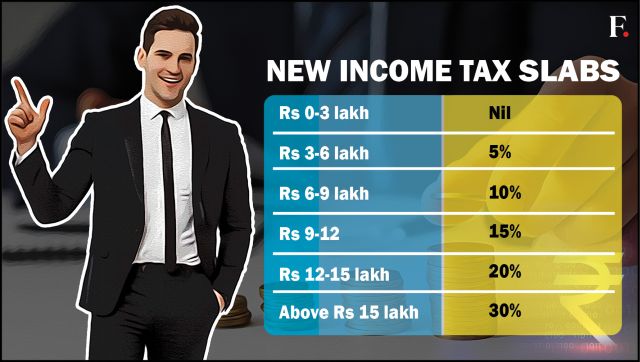
Graphic: Pranay Bhardwaj[/caption]In her speech, she explained that this would provide major relief to all taxpayers opting for the new regime. She said, “An individual with an annual income of Rs 9 lakh will now be required to pay only Rs 45,000. This is only five per cent of his or her income. It is a reduction of 25 per cent on what he or she is required to pay now, — Rs 60,000. Similarly, an individual with an income of Rs 15 lakh would be required to pay only Rs 1.5 lakh or 10 per cent of his or her income, a reduction of 20 per cent from the existing liability of Rs 1,87,500.”The idea behind the new tax slabs is to incentivise people to shift to the new tax regime, which has not seen much traction since its launch. As Shalini Jain, tax partner at EY India told Economic Times, “In line with the expectations of making the new tax regime more attractive for individuals, the finance minister has announced new income slabs bringing down the overall tax outgo for the middle-income earner group in Fy2023-2024.Finance Minister Nirmala Sitharaman also stated in her speech that the new tax regime would now become the default option for the salaried class. She, however, added that the old tax regime still remains an option for the common man.Experts reactSoon after the announcement, people were trying to understand if the new slabs would prove beneficial to them or not. One economic expert said that on first glance of the Budget, it appeared that people in lower middle-income groups would pay less tax.Ankit Jain of Ved Jain & Associates was quoted as telling The Economic Times, “The basic tax slabs have been revised, providing some relief to taxpayers, and the highest surcharge rate has been reduced to 25 per cent from 37 per cent, offering substantial relief to ultra HNIs. However, the highest tax rate remains unchanged at 30 per cent for income above Rs 15 lakh, providing those with income between Rs 15 lakh and Rs 2 crore with insignificant benefits.”Pallav Pradyumn Narang of CNK also told The Economic Times, “The finance minister has provided a shot in the arm for smaller taxpayers by increasing rebates and ensuring that there is no income tax levied up to Rs 7 lakh in income. In addition, the revised tax slabs under the new tax regime and the extension of the standard deduction will ensure that the salaries class will have a little more cash in hand this coming year to fuel consumption and or investments in India.”However, not all welcomed the move. Congress’ Gaurav Gogoi stated that the income tax rebate announced by the finance minister of up to Rs 7 lakh was “insignificant”. “Considering the inflation and price rise, it’s like a drop in the ocean for middle class,” Gogoi was quoted as saying by ANI.It is imperative to mention again that changes to the income tax slabs only apply to the new regime and not to those who opt for the old regime.
With inputs from agenciesRead all the Latest News, Trending News, Cricket News, Bollywood News,India News and Entertainment News here. Follow us on Facebook, Twitter and Instagram.
Military drones & police check-ups: How Sri Lanka is fighting against worst dengue outbreak in a decade
How Facebook job ad lured 2 Karnataka men into Myanmar cyber scam camp
Why is India seeing 95% cloud cover despite a Super El Niño?
What is CJP’s fourth demand to the government as protests in Delhi intensify?
The new geography of war: Why the Houthis can no longer be ignored