


Trump’s China visit: Is an informal 'G2' bloc in the offing?
While US President Donald Trump has repeatedly referred to the 'G2' concept over the years and has seemingly placed the United States and China on equal footing in interviews, experts are not optimistic. They say this concept fundamentally misreads China’s point of view towards global affairs

US President Donald Trump has arrived in China.
Trump is set to hold a summit with Chinese President Xi Jinping on Thursday. His visit to China is the first by a US president in 15 years. Trump’s visit has shone the spotlight on the concept of an informal ‘G2’ bloc comprising the United States and China.
Over the years, Trump has repeatedly referred to the 'G2' concept, most recently in 2025. “THE G2 WILL BE CONVENING SHORTLY!” Trump wrote on social media ahead of the meeting with Xi in Busan. Afterwards, Trump referred to the meeting – which he called “amazing” and described Xi as “a tremendous leader of a very powerful country” – as a ‘G2’ summit.
 More from Explainers
But what do we know about the concept? Could the US and China form the 'G2'?
A brief look at the 'G2' concept
As per Al Jazeera, the concept was first proposed by US economist C Fred Bergsten and strategist Zbigniew Brzezinski in 2005. The concept called for the two biggest world economies to share responsibilities for issues that affected everyone and to keep global markets steady. It became increasingly popular during the Barack Obama administration.
In 2009, the Obama administration set up the Strategic and Economic Dialogue (S&ED) with then Chinese President Hu Jintao to establish “positive, cooperative, and comprehensive” relations between the two nations. However, the concept fell away after the two countries developed a heated rivalry.
Much of this is down to China in recent years viewing the United States as a declining power. Even “a decade ago, Washington saw China as a potential co-leader in global governance. Now, the US consensus is that China is a rival, not a partner,” Hongda Fan, a professor at the Middle East Studies Institute of Shanghai International Studies University, China, wrote in a piece in The Diplomat last year. Hongda, a visiting scholar at the University of California, Berkeley, entitled the piece “From G2 to Cold War 2.0: The Changing US Attitude Toward China”.
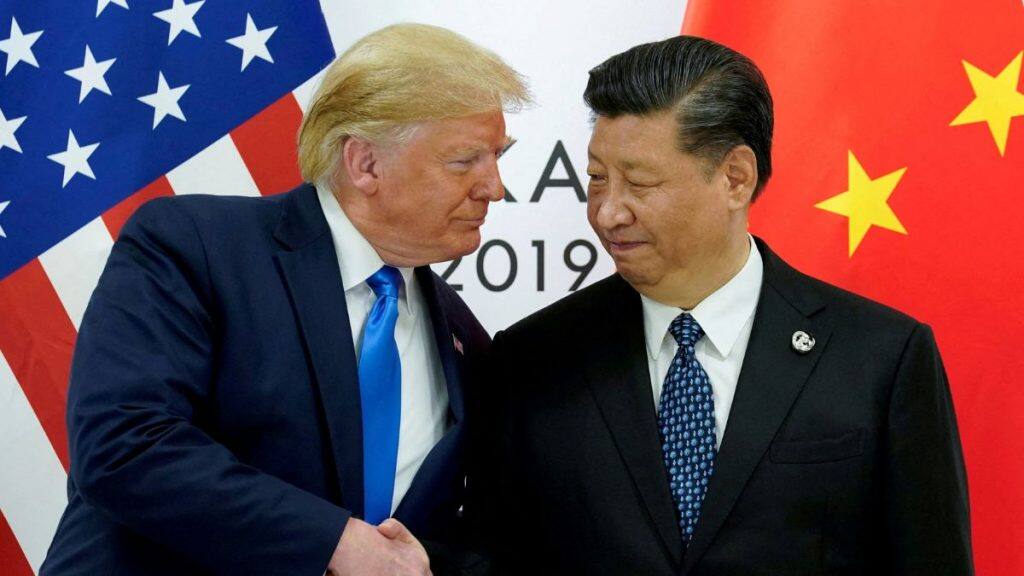
Jianlu Bi, a Beijing-based Chinese current affairs commentator, pointed out to TRT World that the 'G2' has its origins “among the US political elites” and does not echo China’s point of view. “China adheres to the vision of building a community with a shared future for mankind, advocates that countries work together to promote global governance, and promotes the construction of a more just and reasonable international order,” Bi added.
“Trump’s mention of the ‘G2’ concept indicates that he acknowledges the equal position of China and the US,” Jianlu said. “But China firmly safeguards multilateralism and advocates that global affairs should be jointly participated in by the international community, rather than being dominated by two countries,” Jianlu added.
Could it work?
Despite Trump seeming to place both the United States and China on an equal footing, most experts are not optimistic.
Jing Gu, director of the Centre for Rising Powers and Global Development at the Institute of Development Studies (IDS) in the UK, told Al Jazeera the meeting ought to be viewed as a “strategic reconnaissance”.
“Both sides are trying to read the other’s latest bottom line, clarify red lines, and test how far pressure can go before stable tension turns into rupture,” Gu said. “The purpose is not necessarily to end the contest but to understand the terrain, manage the tempo, and avoid fighting on unfavourable terms. In that sense, the visit is less about reconciliation than about preserving a controlled tension in which competition can continue without tipping into open collision.”
Steve Tsang, director of the SOAS China Institute in London, UK, added that a trade deal is possible “as both want to ensure the meeting is a success. But that’s not the same as working as 'G2', which is unlikely.”
“The basic tension is that Trump wants to reassert the US as the most powerful country, and Xi wants the same. They cannot both succeed, even if Xi only wants China to be recognised as pre-eminent rather than as the hegemon,” Tsang added.
However, others say countries will be watching closely. “I think all third countries need to watch the summit and its outcomes very, very carefully,” Wendy Cutler, former US trade negotiator, said on the Geoeconomic Competition podcast this week.
Much of Europe, in particular, remains wary of a trade alignment that could accelerate its “declining position of strength”. Transatlantic ties are already frayed by disputes over NATO, territorial claims regarding Greenland, and military aid to Ukraine. In response, EU leaders recently pledged to bolster their internal market to reduce reliance on the US for energy and on China for critical “rare-earth minerals”, over which Beijing maintains a “stranglehold”.
French President Emmanuel Macron underscored a sense of “urgency” regarding this superpower rivalry, noting that Europe is being “shaken by competition, sometimes by unfair competition and tariffs”. Meanwhile, emerging economies within the BRICS bloc also view the burgeoning US-China dynamic as a potential hurdle to their own global aspirations.
FAQs
1. What is the ‘G2’ concept?
The 'G2' refers to a proposed informal partnership between the United States and China to jointly manage global economic and political issues.
2. Why are experts sceptical about a 'G2'?
Experts believe the idea misreads China’s preference for multilateralism and ignores the strategic rivalry between the US and China.
3. Could the Trump–Xi meeting lead to a 'G2'?
While cooperation such as trade deals is possible, most analysts think a full 'G2'-style partnership is unlikely due to competing global ambitions.
With inputs from agencies

Why India may not witness a medal rush at 2026 Commonwealth Games
Delhi Police asks personnel to wear uniform: What the law says on cops in plainclothes during protests
Military drones & police check-ups: How Sri Lanka is fighting against worst dengue outbreak in a decade
How Facebook job ad lured 2 Karnataka men into Myanmar cyber scam camp
Why is India seeing 95% cloud cover despite a Super El Niño?