


Tomatoes more expensive than petrol: How viruses have destroyed the crop
Farmers in Karnataka’s Kolar are blaming the tomato leaf curl virus (ToLCV) for crop losses due to which vegetable prices have skyrocketed. While in Maharashtra, tomato growers say cucumber mosaic virus (CMV) and tomato mosaic virus (ToMV) are affecting their produce

Tomato prices have breached petrol and diesel rates in several cities across the country as they skyrocket to over Rs 100 per kilogramme. The situation is such that a farmer in Karnataka’s Hassan district alleged that her tomato produce worth Rs 2.5 lakh was stolen from her farm.
The prices of tomato, which is a major staple in the kitchen, are burning a hole in consumers’ pockets. High temperatures and delayed rainfall have hit the crop production this year. As per reports, farmers in Karnataka’s Kolar are also blaming the tomato leaf curl virus (ToLCV) for a drop in the yield and a surge in the vegetable rates.
According to Indian Express, farmers in Maharashtra say the cucumber mosaic virus (CMV) has harmed their tomato produce, while some in Karnataka and other southern states believe the tomato mosaic virus (ToMV) has led to crop loss.
Let’s take a closer look at these viruses and how they impact crop production.
 More from Explainers
Tomato leaf curl virus
Transmitted by whitefly Bemisia tabaci, the ToLCV is a plant virus that infects tomatoes. It can affect plants at any stage of growth but they are mostly vulnerable when they are young, according to a Science Direct article.
The symptoms of the infected tomato plants include dwarfed and deformed leaves which are curled upwards and have yellow margins. “This disease affects the fruit formation as well as growth, and the infection shows more prominently once the plant is mature,” as per Science Direct.
CMV and ToMV
Tomato plants infected with CMV are yellow, bushy and have a stunted growth initially. According to the American Phytopathological Society (APS), the most common symptom these infected plants exhibit is shoestring-like leaf blades.
The leaves may have mottle similar to that brought on by the tomato mosaic virus.
Other CMV hosts include cucumber, melon, eggplant, carrot, lettuce, celery, beams and cucurbits – squash, pumpkin, zucchini and other members of the gourd family.

According to a Michigan State University article, this virus is spread by several aphid vectors. Aphids are sap-sucking and soft-bodied insects that transmit the virus by feeding on plant tissues.
In ToMV-infected tomato plants, the most common symptom is mottled light and dark green patterns on the leaves.
Sometimes yellow rings or brown sunken lesions can appear on the ripe fruit, while the leaves of the infected plant will be misshapen. The plant will have a yellowish hue and stunted growth.
As per Indian Express, ToMV can also infect tobacco, peppers, and some ornamental plants. It is mostly transmitted through infected seeds, saplings, agricultural tools and human activities.
ALSO READ: Tomatoes at Rs 100 per kg: What’s behind the price hike?
Viruses impact tomato cultivation in India
Farmers say their yield has dropped due to the tomato leaf curl virus which has affected the crop in Kolar and neighbouring tomato-producing districts in Karnataka, as per the Deccan Herald (DH) report.
A report by ICAR-IIHR scientists has confirmed that more than half of the tomatoes in Kolar’s villages were infected with tomato leaf curl disease, the report added.
The Kolar Agricultural Produce Market Committee (APMC), which becomes a major supplier of tomatoes across the country from June to September, told DH that it has received only 3.2 lakh quintals of the crop this June, as compared to 5.45 lakh quintals in the same month last year.
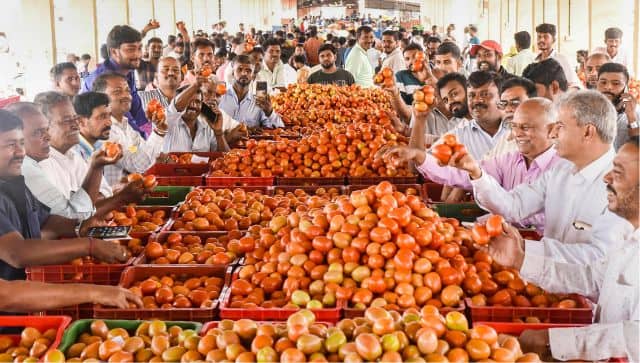
Vijayalakshmi N, the Kolar APMC secretary, told News18 that there is a fall in the arrival of tomatoes. “If there are 100 boxes of the tomato yield that we receive at the APMC yard, we get only 30 boxes today. If the yield is low, then it drives the prices up. That is why the prices have been escalating. At present, in the Kolar region, the farmlands are highly affected by the whitefly and leaf curl disease. This affects the tomato crop in the begging stage itself and does not allow it to flower or bear the tomato fruit. It also spreads through the air,” she explained.
ALSO READ: Tamil Nadu Govt initiates tomato sales via fair price shops to counterbalance soaring prices
This year, the quality of the fruit is also not up to the mark. “We are not getting quality fruits that meet three important parameters — size, colour and firmness. Previously, we used to supply 2.5-3 lakh boxes every day in June,” the secretary of Kolar APMC was quoted as saying by DH. The situation could worsen as standing crops are declining and it takes 70-100 days to harvest tomatoes, as per the report.
Meanwhile, ToMV can spread through the hands of nursery workers if they fail to properly sanitise themselves before going to the field, as per the Indian Express report. Farmers in Maharashtra have put the onus on seed manufacturers and nurseries for the transmission of this virus, the report added.
“Seed treatment at the nursery is necessary to prevent future spread of the virus,” Dr M Krishna Reddy, a former head of crop protection at Indian Institute of Horticulture (IIHR), Bengaluru, told Indian Express. The expert advised maintaining biosafety at nurseries and adopting mandatory seed treatment to control the spread of the virus.
With inputs from agencies

Military drones & police check-ups: How Sri Lanka is fighting against worst dengue outbreak in a decade
How Facebook job ad lured 2 Karnataka men into Myanmar cyber scam camp
Why is India seeing 95% cloud cover despite a Super El Niño?
What is CJP’s fourth demand to the government as protests in Delhi intensify?
The new geography of war: Why the Houthis can no longer be ignored