
Advertisement


Sections
The People's Man? Why Russian president Vladimir Putin is wooing the crowds
Russian president Vladimir Putin is newly out and about in a bid to show that his years of pandemic-induced isolation are over. He aims to demonstrate that the people still back him despite the war in Ukraine and a failed mutiny against his government

He worked a throng of screaming fans in Dagestan. He hoisted a young girl onto his hip in Kronstadt. He posed shoulder-to-shoulder with seven young siblings, shaking their father’s hand after a naval parade.President Vladimir Putin of Russia is newly out and about, pressing the flesh of the Russian people, in a bid to demonstrate that his years of pandemic-induced isolation are over and that his public support remains strong despite the war in Ukraine and a failed mutiny against his government.His behaviour is a noticeable change for the Russian president, who cultivated extreme seclusion during the pandemic, forcing visiting leaders to sit at the opposite end of giant oblong tables and requiring people to quarantine for up to two weeks to see him.The isolation persisted until well after politicians elsewhere had dispensed with such precautions amid receding fears about COVID-19. And once Russia invaded Ukraine, Putin’s distance stood in stark contrast to President Volodymyr Zelenskyy of Ukraine, who made regular visits to front-line positions, crowded ceremonies and cramped hospital rooms.Though many precautions remain in place, and Putin hardly rivals President Joe Biden on an Iowa rope line, the Russian leader is noticeably interacting with crowds in orchestrated appearances — portraying himself as in touch and in charge after the rebellion by the Wagner private militia suggested that he was neither.“What about the quarantine?” a journalist called out to Putin last month as the Russian leader worked a crowd in Kronstadt.![]() Russian president Vladimir Putin meet with people following an annual parade marking Navy Day in Saint Petersburg, Russia. Reuters[/caption]Days after Prigozhin’s uprising, Putin travelled to Derbent, a city in Russia’s southern Dagestan region, and appeared before a crowd screaming with delight — a boisterous encounter the likes of which Russia had not seen from its leader in years.His spokesperson, Dmitry Peskov, later said that Putin had gone against the “strong recommendations from experts” and made a “firm decision” to interact with the crowd, because “he couldn’t refuse these people and not greet them.”Tatiana Stanovaya, a senior fellow at the Carnegie Russia Eurasia Centre, said the decision to work the crowd was almost certainly Putin’s personal choice — designed in part to send the message to Russia’s elite that he maintains the adoration of the nation’s public.“Prigozhin’s rebellion — that was the strongest blow to the legitimacy of the leadership,” Stanovaya said. “And where does legitimacy come from? From the people. Therefore, the desire to throw oneself into the people and feel you are supported, it’s the kind of need that arises against the backdrop of a rebellion.”Putin’s appearances with crowds have continued in the days since.On 23 July, he took Belarusian president Alexander Lukashenko to Kronstadt, a city on an island outside St. Petersburg known for its early-20th-Century history of mutinies. The two leaders mingled with a crowd outside a cathedral, where Putin stood between a bride and groom. He lifted a smiling girl with pink sunglasses on her head.[caption id="attachment_12966682" align="alignnone" width="640"]
Russian president Vladimir Putin meet with people following an annual parade marking Navy Day in Saint Petersburg, Russia. Reuters[/caption]Days after Prigozhin’s uprising, Putin travelled to Derbent, a city in Russia’s southern Dagestan region, and appeared before a crowd screaming with delight — a boisterous encounter the likes of which Russia had not seen from its leader in years.His spokesperson, Dmitry Peskov, later said that Putin had gone against the “strong recommendations from experts” and made a “firm decision” to interact with the crowd, because “he couldn’t refuse these people and not greet them.”Tatiana Stanovaya, a senior fellow at the Carnegie Russia Eurasia Centre, said the decision to work the crowd was almost certainly Putin’s personal choice — designed in part to send the message to Russia’s elite that he maintains the adoration of the nation’s public.“Prigozhin’s rebellion — that was the strongest blow to the legitimacy of the leadership,” Stanovaya said. “And where does legitimacy come from? From the people. Therefore, the desire to throw oneself into the people and feel you are supported, it’s the kind of need that arises against the backdrop of a rebellion.”Putin’s appearances with crowds have continued in the days since.On 23 July, he took Belarusian president Alexander Lukashenko to Kronstadt, a city on an island outside St. Petersburg known for its early-20th-Century history of mutinies. The two leaders mingled with a crowd outside a cathedral, where Putin stood between a bride and groom. He lifted a smiling girl with pink sunglasses on her head.[caption id="attachment_12966682" align="alignnone" width="640"]![]() Russian president Vladimir Putin and Belarusian president Alexander Lukashenko meet people outside the Naval Cathedral of St. Nicholas in Kronstadt. Reuters[/caption]Days later, Putin hosted top African leaders in St. Petersburg, his home city.If the summit, with its limited roster of African heads of state, failed to solve Russia’s geopolitical isolation, it did address the enduring images of Putin’s physical isolation. In a marathon of photo ops, meetings and excursions, he had perhaps more sustained personal contact than at any time since before the pandemic, certainly with international officials.Putin glad-handed African leaders of all levels as well as their spouses, hosted a gala dinner and entertained some officials who stayed on for Russia’s traditional Navy Day parade of warships on the Neva River. He returned to Kronstadt flanked by Russian defence officials and African leaders on a crowded boat.On the sidelines of the naval parade, he greeted the Gorelov family from Magadan, in Russia’s far east. The parents a day earlier had received the Order of Parental Glory for raising 10 children, part of a long-running Russian state effort to combat demographic decline by promoting “multi-child families.”Putin slipped in between the seven children the Gorelovs had brought for a photograph.In recent days, Putin has alternated between appearances that address the war and interactions with crowds that seem designed to communicate normalcy and demonstrate that he broadly retains the population’s loyalty, even as the war causes continued hardship that has fuelled discontent for many Russians.On Wednesday, he appeared before widows whose husbands had died in the war, brushing his hand over the head of a fallen soldier’s young daughter and patting the shoulder of the boy next to her.By the standards of most world politicians, Putin’s encounters with crowds are still limited. Zelenskyy, by comparison, follows a schedule packed with public interactions. A busy American presidential candidate might interact with more public crowds in a week than Putin has in the past year.
Russian president Vladimir Putin and Belarusian president Alexander Lukashenko meet people outside the Naval Cathedral of St. Nicholas in Kronstadt. Reuters[/caption]Days later, Putin hosted top African leaders in St. Petersburg, his home city.If the summit, with its limited roster of African heads of state, failed to solve Russia’s geopolitical isolation, it did address the enduring images of Putin’s physical isolation. In a marathon of photo ops, meetings and excursions, he had perhaps more sustained personal contact than at any time since before the pandemic, certainly with international officials.Putin glad-handed African leaders of all levels as well as their spouses, hosted a gala dinner and entertained some officials who stayed on for Russia’s traditional Navy Day parade of warships on the Neva River. He returned to Kronstadt flanked by Russian defence officials and African leaders on a crowded boat.On the sidelines of the naval parade, he greeted the Gorelov family from Magadan, in Russia’s far east. The parents a day earlier had received the Order of Parental Glory for raising 10 children, part of a long-running Russian state effort to combat demographic decline by promoting “multi-child families.”Putin slipped in between the seven children the Gorelovs had brought for a photograph.In recent days, Putin has alternated between appearances that address the war and interactions with crowds that seem designed to communicate normalcy and demonstrate that he broadly retains the population’s loyalty, even as the war causes continued hardship that has fuelled discontent for many Russians.On Wednesday, he appeared before widows whose husbands had died in the war, brushing his hand over the head of a fallen soldier’s young daughter and patting the shoulder of the boy next to her.By the standards of most world politicians, Putin’s encounters with crowds are still limited. Zelenskyy, by comparison, follows a schedule packed with public interactions. A busy American presidential candidate might interact with more public crowds in a week than Putin has in the past year.
“The people are more important than quarantine,” Putin shot back.Putin has long loathed populist retail politics, deriding the sort of baby kissing required of American politicians campaigning for office as frivolous and vulgar.His attempts at impromptu interaction with the Russian populace over the years have often come off as wooden or peculiar, such as when he lifted the shirt of a young boy and kissed his belly in a 2006 appearance at the Kremlin. (Putin later said he had wanted to cuddle him like a kitten, a discordant image for a former KGB lieutenant colonel.)The Russian leader has preferred more controlled events, often inspecting production facilities and meeting with worker collectives, holding court over subordinate officials, presiding over military ceremonies or cutting the image of a rugged outdoorsman in carefully orchestrated publicity stunts, sometimes with animals.Much of that active image fell away with the pandemic, when Putin began to come across as more of a withdrawn autocrat — beaming in from behind a desk over a flat screen, at one point to launch an ill-planned war.But an aborted 24 June mutiny by Yevgeny Prigozhin, the mercenary tycoon, seems to have changed the calculation for the Russian leader.[caption id="attachment_12966672" align="alignnone" width="640"]
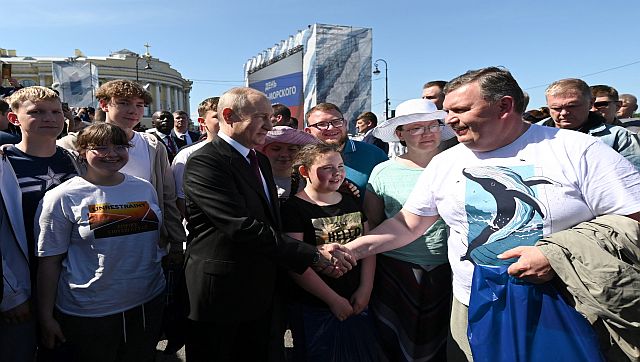 Russian president Vladimir Putin meet with people following an annual parade marking Navy Day in Saint Petersburg, Russia. Reuters[/caption]Days after Prigozhin’s uprising, Putin travelled to Derbent, a city in Russia’s southern Dagestan region, and appeared before a crowd screaming with delight — a boisterous encounter the likes of which Russia had not seen from its leader in years.His spokesperson, Dmitry Peskov, later said that Putin had gone against the “strong recommendations from experts” and made a “firm decision” to interact with the crowd, because “he couldn’t refuse these people and not greet them.”Tatiana Stanovaya, a senior fellow at the Carnegie Russia Eurasia Centre, said the decision to work the crowd was almost certainly Putin’s personal choice — designed in part to send the message to Russia’s elite that he maintains the adoration of the nation’s public.“Prigozhin’s rebellion — that was the strongest blow to the legitimacy of the leadership,” Stanovaya said. “And where does legitimacy come from? From the people. Therefore, the desire to throw oneself into the people and feel you are supported, it’s the kind of need that arises against the backdrop of a rebellion.”Putin’s appearances with crowds have continued in the days since.On 23 July, he took Belarusian president Alexander Lukashenko to Kronstadt, a city on an island outside St. Petersburg known for its early-20th-Century history of mutinies. The two leaders mingled with a crowd outside a cathedral, where Putin stood between a bride and groom. He lifted a smiling girl with pink sunglasses on her head.[caption id="attachment_12966682" align="alignnone" width="640"]
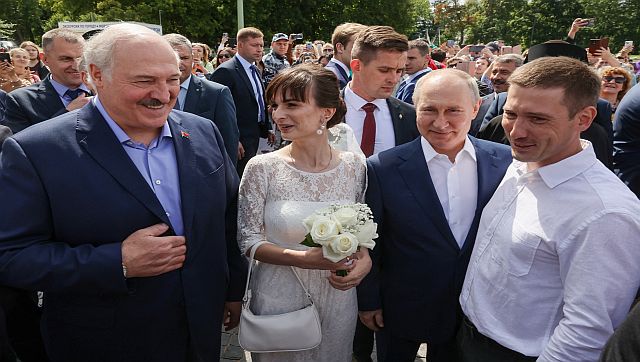 Russian president Vladimir Putin and Belarusian president Alexander Lukashenko meet people outside the Naval Cathedral of St. Nicholas in Kronstadt. Reuters[/caption]Days later, Putin hosted top African leaders in St. Petersburg, his home city.If the summit, with its limited roster of African heads of state, failed to solve Russia’s geopolitical isolation, it did address the enduring images of Putin’s physical isolation. In a marathon of photo ops, meetings and excursions, he had perhaps more sustained personal contact than at any time since before the pandemic, certainly with international officials.Putin glad-handed African leaders of all levels as well as their spouses, hosted a gala dinner and entertained some officials who stayed on for Russia’s traditional Navy Day parade of warships on the Neva River. He returned to Kronstadt flanked by Russian defence officials and African leaders on a crowded boat.On the sidelines of the naval parade, he greeted the Gorelov family from Magadan, in Russia’s far east. The parents a day earlier had received the Order of Parental Glory for raising 10 children, part of a long-running Russian state effort to combat demographic decline by promoting “multi-child families.”Putin slipped in between the seven children the Gorelovs had brought for a photograph.In recent days, Putin has alternated between appearances that address the war and interactions with crowds that seem designed to communicate normalcy and demonstrate that he broadly retains the population’s loyalty, even as the war causes continued hardship that has fuelled discontent for many Russians.On Wednesday, he appeared before widows whose husbands had died in the war, brushing his hand over the head of a fallen soldier’s young daughter and patting the shoulder of the boy next to her.By the standards of most world politicians, Putin’s encounters with crowds are still limited. Zelenskyy, by comparison, follows a schedule packed with public interactions. A busy American presidential candidate might interact with more public crowds in a week than Putin has in the past year.
But by the Russian leader’s recent standards, the change is noticeable.Sam Greene, director for democratic resilience at the Centre for European Policy Analysis in Washington, said Putin might be ramping up his public activity before the presidential election next March. It will be the Russian leader’s fifth, though he has yet to announce his candidacy officially.With a system that has neutralised competitors over the years, Putin will undoubtedly win, but the Kremlin will still monitor turnout and victory margins — as will the Russian elite Putin must keep on side.“You’ve got all of these oligarchs and people throughout the system who are rich and powerful and unaccountable — and that is all made possible by the fact that you’ve got somebody up on the stage who is keeping the show going,” Greene said. “He needs to communicate to the elite that not only is he good at doing that — but it’s not even close.”Paul Sonne, c.2023 The New York Times Company
First Published:Aug 07, 2023, 11:31:50 IST
Advertisement
Advertisement

Military drones & police check-ups: How Sri Lanka is fighting against worst dengue outbreak in a decade
Sri Lanka is fighting its most severe dengue outbreak in nearly a decade, with infections rising sharply across the nation. Military drones have been deployed to tackle the outbreak, which has claimed 56 lives. Health officials said the outbreak is being driven primarily by the DENV-2 variant of the virus
3 min read
How Facebook job ad lured 2 Karnataka men into Myanmar cyber scam camp
The Karnataka Cyber Command has rescued two youths from a scam compound in Myanmar operated by Chinese fraudsters. The duo from Karnataka were lured on the pretext of data-entry jobs. They were asked to work for 16 hours a day and were expected to sleep for six hours daily
4 min read
Why is India seeing 95% cloud cover despite a Super El Niño?
India is witnessing nearly 95 per cent cloud cover despite a Super El Niño, a climate event usually linked to weaker monsoons. Regional weather systems, cyclonic circulations, the monsoon trough and moisture from two seas are temporarily overpowering one of the world's strongest climate phenomena
5 min read
What is CJP’s fourth demand to the government as protests in Delhi intensify?
The protest by the Cockroach Janta Party at Delhi’s Jantar Mantar refuses to die down. The group have made a fourth demand to the Centre, asking that no FIRs are filed against the agitators and that no legal action be taken. The government has expressed willingness to speak to the protesters, but refused to accede on the resignation of Education Minister Dharmandra Pradhan
5 min read
The new geography of war: Why the Houthis can no longer be ignored
The rise of the Houthis marks the emergence of a new geography of war — one in which influence flows not only from capitals and conventional armies, but also from rugged mountains overlooking vital sea lanes
6 min read
Advertisement
Advertisement