


SpaceX’s second test flight for Starship rocket on Friday: What to expect
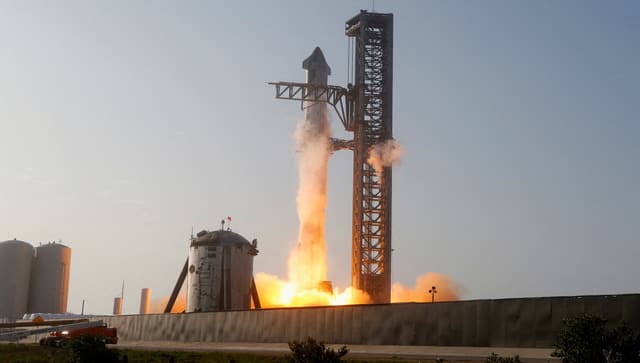
Standing nearly 400-feet tall, Starship – the most powerful rocket ever built – will take its second test flight on 17 November at SpaceX’s facility Starbase in Texas. The maiden liftoff of the launch vehicle in April had resulted in a fiery explosion

Elon Musk’s SpaceX will attempt a second test flight for its huge Starship rocket on Friday (17 November). The liftoff will take place during a two-hour window starting from 6:30 pm IST from Starbase, SpaceX’s facility in Boca Chica, Texas.
“Residents of Cameron County and those in the nearby area may hear a loud noise resulting from the rocket’s 33 Raptor engines firing upon ignition and as the vehicle launches toward space, but what people experience will depend on weather and other conditions,” NBC News quoted the American spacecraft manufacturer as saying.
The second test flight comes after clearance from the US Federal Aviation Administration (FAA) after it determined that Musk’s company “met all safety, environmental, policy and financial responsibility requirements.”
Let’s take a closer look at the development.
Starship's second test flight
Nearly 400 feet tall, Starship is touted as the most powerful rocket ever built. If everything goes as planned, the mega rocket will fly for 90 minutes after launch before its vertical descent into the Pacific Ocean.
 More from Explainers
The second flight will “debut a hot-stage separation system and a new electronic Thrust Vector Control (TVC) system for Super Heavy Raptor engines, in addition to reinforcements to the pad foundation and a water-cooled steel flame deflector, among many other enhancements,” The Verge reported citing SpaceX.
How will it work?
At about 6.10 pm IST, the 39 Raptor engines, 33 on the Super Heavy first stage and six on the upper-stage spacecraft, will “chill” ahead of ignitition, according to a report in Space.com.
“This process is crucial for conditioning the engines to handle the super-cold propellants during ignition and flight,” reported Gizmodo.
The newly put water deluge system will be activated ten seconds before the launch. This water-spraying steel plate aims to protect Starbase's orbital launch mount from damage by the Super Heavy Raptor engines.
Around 2 minutes and 30 seconds into the liftoff, the stage of Most Engines Cut Off will occur where it is expected that the majority of the Raptor engines will shut down, as per the Gizmodo report.
The boostback burn startup will kickstart its flip maneouvre at 2 minutes and 53 seconds, making its rapid descent back to the Earth. The booster is expected to land in the Gulf of Mexico around seven minutes into the flight.
During hot staging, Starship's two stages will separate two minutes and 41 seconds into the flight, with the upper stage continuing its upward and eastward flight. It will fly over the Caribbean, southern Africa, the Indian Ocean, and New Guinea, before the planned splashdown in the Pacific near Hawaii, Gizmodo reported.
ALSO READ: Why SpaceX called off the launch of Starship, the most powerful rocket ever built
What went wrong with the first launch
The maiden test flight of the huge Starship rocket in April resulted in a fiery explosion just a few minutes into the liftoff.
Starship's two stages failed to separate, forcing SpaceX to intentionally explode the vehicle four minutes after its launch, as per Space.com. The rocket had not responded quickly to the self-destruct command. This has also been revised for the second flight.
Citing SpaceX’s findings in September, The Verge reported that the leaking propellant from the Super Heavy booster was responsible for the failure of the first test flight, having “severed connection with the vehicle’s primary flight computer.”
The damage to the surrounding areas caused by the rocket was criticised by environmental activists and locals near the Starbase facility in Boca Chica. As per Gizmodo, the 8-second-long firing sequence and the force of 33 Raptor engines had torn up the area beneath the launch mount, sending the debris to nearby places. The water deluge system has been developed to tackle this problem.
Later, the US Fish and Wildlife Service carried out an investigation at the site, leading to a safety review. The FAA recommended 63 actions that the company needed to implement at the launch site and on the Starship. The second test flight is taking place after the final clearance.
This is a highly important mission for Musk’s SpaceX which aims to send the Starship rocket – evolving it into a fully reusable launch and landing system – to more ambitious missions to the Moon and Mars in the future.
With inputs from agencies

Why India may not witness a medal rush at 2026 Commonwealth Games
Delhi Police asks personnel to wear uniform: What the law says on cops in plainclothes during protests
Military drones & police check-ups: How Sri Lanka is fighting against worst dengue outbreak in a decade
How Facebook job ad lured 2 Karnataka men into Myanmar cyber scam camp
Why is India seeing 95% cloud cover despite a Super El Niño?