
Advertisement


Sections
Singapore executes second man in 3 weeks over cannabis: Countries with the harshest drug penalties
Singapore has executed a second man in three weeks for cannabis trafficking, inviting the ire of human rights activists across the world. However, the city-state isn’t the only one with harsh laws on drug-related crimes. Countries like China, Malaysia and even Iran have zero tolerance for drugs

There are countries across the world that are changing their attitude towards marijuana and drug use. However, the same can’t be said of Singapore. On Wednesday, the city-state hanged a man for trafficking drugs, the second such incident in a short span of three weeks.The action comes even as international groups and activists within the country decry the strict death penalty. The United Nations, British mogul Richard Branson, have urged Singapore to halt executions for drug-related offenses as increasing evidence shows the death penalty is ineffective as a deterrent. But Singapore authorities insist that all prisoners get due process of law and that capital punishment remains “part of Singapore’s comprehensive harm prevention strategy which targets both drug demand and supply.”Here’s a look at how strict are Singapore’s laws on drug offences and where it stands compared to other countries.Singapore, death penalty & drug offencesOn Wednesday, Singapore hanged a 36-year-old man at Changi Prison on the island’s east coast at dawn after a last-minute attempt to reopen his case was rejected by the appeal court without a hearing.The man, whose name was not revealed, was convicted in 2019 of trafficking about 1.5 kilogrammes of cannabis, according to Kokila Annamalai of the Transformative Justice Collective that campaigns for the abolition of the death penalty in Singapore.In a statement, the Singapore authorities said, “A 36-year-old Singaporean man had his capital sentence carried out today at Changi Prison Complex. The person was accorded full due process under the law, and had access to legal counsel throughout the process.”This was the second execution carried out by Singapore in three weeks’ time. Earlier, on 26 April, Singapore hanged a 46-year-old Indian-origin for conspiracy to smuggle one kilo cannabis. It was found that Tangaraju Suppiah was involved in a conspiracy to traffic the cannabis from Malaysia to Singapore. The court found he was in phone communication with two other men caught trying to smuggle cannabis into Singapore.Suppiah’s family and rights groups took up his cause rejecting the government’s claims of justice being accorded and detailed why they believed his death sentence conviction was unsafe. “Tangaraju’s conviction relied mainly on statements from his police interrogation – taken without a lawyer and interpreter present – and the testimony of his two co-accused, one of which had his charges dismissed,” Amnesty International said.[caption id="attachment_12614172" align="alignnone" width="640"]![]() Leelavathy Suppiah (left), sister of a Tangaraju Suppiah, who was executed, in Singapore. The family had pleaded for clemency from the authorities but to no avail. File image/AFP[/caption]Leelavathy spoke of her brother’s anguish and determination before his death sentence was carried out. “Even from inside prison, he wanted to fight for his innocence,” she told CNN. “He believed that there would be a fair trial and wanted to prove his innocence – every step of the way.”Suppiah’s execution attracted a lot of criticism from around the world. The UN strongly condemned the hangings in April this year, calling the number of such punishments “highly alarming”.Singapore’s strict laws relating to drug offences have come under the spotlight recently. The city-state executed 11 people last year for drug offences after a two-year hiatus due to the COVID-19 pandemic.The authorities argue that such strict laws are necessary due to its proximity to the Golden Triangle — the area comprising parts of Myanmar, Laos, and Vietnam, historically known for the narcotics trade. “As a key commercial and transport hub, Singapore is vulnerable to the scourge of drugs, both as a transit point and as an import market for illicit drugs,” says the background document provided to TIME magazine by the Singapore government.Countries with strictest drug laws However, Singapore is not alone in having harsh punishments for drug-related crimes. A report by Harm Reduction International (HRI) reveals that it is one of just 35 countries that maintain the death penalty for drug offences and one of only eight in the world to regularly hand out such a sentence.The report reveals that in 2022 there were at least 285 executions for drugs, more than double the number of the previous year, when at least 131 people were executed. The number of death sentences handed out to those found guilty of drug crimes also rose, the report said, with at least 303 people in 18 countries sentenced to death. That was 28 per cent more than in 2021. More than 3,700 people on death row around the world are now there as a result of drug offences, it added.[caption id="attachment_12614212" align="alignnone" width="640"]
Leelavathy Suppiah (left), sister of a Tangaraju Suppiah, who was executed, in Singapore. The family had pleaded for clemency from the authorities but to no avail. File image/AFP[/caption]Leelavathy spoke of her brother’s anguish and determination before his death sentence was carried out. “Even from inside prison, he wanted to fight for his innocence,” she told CNN. “He believed that there would be a fair trial and wanted to prove his innocence – every step of the way.”Suppiah’s execution attracted a lot of criticism from around the world. The UN strongly condemned the hangings in April this year, calling the number of such punishments “highly alarming”.Singapore’s strict laws relating to drug offences have come under the spotlight recently. The city-state executed 11 people last year for drug offences after a two-year hiatus due to the COVID-19 pandemic.The authorities argue that such strict laws are necessary due to its proximity to the Golden Triangle — the area comprising parts of Myanmar, Laos, and Vietnam, historically known for the narcotics trade. “As a key commercial and transport hub, Singapore is vulnerable to the scourge of drugs, both as a transit point and as an import market for illicit drugs,” says the background document provided to TIME magazine by the Singapore government.Countries with strictest drug laws However, Singapore is not alone in having harsh punishments for drug-related crimes. A report by Harm Reduction International (HRI) reveals that it is one of just 35 countries that maintain the death penalty for drug offences and one of only eight in the world to regularly hand out such a sentence.The report reveals that in 2022 there were at least 285 executions for drugs, more than double the number of the previous year, when at least 131 people were executed. The number of death sentences handed out to those found guilty of drug crimes also rose, the report said, with at least 303 people in 18 countries sentenced to death. That was 28 per cent more than in 2021. More than 3,700 people on death row around the world are now there as a result of drug offences, it added.[caption id="attachment_12614212" align="alignnone" width="640"]![]() Graphic: Pranay Bhardwaj[/caption]So, which countries join Singapore? Singapore’s neighbour Malaysia has similar rules when it comes to drug-related crimes. In Malaysia if you are caught with more than 15 grams of heroin, you can receive a death sentence. Additionally, authorities can also detain anyone for up to two weeks on suspicion of drug use and forcibly test them for any traces of illegal drugs in their system. Those who test positive are automatically sentenced to a minimum of one year of compulsory treatment, even if they’re not caught with any drugs on them at the time.Indonesia is another South-east Asian nation with very strict rules. Possession, trafficking and manufacture of any illegal drugs are serious offences in Indonesia. The Indonesian authorities have a zero-tolerance policy and those caught face lengthy prison sentences or the death penalty. HRI revealed that the country had sentenced 122 people to death last year, a jump from the 89 in the preceding year.China too has very strict laws on drugs. In accordance with Chinese drug laws, anyone caught trying to smuggle a kilo or more of heroin into the country could face the death penalty. And the same fate could befall anyone found carrying more than 50 grams of other narcotics, including cocaine, opium, and cannabis.Japan is another Asian nation which has some of the strictest drug laws. The country also has strict controls on prescription drugs and requires travellers to declare any medication they are bringing into the country.The small, oil-rich nation of Brunei has come under fire for using caning as a punishment for drug offences. Possession of drugs can result in long-term prison sentences and even the death penalty.[caption id="attachment_12614222" align="alignnone" width="640"]
Graphic: Pranay Bhardwaj[/caption]So, which countries join Singapore? Singapore’s neighbour Malaysia has similar rules when it comes to drug-related crimes. In Malaysia if you are caught with more than 15 grams of heroin, you can receive a death sentence. Additionally, authorities can also detain anyone for up to two weeks on suspicion of drug use and forcibly test them for any traces of illegal drugs in their system. Those who test positive are automatically sentenced to a minimum of one year of compulsory treatment, even if they’re not caught with any drugs on them at the time.Indonesia is another South-east Asian nation with very strict rules. Possession, trafficking and manufacture of any illegal drugs are serious offences in Indonesia. The Indonesian authorities have a zero-tolerance policy and those caught face lengthy prison sentences or the death penalty. HRI revealed that the country had sentenced 122 people to death last year, a jump from the 89 in the preceding year.China too has very strict laws on drugs. In accordance with Chinese drug laws, anyone caught trying to smuggle a kilo or more of heroin into the country could face the death penalty. And the same fate could befall anyone found carrying more than 50 grams of other narcotics, including cocaine, opium, and cannabis.Japan is another Asian nation which has some of the strictest drug laws. The country also has strict controls on prescription drugs and requires travellers to declare any medication they are bringing into the country.The small, oil-rich nation of Brunei has come under fire for using caning as a punishment for drug offences. Possession of drugs can result in long-term prison sentences and even the death penalty.[caption id="attachment_12614222" align="alignnone" width="640"]![]() An Indonesian National Narcotics Agency (BNN) officer destroys marijuana plantations during a raid at Indrapuri forest line in Aceh province in February. Possession, trafficking and manufacture of illegal drugs is a serious offence in Indonesia. File image/AFP[/caption]Outside of Asia, Iran, perhaps, has the strictest laws when it comes to drug offences. The HRI report revealed that the nation had executed at least 252 people last year for drug-related crimes. Despite the high rate of executions and strict laws, Iran continues to have a problem of drug addiction in the country. In 2016, the country had a reported two million addicts. Experts state that its proximity to Afghanistan where opium is grown is one of the reasons for the high rate of addiction in Iran.In Saudi Arabia, the situation is no different. The country has a zero-tolerance policy towards drug use, and offences such as possession and trafficking are punishable by jail time, public flogging, and in some cases, the death penalty. In November last year, the Kingdom had executed two Pakistani nationals for drug-related crimes, a first since it had announced a moratorium on the use of the death penalty for drug-related crimes in January 2021. Amnesty International condemned the executions then and said, “The lives of individuals on death row for drug-related crimes and other crimes are at risk. Regardless of the crimes committed, no one should suffer this cruel, inhuman and degrading punishment.”The United Arab Emirates also has strict laws when it comes to drugs. The purchase, possession, consumption, and distribution of drugs are strictly prohibited. In 2022, the UAE eased some of its harsh drug laws, relaxing penalties for travellers who arrive in the country with products containing THC – the main intoxicating chemical in cannabis. The amended law stated that people found carrying food, drinks or other items containing THC would no longer face prison, but would have the substance confiscated, and will at most face a fine. The law also reduced minimum sentences from two years to three months for first-time drug offenders.[caption id="attachment_12614402" align="alignnone" width="640"]
An Indonesian National Narcotics Agency (BNN) officer destroys marijuana plantations during a raid at Indrapuri forest line in Aceh province in February. Possession, trafficking and manufacture of illegal drugs is a serious offence in Indonesia. File image/AFP[/caption]Outside of Asia, Iran, perhaps, has the strictest laws when it comes to drug offences. The HRI report revealed that the nation had executed at least 252 people last year for drug-related crimes. Despite the high rate of executions and strict laws, Iran continues to have a problem of drug addiction in the country. In 2016, the country had a reported two million addicts. Experts state that its proximity to Afghanistan where opium is grown is one of the reasons for the high rate of addiction in Iran.In Saudi Arabia, the situation is no different. The country has a zero-tolerance policy towards drug use, and offences such as possession and trafficking are punishable by jail time, public flogging, and in some cases, the death penalty. In November last year, the Kingdom had executed two Pakistani nationals for drug-related crimes, a first since it had announced a moratorium on the use of the death penalty for drug-related crimes in January 2021. Amnesty International condemned the executions then and said, “The lives of individuals on death row for drug-related crimes and other crimes are at risk. Regardless of the crimes committed, no one should suffer this cruel, inhuman and degrading punishment.”The United Arab Emirates also has strict laws when it comes to drugs. The purchase, possession, consumption, and distribution of drugs are strictly prohibited. In 2022, the UAE eased some of its harsh drug laws, relaxing penalties for travellers who arrive in the country with products containing THC – the main intoxicating chemical in cannabis. The amended law stated that people found carrying food, drinks or other items containing THC would no longer face prison, but would have the substance confiscated, and will at most face a fine. The law also reduced minimum sentences from two years to three months for first-time drug offenders.[caption id="attachment_12614402" align="alignnone" width="640"]![]() Protesters hold placards including one reading in French "Together Against Death Penalty" during a rally against the death penalty and in support of French national Serge Atlaoui, on death row in Indonesia for drug trafficking. File image/AFP[/caption]ExpertSpeakMany drug addiction experts believe that countries with tough laws on drugs won’t help the situation. As Singapore’s Kokila Annamalai, a cofounder of the Transformative Justice Collective, told TIME, “Thousands of grams of drugs are seized every week in Singapore. There is no evidence that the supply has gone down.”The Global Commission on Drug Policy says the use of the death penalty for drug-related offences does not meet the threshold of “most serious crimes” – for the purposes of Article 6 of the International Covenant on Civil and Political Rights – and therefore is in breach of international human rights law. The United Nations General Assembly, and the secretary-general, have also echoed that stance.Richard Branson, the billionaire and founder of Virgin Group, has also spoken out on the issue. “Killing people for allegedly smuggling cannabis is particularly cruel and misguided, given that more countries are now introducing sensible drug policy by decriminalising and regulating both medicinal and recreational cannabis,” he said.With inputs from agenciesRead all the Latest News, Trending News, Cricket News, Bollywood News,India News and Entertainment News here. Follow us on Facebook, Twitter and Instagram.
Protesters hold placards including one reading in French "Together Against Death Penalty" during a rally against the death penalty and in support of French national Serge Atlaoui, on death row in Indonesia for drug trafficking. File image/AFP[/caption]ExpertSpeakMany drug addiction experts believe that countries with tough laws on drugs won’t help the situation. As Singapore’s Kokila Annamalai, a cofounder of the Transformative Justice Collective, told TIME, “Thousands of grams of drugs are seized every week in Singapore. There is no evidence that the supply has gone down.”The Global Commission on Drug Policy says the use of the death penalty for drug-related offences does not meet the threshold of “most serious crimes” – for the purposes of Article 6 of the International Covenant on Civil and Political Rights – and therefore is in breach of international human rights law. The United Nations General Assembly, and the secretary-general, have also echoed that stance.Richard Branson, the billionaire and founder of Virgin Group, has also spoken out on the issue. “Killing people for allegedly smuggling cannabis is particularly cruel and misguided, given that more countries are now introducing sensible drug policy by decriminalising and regulating both medicinal and recreational cannabis,” he said.With inputs from agenciesRead all the Latest News, Trending News, Cricket News, Bollywood News,India News and Entertainment News here. Follow us on Facebook, Twitter and Instagram.
 Leelavathy Suppiah (left), sister of a Tangaraju Suppiah, who was executed, in Singapore. The family had pleaded for clemency from the authorities but to no avail. File image/AFP[/caption]Leelavathy spoke of her brother’s anguish and determination before his death sentence was carried out. “Even from inside prison, he wanted to fight for his innocence,” she told CNN. “He believed that there would be a fair trial and wanted to prove his innocence – every step of the way.”Suppiah’s execution attracted a lot of criticism from around the world. The UN strongly condemned the hangings in April this year, calling the number of such punishments “highly alarming”.Singapore’s strict laws relating to drug offences have come under the spotlight recently. The city-state executed 11 people last year for drug offences after a two-year hiatus due to the COVID-19 pandemic.The authorities argue that such strict laws are necessary due to its proximity to the Golden Triangle — the area comprising parts of Myanmar, Laos, and Vietnam, historically known for the narcotics trade. “As a key commercial and transport hub, Singapore is vulnerable to the scourge of drugs, both as a transit point and as an import market for illicit drugs,” says the background document provided to TIME magazine by the Singapore government.Countries with strictest drug laws However, Singapore is not alone in having harsh punishments for drug-related crimes. A report by Harm Reduction International (HRI) reveals that it is one of just 35 countries that maintain the death penalty for drug offences and one of only eight in the world to regularly hand out such a sentence.The report reveals that in 2022 there were at least 285 executions for drugs, more than double the number of the previous year, when at least 131 people were executed. The number of death sentences handed out to those found guilty of drug crimes also rose, the report said, with at least 303 people in 18 countries sentenced to death. That was 28 per cent more than in 2021. More than 3,700 people on death row around the world are now there as a result of drug offences, it added.[caption id="attachment_12614212" align="alignnone" width="640"]
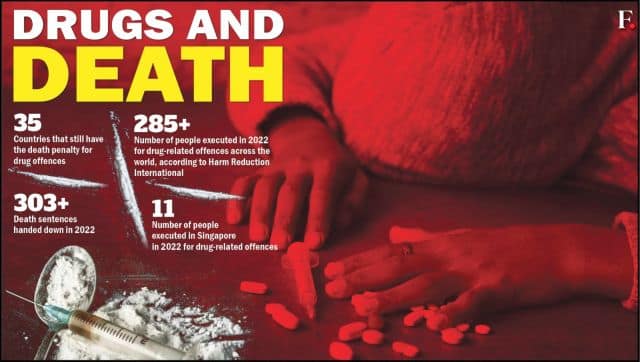 Graphic: Pranay Bhardwaj[/caption]So, which countries join Singapore? Singapore’s neighbour Malaysia has similar rules when it comes to drug-related crimes. In Malaysia if you are caught with more than 15 grams of heroin, you can receive a death sentence. Additionally, authorities can also detain anyone for up to two weeks on suspicion of drug use and forcibly test them for any traces of illegal drugs in their system. Those who test positive are automatically sentenced to a minimum of one year of compulsory treatment, even if they’re not caught with any drugs on them at the time.Indonesia is another South-east Asian nation with very strict rules. Possession, trafficking and manufacture of any illegal drugs are serious offences in Indonesia. The Indonesian authorities have a zero-tolerance policy and those caught face lengthy prison sentences or the death penalty. HRI revealed that the country had sentenced 122 people to death last year, a jump from the 89 in the preceding year.China too has very strict laws on drugs. In accordance with Chinese drug laws, anyone caught trying to smuggle a kilo or more of heroin into the country could face the death penalty. And the same fate could befall anyone found carrying more than 50 grams of other narcotics, including cocaine, opium, and cannabis.Japan is another Asian nation which has some of the strictest drug laws. The country also has strict controls on prescription drugs and requires travellers to declare any medication they are bringing into the country.The small, oil-rich nation of Brunei has come under fire for using caning as a punishment for drug offences. Possession of drugs can result in long-term prison sentences and even the death penalty.[caption id="attachment_12614222" align="alignnone" width="640"]
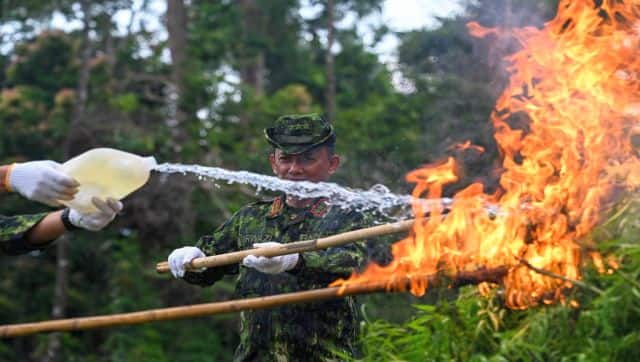 An Indonesian National Narcotics Agency (BNN) officer destroys marijuana plantations during a raid at Indrapuri forest line in Aceh province in February. Possession, trafficking and manufacture of illegal drugs is a serious offence in Indonesia. File image/AFP[/caption]Outside of Asia, Iran, perhaps, has the strictest laws when it comes to drug offences. The HRI report revealed that the nation had executed at least 252 people last year for drug-related crimes. Despite the high rate of executions and strict laws, Iran continues to have a problem of drug addiction in the country. In 2016, the country had a reported two million addicts. Experts state that its proximity to Afghanistan where opium is grown is one of the reasons for the high rate of addiction in Iran.In Saudi Arabia, the situation is no different. The country has a zero-tolerance policy towards drug use, and offences such as possession and trafficking are punishable by jail time, public flogging, and in some cases, the death penalty. In November last year, the Kingdom had executed two Pakistani nationals for drug-related crimes, a first since it had announced a moratorium on the use of the death penalty for drug-related crimes in January 2021. Amnesty International condemned the executions then and said, “The lives of individuals on death row for drug-related crimes and other crimes are at risk. Regardless of the crimes committed, no one should suffer this cruel, inhuman and degrading punishment.”The United Arab Emirates also has strict laws when it comes to drugs. The purchase, possession, consumption, and distribution of drugs are strictly prohibited. In 2022, the UAE eased some of its harsh drug laws, relaxing penalties for travellers who arrive in the country with products containing THC – the main intoxicating chemical in cannabis. The amended law stated that people found carrying food, drinks or other items containing THC would no longer face prison, but would have the substance confiscated, and will at most face a fine. The law also reduced minimum sentences from two years to three months for first-time drug offenders.[caption id="attachment_12614402" align="alignnone" width="640"]
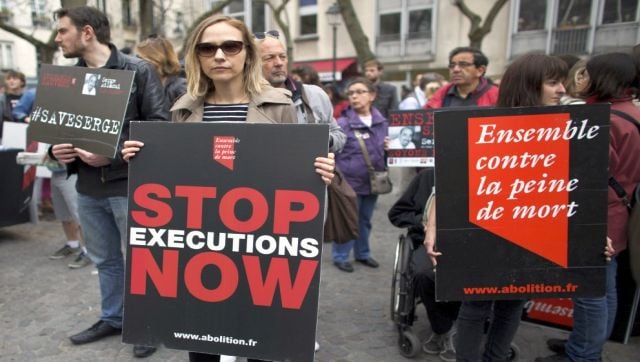 Protesters hold placards including one reading in French "Together Against Death Penalty" during a rally against the death penalty and in support of French national Serge Atlaoui, on death row in Indonesia for drug trafficking. File image/AFP[/caption]ExpertSpeakMany drug addiction experts believe that countries with tough laws on drugs won’t help the situation. As Singapore’s Kokila Annamalai, a cofounder of the Transformative Justice Collective, told TIME, “Thousands of grams of drugs are seized every week in Singapore. There is no evidence that the supply has gone down.”The Global Commission on Drug Policy says the use of the death penalty for drug-related offences does not meet the threshold of “most serious crimes” – for the purposes of Article 6 of the International Covenant on Civil and Political Rights – and therefore is in breach of international human rights law. The United Nations General Assembly, and the secretary-general, have also echoed that stance.Richard Branson, the billionaire and founder of Virgin Group, has also spoken out on the issue. “Killing people for allegedly smuggling cannabis is particularly cruel and misguided, given that more countries are now introducing sensible drug policy by decriminalising and regulating both medicinal and recreational cannabis,” he said.With inputs from agenciesRead all the Latest News, Trending News, Cricket News, Bollywood News,India News and Entertainment News here. Follow us on Facebook, Twitter and Instagram.
First Published:May 18, 2023, 15:00:06 IST
Advertisement
Advertisement

Delhi Police asks personnel to wear uniform: What the law says on cops in plainclothes during protests
The Delhi Police has instructed all its personnel to wear uniforms when they report for duty at Jantar Mantar for crowd control. This comes after outrage grew over videos of men in civilian clothes or without name tags hitting protesters in the Capital. Is it legal for the police to ditch uniforms during protests?
4 min read
Military drones & police check-ups: How Sri Lanka is fighting against worst dengue outbreak in a decade
Sri Lanka is fighting its most severe dengue outbreak in nearly a decade, with infections rising sharply across the nation. Military drones have been deployed to tackle the outbreak, which has claimed 56 lives. Health officials said the outbreak is being driven primarily by the DENV-2 variant of the virus
3 min read
How Facebook job ad lured 2 Karnataka men into Myanmar cyber scam camp
The Karnataka Cyber Command has rescued two youths from a scam compound in Myanmar operated by Chinese fraudsters. The duo from Karnataka were lured on the pretext of data-entry jobs. They were asked to work for 16 hours a day and were expected to sleep for six hours daily
4 min read
Why is India seeing 95% cloud cover despite a Super El Niño?
India is witnessing nearly 95 per cent cloud cover despite a Super El Niño, a climate event usually linked to weaker monsoons. Regional weather systems, cyclonic circulations, the monsoon trough and moisture from two seas are temporarily overpowering one of the world's strongest climate phenomena
5 min read
What is CJP’s fourth demand to the government as protests in Delhi intensify?
The protest by the Cockroach Janta Party at Delhi’s Jantar Mantar refuses to die down. The group have made a fourth demand to the Centre, asking that no FIRs are filed against the agitators and that no legal action be taken. The government has expressed willingness to speak to the protesters, but refused to accede on the resignation of Education Minister Dharmandra Pradhan
5 min read
Advertisement
Advertisement