
Advertisement


Sections
Explained: The ban on PFI and what this means for the Islamic outfit
The Centre has outlawed the Popular Front of India and all its affiliates for five years for indulging in unlawful activities, which are ‘prejudicial to the integrity, sovereignty and security of the country’. By banning the outfit, its members will be criminalised and its funds frozen

With the government’s latest action, the PFI has been added to the list of 42 banned terrorist organisations under Section 35 of the Unlawful Activities (Prevention) Act.The Centre’s ban on PFI is applicable to its affiliates — Rehab India Foundation (RIF), Campus Front of India (CFI), All India Imams Council (AIIC), National Confederation of Human Rights Organization (NCHRO), National Women’s Front, Junior Front, Empower India Foundation and Rehab Foundation, Kerala.Also read: Islamic State recruitment, 2020 Delhi riots, and more: The long ‘crime record’ of the PFIAs the Kerala-based organisation faces the action, let’s get a better understanding of how the Centre deems a group to be ‘unlawful’ and how does a ban work.What does a ban mean?A group or outfit is banned by the Centre through the Unlawful Activities Prevention Act (UAPA).The Centre in its notification stated that the PFI and its affiliates was an “unlawful association” with immediate effect through the powers conferred by sub-section (1) of section 3 of the Unlawful Activities (Prevention) Act, 1967 (37 of 1967).A ban on PFI means has serious legal ramifications — membership to the association is criminalised, funds collected by the outfit are deemed illegal and frozen and also property of the organisation is forfeited.[caption id="attachment_11346521" align="alignnone" width="640"]
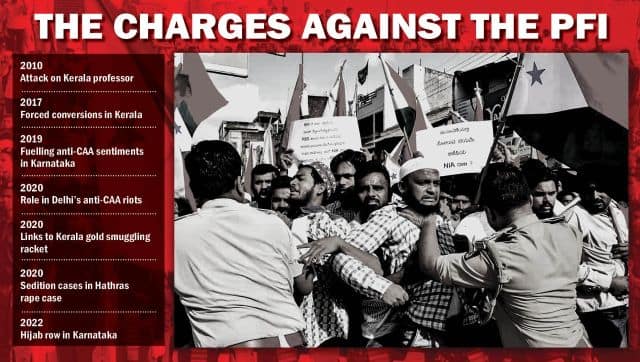 Graphic: Pranay Bhardwaj[/caption]When is an organisation banned and who declares it illegal?The Centre can declare an outfit to be banned when it is found to be a terror organisation.Section 2(m) of the UAPA defines “terrorist organisation” as an organisation listed in the Schedule to the UAPA, or an organisation operating under the same name as an organisation so listed in the Schedule.As of today, 42 organisations, including Hizb-Ul-Mujahideen, Babbar Khalsa International, Liberation Tigers of Tamil Eelam, Students Islamic Movement of India, have been declared as terror organisations and banned in India.Section 35 of the UAPA gives the central government the power to declare an outfit to be a terror organisation “only if it believes that it is involved in terrorism”.The Schedule can be amended by the government to add or remove organisations from the list. The law states that an organisation shall be deemed to be involved in terrorism if it —(a) commits or participates in acts of terrorism, or(b) prepares for terrorism, or(c) promotes or encourages terrorism, or(d) is otherwise involved in terrorism.[caption id="attachment_11345821" align="alignnone" width="640"]
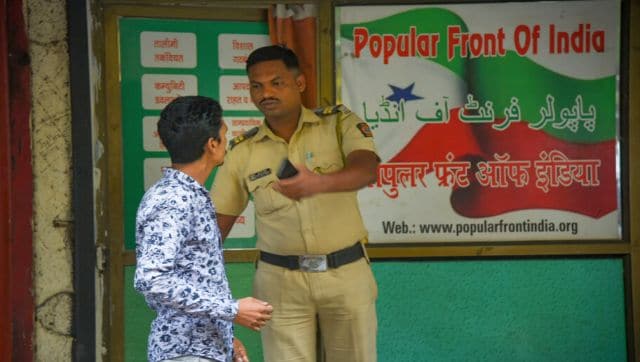 A security person keeps vigil outside the Popular Front of India (PFI) party office in Navi Mumbai. PTI[/caption]Once banned, what action does PFI face now?With the PFI being declared ‘unlawful’, the immediate effect is that its members and funding will be criminalised.Section 38 of the UAPA states that a person who “associates himself, or professes to be associated, with a terrorist organisation with intention to further its activities, commits an offence relating to membership of a terrorist organisation” is punishable with imprisonment for a term not exceeding 10 years.Section 20 of the UAPA also states that “any person who is a member of a terrorist gang or a terrorist organisation, which is involved in terrorist act, shall be punishable with imprisonment for a term which may extend to imprisonment for life, and shall also be liable to fine.”However, those who were part of the outfit before it was declared a terrorist organisation and didn’t take part in activities of the organisation at the time of its inclusion in the Schedule are exempted from legal action. Simply put, a person who wasn’t active in the organisation at the time of it being “banned” won’t face legal action.Also, Section 24 of the UAPA also provides for forfeiture of proceeds of terrorism.Does PFI have any legal recourse?As per the rules, the PFI or any other organisation can make an application to the central government to remove the outfit from the list.A review committee is then set up; this committee is headed by a sitting or former judge of a high court to “judicially review” the application.After studying the application, the committee can remove the organisation if “the decision was flawed”.Is this the end for PFI?The ban on PFI will make it nearly impossible for the outfit to raise funds.However, members of the group have been quoted as saying that a ban can’t stop them. Usman Hameed of PFI in a report by The Quint said, “Even if we get banned, the ideas we have been inculcating will not die.”Additionally banning the outfit could dent the popularity and support it enjoys with the public, making its revival harder.With inputs from agenciesRead all the Latest News, Trending News, Cricket News, Bollywood News,India News and Entertainment News here. Follow us on Facebook, Twitter and Instagram.
First Published:Sep 28, 2022, 10:02:38 IST
Advertisement
Advertisement

Delhi Police asks personnel to wear uniform: What the law says on cops in plainclothes during protests
The Delhi Police has instructed all its personnel to wear uniforms when they report for duty at Jantar Mantar for crowd control. This comes after outrage grew over videos of men in civilian clothes or without name tags hitting protesters in the Capital. Is it legal for the police to ditch uniforms during protests?
4 min read
Military drones & police check-ups: How Sri Lanka is fighting against worst dengue outbreak in a decade
Sri Lanka is fighting its most severe dengue outbreak in nearly a decade, with infections rising sharply across the nation. Military drones have been deployed to tackle the outbreak, which has claimed 56 lives. Health officials said the outbreak is being driven primarily by the DENV-2 variant of the virus
3 min read
How Facebook job ad lured 2 Karnataka men into Myanmar cyber scam camp
The Karnataka Cyber Command has rescued two youths from a scam compound in Myanmar operated by Chinese fraudsters. The duo from Karnataka were lured on the pretext of data-entry jobs. They were asked to work for 16 hours a day and were expected to sleep for six hours daily
4 min read
Why is India seeing 95% cloud cover despite a Super El Niño?
India is witnessing nearly 95 per cent cloud cover despite a Super El Niño, a climate event usually linked to weaker monsoons. Regional weather systems, cyclonic circulations, the monsoon trough and moisture from two seas are temporarily overpowering one of the world's strongest climate phenomena
5 min read
What is CJP’s fourth demand to the government as protests in Delhi intensify?
The protest by the Cockroach Janta Party at Delhi’s Jantar Mantar refuses to die down. The group have made a fourth demand to the Centre, asking that no FIRs are filed against the agitators and that no legal action be taken. The government has expressed willingness to speak to the protesters, but refused to accede on the resignation of Education Minister Dharmandra Pradhan
5 min read
Advertisement
Advertisement