
Advertisement


Sections
Pakistan PM’s visit to Saudi Arabia ‘cancelled’: Is the kingdom distancing itself from Islamabad?
Saudi Arabia has reportedly ‘cancelled’ Pakistan prime minister Shehbaz Sharif’s scheduled visit to Riyadh, which was set for next week. While the oil-rich nation has pledged more financial assistance to Islamabad, it has also toughened its stance in granting those funds

Pakistan prime minister Shehbaz Sharif’s upcoming visit to Saudi Arabia has reportedly been shelved.According to a News18 report, Saudi Arabia has "cancelled" Sharif’s trip because of the current political crisis gripping Islamabad.Why did Saudi Arabia cancel the Pakistan prime minister’s visit? Have relations between the two allies become strained? Why is there a political crisis in Islamabad? Let’s take a closer look.Shehbaz Sharif’s Saudi visit cancelled?Top sources in Pakistan’s foreign office told News18 that Sharif’s visit has been “cancelled due to the ongoing confrontation between the government and the Supreme Court”.The Pakistan prime minister was slated to visit Riyadh, along with his ministers, next week.However, Riyadh “disinvited” Sharif after no meeting could be fixed with the Saudi Royals, as per the report.[caption id="attachment_12481522" align="alignnone" width="640"]![pakistan pm saudi arabia visit]() Shehbaz Sharif told Pakistan's Parliament on Monday that Saudi Arabia has committed another $2 billion in financial assistance. Reuters File Photo[/caption]Notably, Sharif visited Saudi Arabia for a three-day visit last April on his first foreign trip after taking office earlier that month. His trip to the oil-rich Middle East country had come on the heels of an invitation by King Salman and Crown Prince Mohammed bin Salman.According to News18 sources, Sharif will now visit the United Kingdom in May, where he will attend King Charles III’s coronation ceremony.During his London trip, he will also meet his elder brother and former Pakistan prime minister, Nawaz Sharif, to discuss the election issue in the cash-strapped country, the report added.Are the two allies becoming distant?When it comes to assisting Pakistan financially, it seems that Saudi is toughening its stance.The Pakistan prime minister told the lower house of Parliament on Monday (17 April) that Saudi Arabia and the United Arab Emirates (UAE) have pledged to provide financial assistance – a pre-condition by International Monetary Fund (IMF) for a much-needed bailout – in order to strengthen the economic crisis-hit country’s foreign exchange reserves.“Showing great kindness, Saudi Arabia has provided us another $2 billion while the United Arab Emirates (UAE) has also promised to give us $1 billion,” Sharif said while addressing the Nation Assembly, as per The Express Tribune.He also said that Pakistan has met all conditions of the IMF to secure the $1.1 billion bailout.Pakistan's junior finance minister earlier said that Saudi Arabia had told the IMF about its intention to provide funds to Pakistan, as per Reuters.Addressing a ceremony in Lahore last Saturday, the Pakistan prime minister credited the country’s army chief for securing financial assistance from Saudi Arabia and the UAE."Chief of Army Staff General Asim Munir has contributed to the government's efforts to secure funds from Saudi Arabia and the UAE," Sharif was quoted as saying by the news agency PTI.
Shehbaz Sharif told Pakistan's Parliament on Monday that Saudi Arabia has committed another $2 billion in financial assistance. Reuters File Photo[/caption]Notably, Sharif visited Saudi Arabia for a three-day visit last April on his first foreign trip after taking office earlier that month. His trip to the oil-rich Middle East country had come on the heels of an invitation by King Salman and Crown Prince Mohammed bin Salman.According to News18 sources, Sharif will now visit the United Kingdom in May, where he will attend King Charles III’s coronation ceremony.During his London trip, he will also meet his elder brother and former Pakistan prime minister, Nawaz Sharif, to discuss the election issue in the cash-strapped country, the report added.Are the two allies becoming distant?When it comes to assisting Pakistan financially, it seems that Saudi is toughening its stance.The Pakistan prime minister told the lower house of Parliament on Monday (17 April) that Saudi Arabia and the United Arab Emirates (UAE) have pledged to provide financial assistance – a pre-condition by International Monetary Fund (IMF) for a much-needed bailout – in order to strengthen the economic crisis-hit country’s foreign exchange reserves.“Showing great kindness, Saudi Arabia has provided us another $2 billion while the United Arab Emirates (UAE) has also promised to give us $1 billion,” Sharif said while addressing the Nation Assembly, as per The Express Tribune.He also said that Pakistan has met all conditions of the IMF to secure the $1.1 billion bailout.Pakistan's junior finance minister earlier said that Saudi Arabia had told the IMF about its intention to provide funds to Pakistan, as per Reuters.Addressing a ceremony in Lahore last Saturday, the Pakistan prime minister credited the country’s army chief for securing financial assistance from Saudi Arabia and the UAE."Chief of Army Staff General Asim Munir has contributed to the government's efforts to secure funds from Saudi Arabia and the UAE," Sharif was quoted as saying by the news agency PTI.![imran khan]() Imran Khan's ouster last April set off a political crisis in Pakistan. Reuters File Photo[/caption]Khan’s party Pakistan Tehreek-e-Insaf (PTI) had dissolved the provincial assemblies it controlled in Punjab and Khyber Pakhtunkhwa in January this year. With this, the PTI chairman aimed to pressurise the government to announce early polls as Pakistan historically conducts provincial and national elections together, reported Al Jazeera.On 4 April, the Supreme Court declared ECP’s decision to defer the assembly elections in these provinces as “unconstitutional”, creating a standoff between the judiciary and the government.
Imran Khan's ouster last April set off a political crisis in Pakistan. Reuters File Photo[/caption]Khan’s party Pakistan Tehreek-e-Insaf (PTI) had dissolved the provincial assemblies it controlled in Punjab and Khyber Pakhtunkhwa in January this year. With this, the PTI chairman aimed to pressurise the government to announce early polls as Pakistan historically conducts provincial and national elections together, reported Al Jazeera.On 4 April, the Supreme Court declared ECP’s decision to defer the assembly elections in these provinces as “unconstitutional”, creating a standoff between the judiciary and the government.
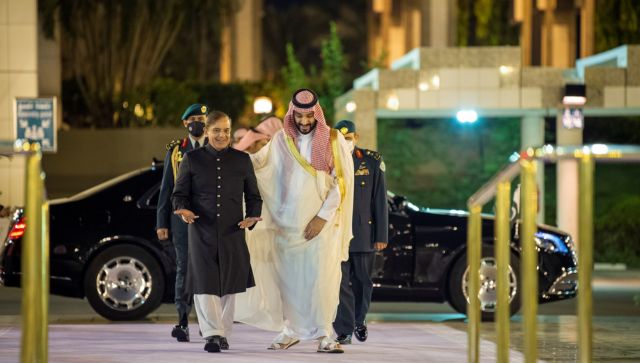 Shehbaz Sharif told Pakistan's Parliament on Monday that Saudi Arabia has committed another $2 billion in financial assistance. Reuters File Photo[/caption]Notably, Sharif visited Saudi Arabia for a three-day visit last April on his first foreign trip after taking office earlier that month. His trip to the oil-rich Middle East country had come on the heels of an invitation by King Salman and Crown Prince Mohammed bin Salman.According to News18 sources, Sharif will now visit the United Kingdom in May, where he will attend King Charles III’s coronation ceremony.During his London trip, he will also meet his elder brother and former Pakistan prime minister, Nawaz Sharif, to discuss the election issue in the cash-strapped country, the report added.Are the two allies becoming distant?When it comes to assisting Pakistan financially, it seems that Saudi is toughening its stance.The Pakistan prime minister told the lower house of Parliament on Monday (17 April) that Saudi Arabia and the United Arab Emirates (UAE) have pledged to provide financial assistance – a pre-condition by International Monetary Fund (IMF) for a much-needed bailout – in order to strengthen the economic crisis-hit country’s foreign exchange reserves.“Showing great kindness, Saudi Arabia has provided us another $2 billion while the United Arab Emirates (UAE) has also promised to give us $1 billion,” Sharif said while addressing the Nation Assembly, as per The Express Tribune.He also said that Pakistan has met all conditions of the IMF to secure the $1.1 billion bailout.Pakistan's junior finance minister earlier said that Saudi Arabia had told the IMF about its intention to provide funds to Pakistan, as per Reuters.Addressing a ceremony in Lahore last Saturday, the Pakistan prime minister credited the country’s army chief for securing financial assistance from Saudi Arabia and the UAE."Chief of Army Staff General Asim Munir has contributed to the government's efforts to secure funds from Saudi Arabia and the UAE," Sharif was quoted as saying by the news agency PTI.
However, this time, the assistance has not come easily from Riyadh.Middle East Eye (MEE) reported in March that Saudi refused any further bailouts to Pakistan unless it meets certain conditions, leaving Islamabad in shock.These provisions, similar to those set by the IMF, included “strict monetary and fiscal reforms along with a drastic reduction" in Pakistan's current account deficit, MEE reported.Umar Karim, an associate fellow at the King Faisal Center for Research and Islamic Studies, told MEE that authorities in Islamabad are surprised by Saudi’s reluctance to grant further financing.“While previously Saudi Arabia and other Gulf countries would bail Pakistan out off the back of a phone call from the foreign minister or the prime minister, this time around they are really being put through the mill,” Karim stated.In January this year, Saudi finance minister Mohammed al-Jadaan highlighted the kingdom’s change in policy.“We used to give direct grants and deposits without strings attached and we are changing that. We are working with multilateral institutions to actually say we need to see reforms”.“We are taxing our people, we are expecting also others to do the same, to do their efforts. We want to help but we want you also to do your part,” he had said at the World Economic Forum in Davos, as per MEE.Pakistan’s political crisisPakistan has been in a political upheaval since former prime minister Imran Khan was ousted from power in April last year through a no-confidence vote in Parliament.Since then, the political crisis has shown no signs of abating. Khan has been calling for early national elections, which are scheduled to be held later this year.The Pakistani government is also engaged in a rift with the country's judiciary.The Shehbaz Sharif-led government is trying to curb the Chief Justice of Pakistan (CJP)’s power after the Supreme Court took a suo motu notice of the election body delaying provincial elections in the country’s most populous province, Punjab.On 1 March, a five-judge bench of the apex court in a 3-2 majority directed the Election Commission of Pakistan (ECP) to announce the election schedule for Punjab and Khyber Pakhtunkhwa provinces.[caption id="attachment_12481542" align="alignnone" width="640"]
 Imran Khan's ouster last April set off a political crisis in Pakistan. Reuters File Photo[/caption]Khan’s party Pakistan Tehreek-e-Insaf (PTI) had dissolved the provincial assemblies it controlled in Punjab and Khyber Pakhtunkhwa in January this year. With this, the PTI chairman aimed to pressurise the government to announce early polls as Pakistan historically conducts provincial and national elections together, reported Al Jazeera.On 4 April, the Supreme Court declared ECP’s decision to defer the assembly elections in these provinces as “unconstitutional”, creating a standoff between the judiciary and the government.
The top court also ordered the Pakistan government to carry out elections in Punjab on 14 May.This verdict came after Khan’s PTI challenged the election commission’s decision to postpone the polls in Punjab from 30 April to 8 October following the government’s refusal to allot funds to hold elections citing the economic crisis.What is the Sharif government doing?According to a Dawn report, the Sharif government has decided to hold a national dialogue with the parties in the ruling coalition after Eidul Fitr to decide on “constitutional and legal issues”.After a high-level meeting, chaired by Sharif on Wednesday, the ruling coalition parties said in a statement that the “process of pre-consultation and negotiations regarding the holding of elections is going on among the coalition parties, for which the prime minister has already formed a committee”, Dawn reported.With inputs from agenciesRead all the Latest News, Trending News, Cricket News, Bollywood News,India News and Entertainment News here. Follow us on Facebook, Twitter and Instagram.
First Published:Apr 20, 2023, 14:12:48 IST
Advertisement
Advertisement

Military drones & police check-ups: How Sri Lanka is fighting against worst dengue outbreak in a decade
Sri Lanka is fighting its most severe dengue outbreak in nearly a decade, with infections rising sharply across the nation. Military drones have been deployed to tackle the outbreak, which has claimed 56 lives. Health officials said the outbreak is being driven primarily by the DENV-2 variant of the virus
3 min read
How Facebook job ad lured 2 Karnataka men into Myanmar cyber scam camp
The Karnataka Cyber Command has rescued two youths from a scam compound in Myanmar operated by Chinese fraudsters. The duo from Karnataka were lured on the pretext of data-entry jobs. They were asked to work for 16 hours a day and were expected to sleep for six hours daily
4 min read
Why is India seeing 95% cloud cover despite a Super El Niño?
India is witnessing nearly 95 per cent cloud cover despite a Super El Niño, a climate event usually linked to weaker monsoons. Regional weather systems, cyclonic circulations, the monsoon trough and moisture from two seas are temporarily overpowering one of the world's strongest climate phenomena
5 min read
What is CJP’s fourth demand to the government as protests in Delhi intensify?
The protest by the Cockroach Janta Party at Delhi’s Jantar Mantar refuses to die down. The group have made a fourth demand to the Centre, asking that no FIRs are filed against the agitators and that no legal action be taken. The government has expressed willingness to speak to the protesters, but refused to accede on the resignation of Education Minister Dharmandra Pradhan
5 min read
The new geography of war: Why the Houthis can no longer be ignored
The rise of the Houthis marks the emergence of a new geography of war — one in which influence flows not only from capitals and conventional armies, but also from rugged mountains overlooking vital sea lanes
6 min read
Advertisement
Advertisement