
Advertisement


Sections
Why did Pakistan import luxury cars worth billions amid economic crisis?
Pakistan is facing a foreign exchange crunch. But that did not stop the government from reportedly allowing luxury cars to be imported even as essential consumer goods and pharmaceuticals were stuck at ports

Pakistan is facing a debilitating economic crisis. Its depleting foreign exchange reserves have nose-dived to an all-time low of $3.7 billion, which means it will be able to sustain imports only for two to three weeks. Inflation is surging and with food prices soaring meals have become unaffordable. The situation is grim and the poor and the middle class are struggling.Amid all this, comes a shocking report that Pakistan allowed over 2,000 luxury cars to be imported last year. This came at a time when shipments of essential consumer goods were stuck at ports, according to the newspaper Dawn.What do we know about the car imports?The first six months of the ongoing fiscal year, from July to December 2022, the Pakistan government gave a go-ahead to import luxury cars. The country had imposed strict foreign exchange control on imports of essential consumer items and industrial goods.According to Dawn, Pakistan imported 164 luxury electric vehicles last year. Imports of used luxury vehicles also went up in the last six months. The country imported close to 1990 such vehicles in the last six months.The imports mostly happened between July to September and only a small number of cars were imported in the last three months of 2022, senior customs officials told the newspaper.Also read: Pakistan’s crippling economic crisis: Is the country going the Sri Lanka way?The cash-strapped country spent hundreds and billions of rupees on imports. It imported units worth USD 53.05 million, which is Rs 118.2 billion in local currency. The revenue collection on the import of used vehicles stood at Rs 7 billion during the first half of the current fiscal year, reports Dawn.[caption id="attachment_12076742" align="alignnone" width="640"]![]() Pakistan imported vehicles worth USD 53.05 million, which is Rs 118.2 billion in local currency. Representational picture/AFP[/caption]Why is there outrage? In May 2022, Pakistan banned the import of all non-essential luxury goods to stabilise the economy. Among the banned goods were cars, cell phones, home appliances and cosmetics. The decision was taken to save critical foreign exchange reserves. The country also imposed strict restrictions on imports of some essential items.While cars were imported, over 5,000 containers were held up at ports across the country. These carried consumer goods, industrial goods, pharmaceuticals and perishable products, reports Dawn. These items were stuck because of the non-opening of letters of credit (LCs).Importers have been facing trouble in opening LCs because of a shortage of dollars. The country is no longer issuing them, except for essential food and medicines, causing a backlog of thousands of shipping containers at Karachi port stuffed with stock the country can no longer afford.What is the government saying?The Pakistan government denied reports that it had imported luxury cars as the country faced a liquidity crunch.“A planned and coordinated disinformation campaign is being run by certain elements regarding import of luxury cars by the federal government. The government of Pakistan categorically denies this fake and misleading news and urges citizens to be watchful of such propaganda,” it said in a statement.[caption id="attachment_12076772" align="alignnone" width="640"]
Pakistan imported vehicles worth USD 53.05 million, which is Rs 118.2 billion in local currency. Representational picture/AFP[/caption]Why is there outrage? In May 2022, Pakistan banned the import of all non-essential luxury goods to stabilise the economy. Among the banned goods were cars, cell phones, home appliances and cosmetics. The decision was taken to save critical foreign exchange reserves. The country also imposed strict restrictions on imports of some essential items.While cars were imported, over 5,000 containers were held up at ports across the country. These carried consumer goods, industrial goods, pharmaceuticals and perishable products, reports Dawn. These items were stuck because of the non-opening of letters of credit (LCs).Importers have been facing trouble in opening LCs because of a shortage of dollars. The country is no longer issuing them, except for essential food and medicines, causing a backlog of thousands of shipping containers at Karachi port stuffed with stock the country can no longer afford.What is the government saying?The Pakistan government denied reports that it had imported luxury cars as the country faced a liquidity crunch.“A planned and coordinated disinformation campaign is being run by certain elements regarding import of luxury cars by the federal government. The government of Pakistan categorically denies this fake and misleading news and urges citizens to be watchful of such propaganda,” it said in a statement.[caption id="attachment_12076772" align="alignnone" width="640"]![]() Daily wage labourers sit along a road as they wait to be hired for day jobs in Karachi. Pakistan's economy is teetering on the edge, with the government dependent on a lifeline cash injection from an emergency IMF visit this week to avoid a Sri Lanka-style default. AFP[/caption]How worrying is the Pakistan crisis?This is one of the worst economic crises Pakistan has been grappling with in the aftermath of the floods that submerged a third of the country. Inflation has touched nearly 25 per cent and interest rates are at a 24-high of 17 per cent.The industry has been hammered by the imports block and massive rupee devaluation. Public construction projects have halted, textiles factories have partially shut down, and domestic investment has slowed, reports AFP.It is also battling severe energy shortages, with capacity drained by poor infrastructure and mismanagement, compounding the misery of businesses and citizens. Last week, the whole country was plunged into a day-long blackout because of a fault in the national grid that followed a cost-cutting measure.Also read: First no food, now no power in Pakistan: The country’s worsening situation explainedTo secure a bailout from the International Monetary Fund (IMF), Pakistan has increased the prices of fuel. It is also likely to impose Rs 200 billion in taxes."We’re at the end of the road. The government has to make the political case to the public for meeting these (IMF) demands," former World Bank economist Abid Hasan told AFP. “If they don’t, the country will certainly default, and we’ll end up like Sri Lanka, which will be even worse.”The IMF delegation will arrive on Tuesday.It is a common pattern in Pakistan, where most people live in rural poverty, with more than two dozen IMF deals brokered and then broken over the decades, the AFP report says.“Even if Pakistan avoids default, the underlying structural factors that triggered the current crisis, one exacerbated by poor leadership and external global shocks, will still be in place,” political analyst Michael Kugelman, the director of the South Asia Institute at the Wilson Center in Washington, wrote on Twitter.“Barring difficult, large-scale reforms, the next crisis could be just around the corner.”With inputs from agencies Read all the Latest News, Trending News, Cricket News, Bollywood News,India News and Entertainment News here. Follow us on Facebook, Twitter and Instagram.
Daily wage labourers sit along a road as they wait to be hired for day jobs in Karachi. Pakistan's economy is teetering on the edge, with the government dependent on a lifeline cash injection from an emergency IMF visit this week to avoid a Sri Lanka-style default. AFP[/caption]How worrying is the Pakistan crisis?This is one of the worst economic crises Pakistan has been grappling with in the aftermath of the floods that submerged a third of the country. Inflation has touched nearly 25 per cent and interest rates are at a 24-high of 17 per cent.The industry has been hammered by the imports block and massive rupee devaluation. Public construction projects have halted, textiles factories have partially shut down, and domestic investment has slowed, reports AFP.It is also battling severe energy shortages, with capacity drained by poor infrastructure and mismanagement, compounding the misery of businesses and citizens. Last week, the whole country was plunged into a day-long blackout because of a fault in the national grid that followed a cost-cutting measure.Also read: First no food, now no power in Pakistan: The country’s worsening situation explainedTo secure a bailout from the International Monetary Fund (IMF), Pakistan has increased the prices of fuel. It is also likely to impose Rs 200 billion in taxes."We’re at the end of the road. The government has to make the political case to the public for meeting these (IMF) demands," former World Bank economist Abid Hasan told AFP. “If they don’t, the country will certainly default, and we’ll end up like Sri Lanka, which will be even worse.”The IMF delegation will arrive on Tuesday.It is a common pattern in Pakistan, where most people live in rural poverty, with more than two dozen IMF deals brokered and then broken over the decades, the AFP report says.“Even if Pakistan avoids default, the underlying structural factors that triggered the current crisis, one exacerbated by poor leadership and external global shocks, will still be in place,” political analyst Michael Kugelman, the director of the South Asia Institute at the Wilson Center in Washington, wrote on Twitter.“Barring difficult, large-scale reforms, the next crisis could be just around the corner.”With inputs from agencies Read all the Latest News, Trending News, Cricket News, Bollywood News,India News and Entertainment News here. Follow us on Facebook, Twitter and Instagram.
 Pakistan imported vehicles worth USD 53.05 million, which is Rs 118.2 billion in local currency. Representational picture/AFP[/caption]Why is there outrage? In May 2022, Pakistan banned the import of all non-essential luxury goods to stabilise the economy. Among the banned goods were cars, cell phones, home appliances and cosmetics. The decision was taken to save critical foreign exchange reserves. The country also imposed strict restrictions on imports of some essential items.While cars were imported, over 5,000 containers were held up at ports across the country. These carried consumer goods, industrial goods, pharmaceuticals and perishable products, reports Dawn. These items were stuck because of the non-opening of letters of credit (LCs).Importers have been facing trouble in opening LCs because of a shortage of dollars. The country is no longer issuing them, except for essential food and medicines, causing a backlog of thousands of shipping containers at Karachi port stuffed with stock the country can no longer afford.What is the government saying?The Pakistan government denied reports that it had imported luxury cars as the country faced a liquidity crunch.“A planned and coordinated disinformation campaign is being run by certain elements regarding import of luxury cars by the federal government. The government of Pakistan categorically denies this fake and misleading news and urges citizens to be watchful of such propaganda,” it said in a statement.[caption id="attachment_12076772" align="alignnone" width="640"]
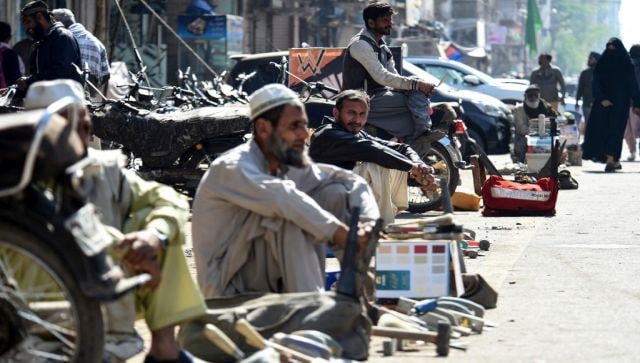 Daily wage labourers sit along a road as they wait to be hired for day jobs in Karachi. Pakistan's economy is teetering on the edge, with the government dependent on a lifeline cash injection from an emergency IMF visit this week to avoid a Sri Lanka-style default. AFP[/caption]How worrying is the Pakistan crisis?This is one of the worst economic crises Pakistan has been grappling with in the aftermath of the floods that submerged a third of the country. Inflation has touched nearly 25 per cent and interest rates are at a 24-high of 17 per cent.The industry has been hammered by the imports block and massive rupee devaluation. Public construction projects have halted, textiles factories have partially shut down, and domestic investment has slowed, reports AFP.It is also battling severe energy shortages, with capacity drained by poor infrastructure and mismanagement, compounding the misery of businesses and citizens. Last week, the whole country was plunged into a day-long blackout because of a fault in the national grid that followed a cost-cutting measure.Also read: First no food, now no power in Pakistan: The country’s worsening situation explainedTo secure a bailout from the International Monetary Fund (IMF), Pakistan has increased the prices of fuel. It is also likely to impose Rs 200 billion in taxes."We’re at the end of the road. The government has to make the political case to the public for meeting these (IMF) demands," former World Bank economist Abid Hasan told AFP. “If they don’t, the country will certainly default, and we’ll end up like Sri Lanka, which will be even worse.”The IMF delegation will arrive on Tuesday.It is a common pattern in Pakistan, where most people live in rural poverty, with more than two dozen IMF deals brokered and then broken over the decades, the AFP report says.“Even if Pakistan avoids default, the underlying structural factors that triggered the current crisis, one exacerbated by poor leadership and external global shocks, will still be in place,” political analyst Michael Kugelman, the director of the South Asia Institute at the Wilson Center in Washington, wrote on Twitter.“Barring difficult, large-scale reforms, the next crisis could be just around the corner.”With inputs from agencies Read all the Latest News, Trending News, Cricket News, Bollywood News,India News and Entertainment News here. Follow us on Facebook, Twitter and Instagram.
First Published:Jan 31, 2023, 15:42:28 IST
Advertisement
Advertisement

Delhi Police asks personnel to wear uniform: What the law says on cops in plainclothes during protests
The Delhi Police has instructed all its personnel to wear uniforms when they report for duty at Jantar Mantar for crowd control. This comes after outrage grew over videos of men in civilian clothes or without name tags hitting protesters in the Capital. Is it legal for the police to ditch uniforms during protests?
4 min read
Military drones & police check-ups: How Sri Lanka is fighting against worst dengue outbreak in a decade
Sri Lanka is fighting its most severe dengue outbreak in nearly a decade, with infections rising sharply across the nation. Military drones have been deployed to tackle the outbreak, which has claimed 56 lives. Health officials said the outbreak is being driven primarily by the DENV-2 variant of the virus
3 min read
How Facebook job ad lured 2 Karnataka men into Myanmar cyber scam camp
The Karnataka Cyber Command has rescued two youths from a scam compound in Myanmar operated by Chinese fraudsters. The duo from Karnataka were lured on the pretext of data-entry jobs. They were asked to work for 16 hours a day and were expected to sleep for six hours daily
4 min read
Why is India seeing 95% cloud cover despite a Super El Niño?
India is witnessing nearly 95 per cent cloud cover despite a Super El Niño, a climate event usually linked to weaker monsoons. Regional weather systems, cyclonic circulations, the monsoon trough and moisture from two seas are temporarily overpowering one of the world's strongest climate phenomena
5 min read
What is CJP’s fourth demand to the government as protests in Delhi intensify?
The protest by the Cockroach Janta Party at Delhi’s Jantar Mantar refuses to die down. The group have made a fourth demand to the Centre, asking that no FIRs are filed against the agitators and that no legal action be taken. The government has expressed willingness to speak to the protesters, but refused to accede on the resignation of Education Minister Dharmandra Pradhan
5 min read
Advertisement
Advertisement