
Advertisement

Out of This World: The discovery of the biggest black hole, 30 billion times the size of the Sun

It is the first black hole ever observed using a phenomenon called gravitational lensing, a new technique that could spot thousands more of the insatiable celestial monsters in the coming years

Advertisement
|Mar 30, 2023, 08:48:35 IST
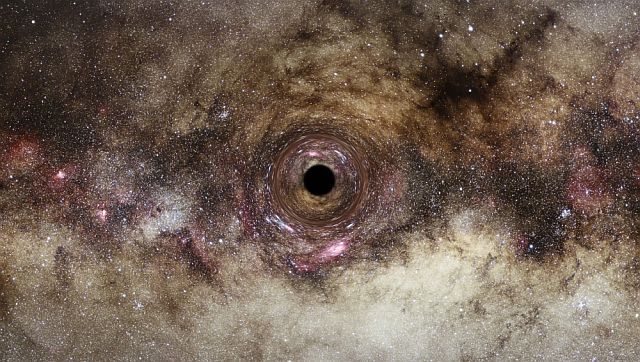
Paris: One of the largest black holes ever recorded has been discovered using a new technique that could spot thousands more of the insatiable celestial monsters in the coming years, according to astronomers.The ultra massive black hole, one of just four ever observed, is more than 30 billion times the mass of the Sun, a new study said.It is the first black hole ever observed using a phenomenon called gravitational lensing, in which light travelling towards us from a distant galaxy appears to magnify and bend inwards, giving away the presence of a dark giant.James Nightingale, an astronomer at the UK's Durham University and the study's lead author, told AFP the process was "similar to shining light through the base of a wine glass".He said it was "very fortuitous" that the light of a galaxy in the distant universe travelled extremely close to this black hole, which is roughly two billion light years from Earth.It could even be the biggest black hole ever recorded, but it was difficult to say for sure given the varying techniques and uncertainties involved, he added.Supermassive black holes sit at the centre of galaxies using their vast gravitational pull to gobble up stars like specks of dust, not even allowing light to escape.Previous black holes of this size have been observed when their voracious devouring gives off huge amounts light at the margins — or by measuring the orbit of stars that speed up as they pass by.But these techniques only work for galaxies relatively close to Earth.Landscape to 'dramatically change'Gravitational lensing allows astronomers to "discover black holes in the other 99 per cent of galaxies that are currently inaccessible," Nightingale said.There are currently around 500 known gravitational lenses — at least one of which we now know is a supermassive black hole.But "the landscape is about to dramatically change," Nightingale said.[caption id="attachment_12375262" align="alignnone" width="640"]

An artist’s impression of a black hole in the Milky Way galaxy, which distorts light passing near it creating a phenomenon known as 'gravitational lensing'. AFP[/caption]The European Space Agency's Euclid mission, planned to launch into space in July, will open a "big data era" for black hole hunters by creating a huge high-resolution map of the universe, he said.In the next six years Euclid could find 100,000 new gravitational lenses, which would potentially point towards thousands of previously hidden black holes, Nightingale added.For the latest discovery, the researchers used computer simulations and images from the Hubble Space Telescope to confirm their findings, as well as eliminating other possibilities such as an overconcentration of dark matter.The huge size is also consistent with what would be expected for a black hole at the centre of its giant host galaxy, Nightingale said.The mass of all the stars in the galaxy, dubbed Abell 1201, is more than a trillion times that of our Sun, meaning it would be expected to have a particularly large black hole at its centre.The study was published in the journal Monthly Notices of the Royal Astronomical Society on Tuesday.Read all the Latest News, Trending News, Cricket News, Bollywood News,India News and Entertainment News here. Follow us on Facebook, Twitter and Instagram.

Handpicked stories, in your inbox
Global stories. Indian perspective. Zero noise.
No Spam. Unsubscribe Any Time.
First Published:Mar 30, 2023, 08:48:35 IST
Advertisement
Advertisement
Trending Stories

Why is India seeing 95% cloud cover despite a Super El Niño?

India is witnessing nearly 95 per cent cloud cover despite a Super El Niño, a climate event usually linked to weaker monsoons. Regional weather systems, cyclonic circulations, the monsoon trough and moisture from two seas are temporarily overpowering one of the world's strongest climate phenomena
5 min read
Advertisement
Advertisement
Up Next