
Advertisement


Sections
Now anonymous, parody accounts a crime in Sri Lanka: Look at controversial social media law
The Online Safety Bill mandates jail terms for illegal content as determined by a five-member commission appointed by the president. It also makes anonymous or parody social media accounts illegal. Critics say the law throttles freedom of speech and creates an oppressive environment

Sri Lanka has passed a new social media law – and many are up in arms.While lawmakers of President Ranil Wickremesinghe's government have said the law is aimed at targeting cybercrime such as child abuse, data theft and fraud, the Opposition and activists have claimed it will tamp down on free speech.But what do we know about the bill?Let’s take a closer look:What do we know?The Online Safety Bill mandates jail terms for illegal content as determined by a five-member commission.It makes social media platforms such as Google, Facebook and X, formerly known as Twitter, liable for such content on their platforms.It prohibits online communication of false statements in Sri Lanka.It also prevents the use of online accounts and inauthentic online accounts for restricted purposes.It makes provisions to identify and declare online locations used for prohibited purposes in the island nation as well as suppresses the financing, and other support of communication of false statements of fact.Executives at social media platforms could face a prison sentence of up to 10 years if they fail to disclose user details of those accused of creating posts deemed illegal under the new law.![]() The law makes anonymous or parody social media accounts illegal. Reuters[/caption]The bill was passed with a majority of 46 votes in the 225-member house, the Speaker announced.One hundred and eight votes were in favour while 62 members voted against it.Alles opening the debate on the bill on Tuesday, said the Supreme Court had suggested amendments to the bill.He added that these would be incorporated after the bill is approved in parliament.What do critics say?Media and civil rights groups accuse the government of trying to introduce more repressive laws in an attempt to “suppress the public’s right to expression as a narrow effort with the aim of winning the upcoming elections at any cost.”Sri Lanka’s presidential and parliamentary elections are likely to be held later this year or early next year.Social media was a key tool used by protesters during the 2022 economic crisis, with countrywide demonstrations forcing then-president Gotabaya Rajapaksa to step down.
The law makes anonymous or parody social media accounts illegal. Reuters[/caption]The bill was passed with a majority of 46 votes in the 225-member house, the Speaker announced.One hundred and eight votes were in favour while 62 members voted against it.Alles opening the debate on the bill on Tuesday, said the Supreme Court had suggested amendments to the bill.He added that these would be incorporated after the bill is approved in parliament.What do critics say?Media and civil rights groups accuse the government of trying to introduce more repressive laws in an attempt to “suppress the public’s right to expression as a narrow effort with the aim of winning the upcoming elections at any cost.”Sri Lanka’s presidential and parliamentary elections are likely to be held later this year or early next year.Social media was a key tool used by protesters during the 2022 economic crisis, with countrywide demonstrations forcing then-president Gotabaya Rajapaksa to step down.![]() Social media was a key tool used by protesters during the 2022 economic crisis, with countrywide demonstrations forcing then president Gotabaya Rajapaksa to step down.[/caption]It was not immediately clear if any of the concerns raised by the AIC had been included in the final version of the Online Safety Bill, which was passed in parliament by 46 votes.A small group of activists and Opposition members protested against the legislation outside parliament.Harsha de Silva, a lawmaker of Sri Lanka's main Opposition Samagi Jana Balawegaya, told parliament that it was not right to hold social media platforms accountable.
Social media was a key tool used by protesters during the 2022 economic crisis, with countrywide demonstrations forcing then president Gotabaya Rajapaksa to step down.[/caption]It was not immediately clear if any of the concerns raised by the AIC had been included in the final version of the Online Safety Bill, which was passed in parliament by 46 votes.A small group of activists and Opposition members protested against the legislation outside parliament.Harsha de Silva, a lawmaker of Sri Lanka's main Opposition Samagi Jana Balawegaya, told parliament that it was not right to hold social media platforms accountable.
The law makes anonymous or parody social media accounts illegal.Users posting from outside Sri Lanka would also be liable for prosecution.The Bill was introduced in the House on Tuesday by public security minister Tiran Alles."Sri Lanka had 8,000 cybercrimes complaints last year. We all agree that we need laws to address these issues. This is why we are bringing this law," Alles said.During debate in parliament, Opposition legislator MA Sumanthiran called the law an "oppressive and a draconian piece of legislation".CNA quoted Eran Wickramaratne, a lawmaker of Sri Lanka's main opposition Samagi Jana Balawegaya, as saying, "We do not understand why the government is in such a hurry to pass this bill.""We should take more time and have a better approach to passing laws that are this significant."[caption id="attachment_13654312" align="alignnone" width="640"]
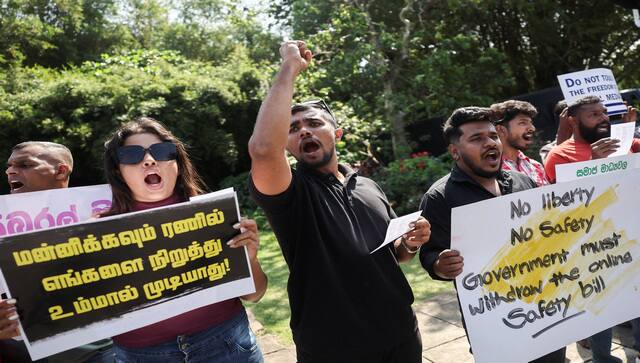 The law makes anonymous or parody social media accounts illegal. Reuters[/caption]The bill was passed with a majority of 46 votes in the 225-member house, the Speaker announced.One hundred and eight votes were in favour while 62 members voted against it.Alles opening the debate on the bill on Tuesday, said the Supreme Court had suggested amendments to the bill.He added that these would be incorporated after the bill is approved in parliament.What do critics say?Media and civil rights groups accuse the government of trying to introduce more repressive laws in an attempt to “suppress the public’s right to expression as a narrow effort with the aim of winning the upcoming elections at any cost.”Sri Lanka’s presidential and parliamentary elections are likely to be held later this year or early next year.Social media was a key tool used by protesters during the 2022 economic crisis, with countrywide demonstrations forcing then-president Gotabaya Rajapaksa to step down.
Last year, the United Nations human rights office (OHCHR) said the law "could potentially criminalise nearly all forms of legitimate expression."Meanwhile, New York-based Human Rights Watch (HRW) said it would "seriously threaten" the right to freedom of expression in the country."Sri Lanka has engaged with AIC and consulted with stakeholders since November. We are open to considering fresh changes and bringing them as amendments to the legislation at a later date," Alles said before the debate on the bill concluded on Wednesday and voting was called.The bill aims to establish an online safety commission with “wide-ranging powers to restrict free speech” that could direct users, service providers and others to “take down content and block access to accounts on extremely vague and overbroad grounds,” said Article 19, a rights watchdog, and 50 other groups.Opposition lawmaker Rauff Hakeem said the government is trying to throttle freedom of speech in Sri Lanka, adding that “a very oppressive environment is going to be created.”“This is a manifestation of a government which is trying to dismantle even the remaining few safeguards for freedom of expression in this country and to destroy democracy," Hakeem said.But Alles rejected the accusations, saying the bill was not drafted with the intention of harassing media or political opponents.“It is not to suppress the media or the Opposition...Any complaint will be taken up by the commission, who will be appointed by the president and they will decide how to act,” Alles said.‘Undermine potential growth’The Asian Internet Coalition (AIC), which comprises Apple, Amazon, Google and Yahoo as members, warned Sri Lanka that the bill could impact investment in the country's IT industry and called for extensive amendments to it."We unequivocally stand by our position that the Online Safety Bill, in its current form, is unworkable and would undermine potential growth and foreign direct investment into Sri Lanka's digital economy," the AIC said in a statement.[caption id="attachment_13272442" align="alignnone" width="640"]
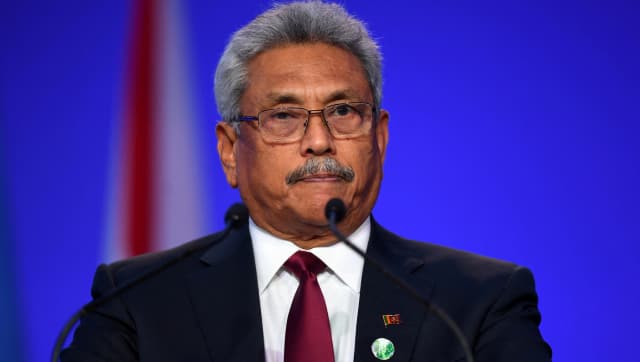 Social media was a key tool used by protesters during the 2022 economic crisis, with countrywide demonstrations forcing then president Gotabaya Rajapaksa to step down.[/caption]It was not immediately clear if any of the concerns raised by the AIC had been included in the final version of the Online Safety Bill, which was passed in parliament by 46 votes.A small group of activists and Opposition members protested against the legislation outside parliament.Harsha de Silva, a lawmaker of Sri Lanka's main Opposition Samagi Jana Balawegaya, told parliament that it was not right to hold social media platforms accountable.
"This legislation is a threat to our democracy," he said."This will have a severe negative impact on expanding e-commerce in Sri Lanka, to provide jobs to our youth and help our economy, which is in desperate need of growth."Debate over the bill comes as Sri Lanka struggles to emerge from its worst economic crisis, which hit the island nation two year ago. The country declared bankruptcy in April 2022 with more than $83 billion in debt, more than half of it to foreign creditors.The crisis caused severe shortages of food, fuel and other necessities. Strident public protests led to the ouster of then president Gotabaya Rajapaksa. The IMF agreed last March to a $2.9 billion bailout package.Under new President Ranil Wickremesinghe, the severe shortages of food, fuel and medicine have largely abated over the past year and authorities have restored power supply. But public dissatisfaction has grown over the government’s effort to increase revenue by raising electricity bills and imposing heavy new income taxes on professionals and businesses.With inputs from agencies
First Published:Jan 25, 2024, 13:47:47 IST
Advertisement
Advertisement

Military drones & police check-ups: How Sri Lanka is fighting against worst dengue outbreak in a decade
Sri Lanka is fighting its most severe dengue outbreak in nearly a decade, with infections rising sharply across the nation. Military drones have been deployed to tackle the outbreak, which has claimed 56 lives. Health officials said the outbreak is being driven primarily by the DENV-2 variant of the virus
3 min read
How Facebook job ad lured 2 Karnataka men into Myanmar cyber scam camp
The Karnataka Cyber Command has rescued two youths from a scam compound in Myanmar operated by Chinese fraudsters. The duo from Karnataka were lured on the pretext of data-entry jobs. They were asked to work for 16 hours a day and were expected to sleep for six hours daily
4 min read
Why is India seeing 95% cloud cover despite a Super El Niño?
India is witnessing nearly 95 per cent cloud cover despite a Super El Niño, a climate event usually linked to weaker monsoons. Regional weather systems, cyclonic circulations, the monsoon trough and moisture from two seas are temporarily overpowering one of the world's strongest climate phenomena
5 min read
What is CJP’s fourth demand to the government as protests in Delhi intensify?
The protest by the Cockroach Janta Party at Delhi’s Jantar Mantar refuses to die down. The group have made a fourth demand to the Centre, asking that no FIRs are filed against the agitators and that no legal action be taken. The government has expressed willingness to speak to the protesters, but refused to accede on the resignation of Education Minister Dharmandra Pradhan
5 min read
The new geography of war: Why the Houthis can no longer be ignored
The rise of the Houthis marks the emergence of a new geography of war — one in which influence flows not only from capitals and conventional armies, but also from rugged mountains overlooking vital sea lanes
6 min read
Advertisement
Advertisement