
Advertisement


Sections
New Members, New Currency: What will foreign ministers discuss at BRICS meet?
The foreign ministers of Brazil, Russia, India, China and South Africa are in Cape Town for the BRICS meet. The talks will see the leaders discuss the inclusion of new countries as well as the prospect of a new common currency. These discussions will set the tone for the 15th BRICS summit in August

All eyes have turned towards Cape Town in South Africa as foreign ministers from the emerging economies of Brazil, Russia, India, China and South Africa have gathered for the all-important BRICS foreign ministers meet.The meeting, scheduled for 1-3 June, will see Brazil’s Mauro Vieira, Russia’s Sergey Lavrov, India’s S Jaishankar, China’s Ma Zhaoxu (vice foreign minister) and South Africa’s Naledi Pandor discuss key issues as well as set the agenda for the 15th BRICS summit scheduled to be held in South Africa in August.South Africa earlier had paved the way for Russia’s Vladimir Putin to attend the August meet by granting immunity to all delegates. Putin’s presence at the meeting had come under a cloud given the International Criminal Court’s (ICC) arrest warrant over alleged war crimes.At the start of the meeting, India’s External Affairs Minister S Jaishankar said, “Our gathering must send out a strong message that the world is multipolar, that it is rebalancing and that old ways cannot address new situations. We are a symbol of change and must act accordingly.”Jaishankar further stressed, “We urge that BRICS will promote the economic decentralisation that is so essential for political democratisation.”What’s on the agenda for the foreign ministers at the BRICS meeting?New members One of the biggest topics that the foreign ministers will discuss is the addition of members to the BRICS collective.According to reports, around 20 countries are in queue wanting to join the BRICS grouping. These include countries such as Argentina, Nicaragua, Mexico, Uruguay, Venezuela from Latin America; Nigeria, Algeria, Egypt, Senegal, Morocco from Africa; Saudi Arabia, the UAE, Türkiye, Syria, Iran from West Asia; Kazakhstan from Central Asia; Bangladesh and Afghanistan from South Asia; and Indonesia and Thailand from South-east Asia.Geopolitical analysts say that the expansion of this grouping and the inclusion of three of the largest oil-producing nations in the world could be seen as a challenge to the United States and the West.Though no final decision has been made on the issue, China’s vice minister of foreign affairs Ma Zhaoxu was quoted as saying, “We are happy to see that more and more countries expressed their willingness to join us in the BRICS family. China will welcome the invitation of those countries to join BRICS and we expect more countries to join our big family.”Interestingly, Russia’s Sergey held talks with Saudi Arabia foreign minister Prince Faisal bin Farhan Al Saud on the sidelines of the BRICS meeting on Thursday – a sign that the Middle-East country is keen on joining the grouping.Experts note that many countries now view BRICS – which has China and Russia in it – as a counterview to the western hegemony as well as to the G7 grouping.[caption id="attachment_12682142" align="alignnone" width="640"]![]() Russia's Sergey Lavrov and Saudi Arabia's foreign minister Prince Faisal bin Farhan Al Saud meet on the sidelines of a meeting of foreign ministers from the BRICS countries, in Cape Town, South Africa. Reuters[/caption]Rajiv Bhatia, Distinguished Fellow at the policy think tank Gateway House and a former Indian diplomat, told Indian Express explained why countries are seeking BRICS out. “First, there is considerable anti-US sentiment in the world, and all these countries are looking for a grouping where they can use that sentiment to gather together. Second, there is a lot of appetite for multipolarity, for a platform where countries of the Global South can express their solidarity.”Let’s talk about moneyIt will come as no surprise that the foreign ministers will also discuss economic cooperation between the countries as well as the idea of trading in one common currency or in local currencies.Currently, Russia and China as well as China and Brazil have been dealing in the yuan. In fact, the Chinese yuan, or renminbi, surpassed the Euro to become Brazil’s second-largest international reserve currency, according to a report published earlier in April. The report showed that the RMB accounted for 5.37 per cent of Brazil’s international exchange reserves by the end of 2022, surpassing the Euro’s 4.74 per cent share, reflecting the deepening economic ties between Brazil and China.[caption id="attachment_12682172" align="alignnone" width="640"]
Russia's Sergey Lavrov and Saudi Arabia's foreign minister Prince Faisal bin Farhan Al Saud meet on the sidelines of a meeting of foreign ministers from the BRICS countries, in Cape Town, South Africa. Reuters[/caption]Rajiv Bhatia, Distinguished Fellow at the policy think tank Gateway House and a former Indian diplomat, told Indian Express explained why countries are seeking BRICS out. “First, there is considerable anti-US sentiment in the world, and all these countries are looking for a grouping where they can use that sentiment to gather together. Second, there is a lot of appetite for multipolarity, for a platform where countries of the Global South can express their solidarity.”Let’s talk about moneyIt will come as no surprise that the foreign ministers will also discuss economic cooperation between the countries as well as the idea of trading in one common currency or in local currencies.Currently, Russia and China as well as China and Brazil have been dealing in the yuan. In fact, the Chinese yuan, or renminbi, surpassed the Euro to become Brazil’s second-largest international reserve currency, according to a report published earlier in April. The report showed that the RMB accounted for 5.37 per cent of Brazil’s international exchange reserves by the end of 2022, surpassing the Euro’s 4.74 per cent share, reflecting the deepening economic ties between Brazil and China.[caption id="attachment_12682172" align="alignnone" width="640"]![]() External Affairs Minister S Jaishankar, South Africa's Naledi Pandor and Russia's Sergey Lavrov share a lighter moment during the BRICS Foreign Ministers' meet. Reuters[/caption]Anil Trigunayat, a former Indian ambassador to Jordan, Libya and Malta who is also senior adviser with the BRICS Chamber of Commerce, such trading is likely to get encouragement at the foreign ministers’ meeting in Cape Town.There’s also the issue of establishing a common currency within the BRICS framework – an idea that was first proposed by Russia’s president Vladimir Putin at the Beijing BRICS summit last year. Initially, the idea received a cautious reception but since the Russia-Ukraine war, this idea has gained traction.Also read: Dumping the Dollar: Will a new BRICS currency replace the US currency for trade?In March this year, Russian lawmaker Alexander Babakov was quoted as saying by Sputnik News that leaders may “present ideas” about a joint currency at the August BRICS summit. The idea behind a common currency is to edge out the dollar – a dedollarisation drive.However, the establishment of a new currency comes with its own set of challenges. As South Africa’s Naledi Pandor had told Bloomberg earlier this year that the idea needed to be “properly” discussed. “I don’t think we should always assume the idea will work, because economics is very difficult and you have to have regard to all countries, especially in a situation of low growth when you are emerging from crises,” she said.Besides the economic complications, there’s also political aspects that need to be looked at. For instance, it is unclear if India and China can find an agreement amid the ongoing border standoff.[caption id="attachment_12682202" align="alignnone" width="640"]
External Affairs Minister S Jaishankar, South Africa's Naledi Pandor and Russia's Sergey Lavrov share a lighter moment during the BRICS Foreign Ministers' meet. Reuters[/caption]Anil Trigunayat, a former Indian ambassador to Jordan, Libya and Malta who is also senior adviser with the BRICS Chamber of Commerce, such trading is likely to get encouragement at the foreign ministers’ meeting in Cape Town.There’s also the issue of establishing a common currency within the BRICS framework – an idea that was first proposed by Russia’s president Vladimir Putin at the Beijing BRICS summit last year. Initially, the idea received a cautious reception but since the Russia-Ukraine war, this idea has gained traction.Also read: Dumping the Dollar: Will a new BRICS currency replace the US currency for trade?In March this year, Russian lawmaker Alexander Babakov was quoted as saying by Sputnik News that leaders may “present ideas” about a joint currency at the August BRICS summit. The idea behind a common currency is to edge out the dollar – a dedollarisation drive.However, the establishment of a new currency comes with its own set of challenges. As South Africa’s Naledi Pandor had told Bloomberg earlier this year that the idea needed to be “properly” discussed. “I don’t think we should always assume the idea will work, because economics is very difficult and you have to have regard to all countries, especially in a situation of low growth when you are emerging from crises,” she said.Besides the economic complications, there’s also political aspects that need to be looked at. For instance, it is unclear if India and China can find an agreement amid the ongoing border standoff.[caption id="attachment_12682202" align="alignnone" width="640"]![]() Demonstrators protest against the war in Ukraine at a venue where the Russian and Chinese foreign ministers are gathering for the BRICS meet. AP[/caption]Peace plan for UkraineThe ongoing Russia-Ukraine war, edging towards the 500th day, is also expected to be discussed at the meet. It is expected that China may push its 12-point peace plan but achieving a consensus among the member countries on this plan seems unlikely.Kamal Madishetty, senior researcher, Institute of Peace and Conflict Studies (IPCS), told The Print, “there may be a wider discussion about the urgency to end the war, as well as in dealing with the impact of the Ukraine conflict on the Global South, especially on food and energy security.”Last month, South African president Cyril Ramaphosa said Putin and Ukrainian president Volodymyr Zelenskyy had agreed to meet a group of African leaders to discuss a potential peace plan.Fight against terrorismThe matter of terrorism will also be discussed, with the BRICS issuing a joint statement, titled ‘The Cape of Good Hope’, expressing strong condemnation of terrorism “whenever, wherever and by whomsoever committed”.Speaking on the same, External Affairs Minister S Jaishankar on Thursday said that terrorism is one of the key threats to international peace and security and requested all nations to take measures “against this menace, including its financing and propaganda.”It is interesting to see what the meeting of the foreign ministers yield, but there’s bound to be interest as the five nation grouping represents 41 per cent of the global population, 24 per cent of the global GDP and 16 per cent of the global trade.With inputs from agenciesRead all the Latest News, Trending News, Cricket News, Bollywood News,India News and Entertainment News here. Follow us on Facebook, Twitter and Instagram.
Demonstrators protest against the war in Ukraine at a venue where the Russian and Chinese foreign ministers are gathering for the BRICS meet. AP[/caption]Peace plan for UkraineThe ongoing Russia-Ukraine war, edging towards the 500th day, is also expected to be discussed at the meet. It is expected that China may push its 12-point peace plan but achieving a consensus among the member countries on this plan seems unlikely.Kamal Madishetty, senior researcher, Institute of Peace and Conflict Studies (IPCS), told The Print, “there may be a wider discussion about the urgency to end the war, as well as in dealing with the impact of the Ukraine conflict on the Global South, especially on food and energy security.”Last month, South African president Cyril Ramaphosa said Putin and Ukrainian president Volodymyr Zelenskyy had agreed to meet a group of African leaders to discuss a potential peace plan.Fight against terrorismThe matter of terrorism will also be discussed, with the BRICS issuing a joint statement, titled ‘The Cape of Good Hope’, expressing strong condemnation of terrorism “whenever, wherever and by whomsoever committed”.Speaking on the same, External Affairs Minister S Jaishankar on Thursday said that terrorism is one of the key threats to international peace and security and requested all nations to take measures “against this menace, including its financing and propaganda.”It is interesting to see what the meeting of the foreign ministers yield, but there’s bound to be interest as the five nation grouping represents 41 per cent of the global population, 24 per cent of the global GDP and 16 per cent of the global trade.With inputs from agenciesRead all the Latest News, Trending News, Cricket News, Bollywood News,India News and Entertainment News here. Follow us on Facebook, Twitter and Instagram.
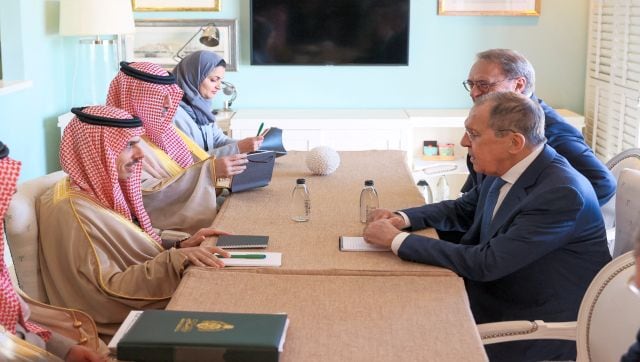 Russia's Sergey Lavrov and Saudi Arabia's foreign minister Prince Faisal bin Farhan Al Saud meet on the sidelines of a meeting of foreign ministers from the BRICS countries, in Cape Town, South Africa. Reuters[/caption]Rajiv Bhatia, Distinguished Fellow at the policy think tank Gateway House and a former Indian diplomat, told Indian Express explained why countries are seeking BRICS out. “First, there is considerable anti-US sentiment in the world, and all these countries are looking for a grouping where they can use that sentiment to gather together. Second, there is a lot of appetite for multipolarity, for a platform where countries of the Global South can express their solidarity.”Let’s talk about moneyIt will come as no surprise that the foreign ministers will also discuss economic cooperation between the countries as well as the idea of trading in one common currency or in local currencies.Currently, Russia and China as well as China and Brazil have been dealing in the yuan. In fact, the Chinese yuan, or renminbi, surpassed the Euro to become Brazil’s second-largest international reserve currency, according to a report published earlier in April. The report showed that the RMB accounted for 5.37 per cent of Brazil’s international exchange reserves by the end of 2022, surpassing the Euro’s 4.74 per cent share, reflecting the deepening economic ties between Brazil and China.[caption id="attachment_12682172" align="alignnone" width="640"]
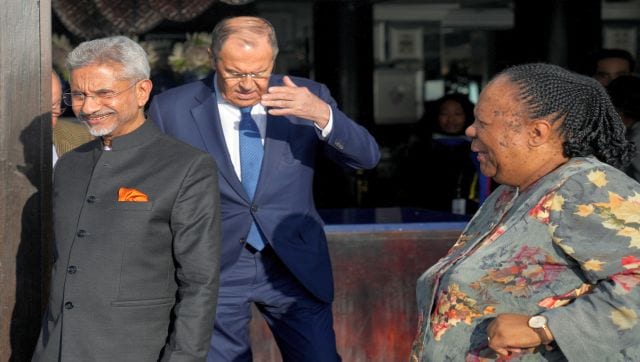 External Affairs Minister S Jaishankar, South Africa's Naledi Pandor and Russia's Sergey Lavrov share a lighter moment during the BRICS Foreign Ministers' meet. Reuters[/caption]Anil Trigunayat, a former Indian ambassador to Jordan, Libya and Malta who is also senior adviser with the BRICS Chamber of Commerce, such trading is likely to get encouragement at the foreign ministers’ meeting in Cape Town.There’s also the issue of establishing a common currency within the BRICS framework – an idea that was first proposed by Russia’s president Vladimir Putin at the Beijing BRICS summit last year. Initially, the idea received a cautious reception but since the Russia-Ukraine war, this idea has gained traction.Also read: Dumping the Dollar: Will a new BRICS currency replace the US currency for trade?In March this year, Russian lawmaker Alexander Babakov was quoted as saying by Sputnik News that leaders may “present ideas” about a joint currency at the August BRICS summit. The idea behind a common currency is to edge out the dollar – a dedollarisation drive.However, the establishment of a new currency comes with its own set of challenges. As South Africa’s Naledi Pandor had told Bloomberg earlier this year that the idea needed to be “properly” discussed. “I don’t think we should always assume the idea will work, because economics is very difficult and you have to have regard to all countries, especially in a situation of low growth when you are emerging from crises,” she said.Besides the economic complications, there’s also political aspects that need to be looked at. For instance, it is unclear if India and China can find an agreement amid the ongoing border standoff.[caption id="attachment_12682202" align="alignnone" width="640"]
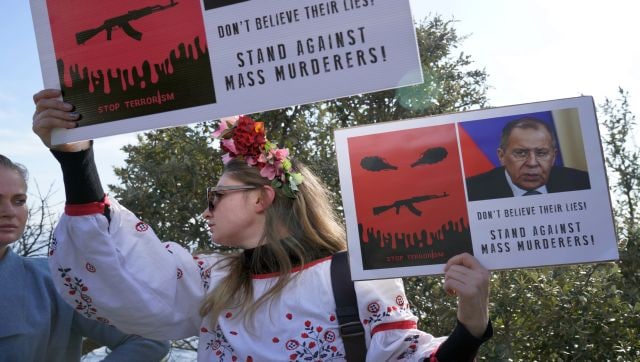 Demonstrators protest against the war in Ukraine at a venue where the Russian and Chinese foreign ministers are gathering for the BRICS meet. AP[/caption]Peace plan for UkraineThe ongoing Russia-Ukraine war, edging towards the 500th day, is also expected to be discussed at the meet. It is expected that China may push its 12-point peace plan but achieving a consensus among the member countries on this plan seems unlikely.Kamal Madishetty, senior researcher, Institute of Peace and Conflict Studies (IPCS), told The Print, “there may be a wider discussion about the urgency to end the war, as well as in dealing with the impact of the Ukraine conflict on the Global South, especially on food and energy security.”Last month, South African president Cyril Ramaphosa said Putin and Ukrainian president Volodymyr Zelenskyy had agreed to meet a group of African leaders to discuss a potential peace plan.Fight against terrorismThe matter of terrorism will also be discussed, with the BRICS issuing a joint statement, titled ‘The Cape of Good Hope’, expressing strong condemnation of terrorism “whenever, wherever and by whomsoever committed”.Speaking on the same, External Affairs Minister S Jaishankar on Thursday said that terrorism is one of the key threats to international peace and security and requested all nations to take measures “against this menace, including its financing and propaganda.”It is interesting to see what the meeting of the foreign ministers yield, but there’s bound to be interest as the five nation grouping represents 41 per cent of the global population, 24 per cent of the global GDP and 16 per cent of the global trade.With inputs from agenciesRead all the Latest News, Trending News, Cricket News, Bollywood News,India News and Entertainment News here. Follow us on Facebook, Twitter and Instagram.
First Published:Jun 02, 2023, 13:42:10 IST
Advertisement
Advertisement

Delhi Police asks personnel to wear uniform: What the law says on cops in plainclothes during protests
The Delhi Police has instructed all its personnel to wear uniforms when they report for duty at Jantar Mantar for crowd control. This comes after outrage grew over videos of men in civilian clothes or without name tags hitting protesters in the Capital. Is it legal for the police to ditch uniforms during protests?
4 min read
Military drones & police check-ups: How Sri Lanka is fighting against worst dengue outbreak in a decade
Sri Lanka is fighting its most severe dengue outbreak in nearly a decade, with infections rising sharply across the nation. Military drones have been deployed to tackle the outbreak, which has claimed 56 lives. Health officials said the outbreak is being driven primarily by the DENV-2 variant of the virus
3 min read
How Facebook job ad lured 2 Karnataka men into Myanmar cyber scam camp
The Karnataka Cyber Command has rescued two youths from a scam compound in Myanmar operated by Chinese fraudsters. The duo from Karnataka were lured on the pretext of data-entry jobs. They were asked to work for 16 hours a day and were expected to sleep for six hours daily
4 min read
Why is India seeing 95% cloud cover despite a Super El Niño?
India is witnessing nearly 95 per cent cloud cover despite a Super El Niño, a climate event usually linked to weaker monsoons. Regional weather systems, cyclonic circulations, the monsoon trough and moisture from two seas are temporarily overpowering one of the world's strongest climate phenomena
5 min read
What is CJP’s fourth demand to the government as protests in Delhi intensify?
The protest by the Cockroach Janta Party at Delhi’s Jantar Mantar refuses to die down. The group have made a fourth demand to the Centre, asking that no FIRs are filed against the agitators and that no legal action be taken. The government has expressed willingness to speak to the protesters, but refused to accede on the resignation of Education Minister Dharmandra Pradhan
5 min read
Advertisement
Advertisement