
Advertisement


Sections
NASA says Mars is spinning faster and faster. Here’s what we know
The findings, published in the journal Nature, come from data sent by the InSight Mars Lander which went dark after running out of power in December 2022. While scientists aren’t sure why this is happening, they say ice accumulating on Mars’ polar caps or post-glacial rebound could be responsible

The Red Planet is spinning faster and faster.The discovery was made by the National Aeronautics and Space Administration (NASA) which conducted its ‘most precise measurements ever’ of Mars’ rotation.Scientists have also for the first time revealed how the planet wobbles due to the “sloshing” of its molten metal core.But what does this mean exactly? And why is this happening?Let’s take a closer look:What do we know?The findings were published in the journal Nature.They are extrapolated based on data from NASA’s InSight Mars lander – which operated for four years before running out of power during its extended mission in December 2022.To track the planet’s spin rate, the study’s authors relied on one of InSight’s instruments: a radio transponder and antennas collectively called the Rotation and Interior Structure Experiment, or RISE.According to the NASA website, RISE would track the InSight Mars lander daily and be aware of its location down to a few centimetres.![]()
This allowed it to understand how much Mars' north pole wobbles as it orbits the Sun.It worked on the same principle that causes the sound from a fast-moving siren to change as it moves away, as per the website.It sent the signal back to Earth through the Deep Space Network.These observations provided detailed information on the size, composition, and characteristics of Mars' iron-rich core, the website states.The paper examined data from InSight’s first 900 Martian days.What did the researchers discover?They found the planet’s rotation is accelerating by about 4 milliarcseconds per year – corresponding to a shortening of the length of the Martian day by a fraction of a millisecond per year.Scientists had their work cut out for them to eliminate sources of noise: Water slows radio signals, so moisture in the Earth’s atmosphere can distort the signal coming back from Mars. So can the solar wind, the electrons and protons flung into deep space from the Sun.[caption id="attachment_12979452" align="alignnone" width="640"]
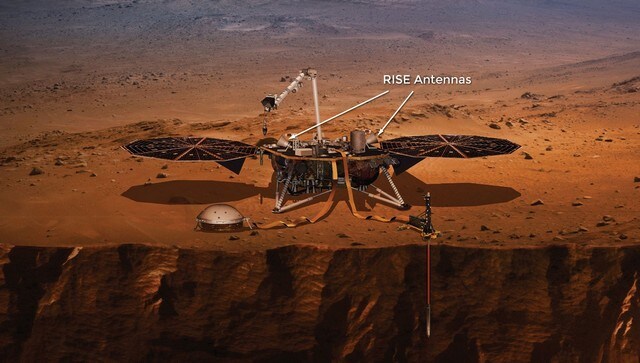
Artist's concept of InSight Lander on Mars. Image courtesy: NASA[/caption]“What we’re looking for are variations that are just a few tens of centimetres over the course of a Martian year,” said lead author and RISE’s principal investigator, Sebastien Le Maistre at the Royal Observatory of Belgium.“It takes a very long time and a lot of data to accumulate before we can even see these variations.”
“It’s a historic experiment,” added Le Maistre.“We have spent a lot of time and energy preparing for the experiment and anticipating these discoveries. But despite this, we were still surprised along the way – and it’s not over, since RISE still has a lot to reveal about Mars.”Why is this happening?It’s a subtle acceleration, and scientists aren’t entirely sure of the cause.But they have a few ideas, including ice accumulating on the polar caps or post-glacial rebound, where landmasses rise after being buried by ice.According to the website Daze Digital, Mars, despite its barren appearance, has ice caps at both poles.
The theory puts the expansion or reduction of these ice caps as a possible reason for its spin increasing.The shift in a planet’s mass can cause it to accelerate a bit like an ice skater spinning with their arms stretched out, then pulling their arms in.Digital Daze quoted Bruce Banerdt, InSight’s principal investigator, NASA’s Jet Propulsion Laboratory in Southern California, as saying in a statement, “It’s really cool to be able to get this latest measurement – and so precisely.”“I’ve been involved in efforts to get a geophysical station like InSight onto Mars for a long time, and results like this make all those decades of work worth it.”A piece on Science Alert.com noted that scientists will need to further analyse of Mars to understand why the planet is spinning faster and faster.RISE data was also used by the study authors to measure Mars’ wobble – called its nutation – due to sloshing in its liquid core. The measurement allows scientists to determine the size of the core: Based on RISE data, the core has a radius of roughly 1,835 kilometres.The authors then compared that figure with two previous measurements of the core derived from the spacecraft’s seismometer. Specifically, they looked at how seismic waves travelled through the planet’s interior – whether they reflected off the core or passed through it unimpeded.Taking all three measurements into account, they estimate the core’s radius to be between 1,790 and 1,850 kilometres. Mars as a whole has a radius of 3,390 kilometres – about half the size of Earth’s.Measuring Mars wobble also provided details about the shape of the core.“RISE’s data indicate the core’s shape cannot be explained by its rotation alone,” said the paper’s second author, Attilio Rivoldini of the Royal Observatory of Belgium.“That shape requires regions of slightly higher or lower density buried deep within the mantle.”With inputs from agencies
First Published:Aug 10, 2023, 09:26:54 IST
Advertisement
Advertisement

Delhi Police asks personnel to wear uniform: What the law says on cops in plainclothes during protests
The Delhi Police has instructed all its personnel to wear uniforms when they report for duty at Jantar Mantar for crowd control. This comes after outrage grew over videos of men in civilian clothes or without name tags hitting protesters in the Capital. Is it legal for the police to ditch uniforms during protests?
4 min read
Military drones & police check-ups: How Sri Lanka is fighting against worst dengue outbreak in a decade
Sri Lanka is fighting its most severe dengue outbreak in nearly a decade, with infections rising sharply across the nation. Military drones have been deployed to tackle the outbreak, which has claimed 56 lives. Health officials said the outbreak is being driven primarily by the DENV-2 variant of the virus
3 min read
How Facebook job ad lured 2 Karnataka men into Myanmar cyber scam camp
The Karnataka Cyber Command has rescued two youths from a scam compound in Myanmar operated by Chinese fraudsters. The duo from Karnataka were lured on the pretext of data-entry jobs. They were asked to work for 16 hours a day and were expected to sleep for six hours daily
4 min read
Why is India seeing 95% cloud cover despite a Super El Niño?
India is witnessing nearly 95 per cent cloud cover despite a Super El Niño, a climate event usually linked to weaker monsoons. Regional weather systems, cyclonic circulations, the monsoon trough and moisture from two seas are temporarily overpowering one of the world's strongest climate phenomena
5 min read
What is CJP’s fourth demand to the government as protests in Delhi intensify?
The protest by the Cockroach Janta Party at Delhi’s Jantar Mantar refuses to die down. The group have made a fourth demand to the Centre, asking that no FIRs are filed against the agitators and that no legal action be taken. The government has expressed willingness to speak to the protesters, but refused to accede on the resignation of Education Minister Dharmandra Pradhan
5 min read
Advertisement
Advertisement