


How India is testing waters amid oil shocks and rivalries in West Asia | Ex-envoy decodes
During Prime Minister Narendra Modi’s May 15 UAE stopover visit, both sides signed a major defence framework amid rising Gulf tensions and the UAE’s exit from OPEC+. Former envoy Sunjay Sudhir explains to Firstpost how New Delhi is balancing regional rivalries, safeguarding oil supplies, and advancing strategic autonomy in a polarised world

Last week, Prime Minister Narendra Modi wrapped up a quick stopover in Abu Dhabi before immediately transitioning to the European leg of his multi-nation tour.
This visit to the United Arab Emirates (UAE) came as New Delhi announced its first fuel hike in four years, raising petrol and diesel prices by Rs. 3 per litre. Like numerous nations in South and Southeast Asia, India is navigating a severe energy crunch fuelled by the ongoing US-Iran conflict.
In anticipation of these shocks, Modi made a rare address to the nation on May 11. He signalled that the West Asia crisis would demand a high degree of “citizen participation.”
He outlined seven pillars of economic self-reliance, urging the public to embrace fuel conservation via public transport and Electric Vehicles, and even suggesting a return to remote work to slash national fuel consumption.
 More from Explainers
It is evident that the West Asia conflict has transformed the geopolitical chess board in the Gulf.
The UAE shook the global energy market on May 1 by formally exiting the OPEC+ framework to assert its sovereign production targets while widening a highly visible divergence from Saudi Arabia.
Amidst this regional churning, rumours of targeted immigration crackdowns against certain South Asian nationalities have circulated, even as India and the UAE signed a historic defence industrial framework agreement during the May 15 meeting.
To decode the dynamics of Modi’s UAE visit, the tangible policy outcomes achieved in Abu Dhabi, and the resilience of India's "strategic autonomy" in a polarising world, Firstpost interacted with Ambassador Sunjay Sudhir in a wide-ranging interview.
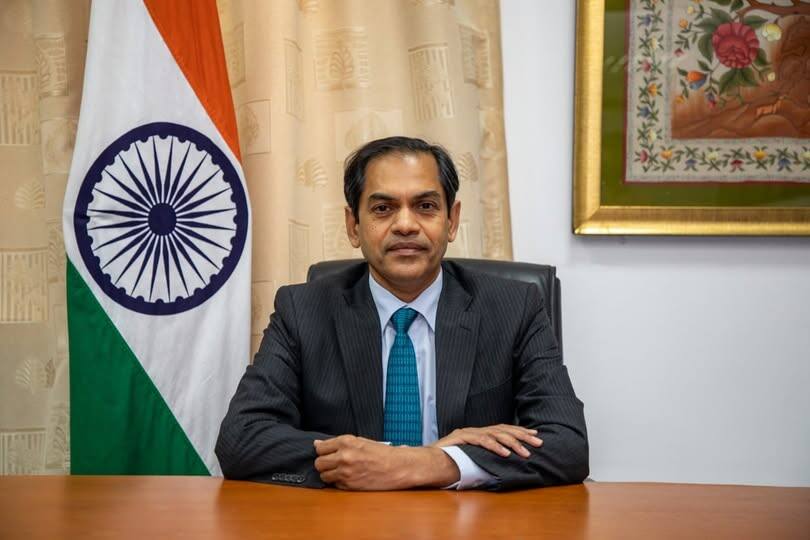
Having served as India’s Ambassador to the UAE from 2021 to 2025 — a transformational window that witnessed the signing of the landmark Comprehensive Economic Partnership Agreement (CEPA) and the integration of bilateral digital financial architectures — Sudhir, currently a Distinguished Fellow at the JSW School of Public Policy at the Indian Institute of Management Ahmedabad (IIMA), provides a window on the contemporary India-UAE paradigm.
An OPEC exit amid demand stewardship at home
The global energy ecosystem is reeling under the weight of maritime choke-point disruptions and a stubborn premium on crude and liquid natural gas (LNG).
With India importing more than 85 per cent of its crude oil requirements, any prolonged price escalation presents a direct threat to fiscal deficits and retail inflation.
The timing of the UAE’s decision to sever ties with OPEC+ quotas has raised vital questions: Can Abu Dhabi act as India’s ultimate energy shock-absorber, and how should the public interpret New Delhi’s sudden calls for domestic fuel conservation?
When asked whether Abu Dhabi could provide the necessary economic cushioning to stabilise domestic fuel prices during this acute crisis, Sudhir offered an expansive look at the structural insulation India has built over the years.
"India's energy security architecture has been deliberately designed for precisely this kind of volatility. We have systematically diversified our crude basket — the share of any single supplier or region has been brought down significantly over the past decade, and we now source crude from over thirty countries,” Sudhir told Firstpost.
“The UAE is among our top suppliers and a particularly reliable one: ADNOC has stood by every term contract obligation, and Abu Dhabi is, notably, the only foreign entity storing crude in our Strategic Petroleum Reserves at Mangalore, which is a unique arrangement that gives us a first-call option in a genuine emergency.”
A cornerstone of Modi’s visit was an agreement for the Abu Dhabi National Oil Company (ADNOC) to fill India’s Mangalore cavern.
“We have also operationalised rupee-dirham settlement, which insulates a portion of our trade from dollar-linked volatility. The Prime Minister's appeal on May 11 should be read as responsible demand-side stewardship, moderating consumption is the right thing to do in any tight market, and not as a signal of supply anxiety,” he added.
By utilising the Local Currency Settlement (LCS) system — the rupee-dirham mechanism formalised during Sudhir’s tenure — New Delhi and Abu Dhabi have effectively bypassed the weaponisation or volatility of dollar-clearing channels for a portion of their transactional volume.
On UAE’s production after OPEC exit, Sudhir added, “That is a sovereign decision for Abu Dhabi to take in light of its own national interests; our engagement with them is on the steady, long-term basis that has characterised the relationship for decades. But surely, after its exit from OPEC its exportable quantity will increase from 3.2 million barrels per day to 4.85 and our oil companies can benefit."
UAE’s “rift” with Pakistan amid India embrace
Over the last several months, reports have pointed to tightening visa regulations, more stringent background verifications, and deportations of Pakistani nationals by UAE authorities.
Questions have been raised over whether Abu Dhabi is replacing volatile regional workforces with Indian professionals as it accelerates its transition toward a high-tech, artificial intelligence-driven knowledge economy.
Last month, the UAE also sought the repayment of $3.5 billion from Islamabad, a demand that came as a jolt to Pakistan's already fragile economic situation.
Firstpost asked Sudhir if these developments indicate a fundamental shift where the UAE has structurally chosen India as its primary human resource and security anchor in South Asia.
Sudhir responded, "It would not be appropriate for me to characterise or comment upon the sovereign immigration and visa decisions taken by one country with respect to the nationals of another. Those are bilateral matters between the UAE and the country in question. What I can speak to is the substance of the India-UAE Comprehensive Strategic Partnership, which has its own independent and very substantial logic.”
“We have approximately 4.5 million Indian nationals living and working in the UAE, which is the largest expatriate community there, and a community whose welfare, dignity, and remittances are a top priority for the Government of India. The Indian community has grown from 2.2 million in 2015 to 4.5 million in 2024. That is a substantial increase.”
“We have CEPA, which has pushed non-oil bilateral trade towards the USD 100 billion target ahead of schedule. We have defence cooperation, counter-terrorism cooperation, fintech integration through UPI-AANI linkage, and strategic investments through ADIA, Mubadala and ADQ into India's infrastructure and energy transition. India's relationship with the UAE is built on this dense, positive agenda. It is neither defined by, nor framed against any third country," he added.
Navigating the Abu Dhabi vs Riyadh schism
It is no secret that the architecture of the Gulf Cooperation Council (GCC) is undergoing its most profound internal realignment in a generation.
This presents an intricate balancing act for New Delhi, which relies heavily on both capitals for energy, remittances, and counter-terrorism coordination.
Firstpost questioned how Indian diplomacy manages to navigate this apparent "open rivalry" without being backed into a corner or forced to compromise its ties with either side.
Sudhir rejected the premise of a zero-sum game, identifying this balancing act as the ultimate validation of India's long-standing policy of strategic autonomy.
"India enjoys deep, independent and historically rooted strategic partnerships with both Abu Dhabi and Riyadh, and we believe each capital values its relationship with New Delhi on its own merits. With Saudi Arabia, we have the Strategic Partnership Council, with two ministerial pillars covering political-security and economic-investment cooperation; the Kingdom remains a top energy supplier and an essential partner for the welfare of over 2.6 million Indians there. With the UAE, we have a Comprehensive Strategic Partnership, CEPA, the I2U2 grouping, and an expanding defence and connectivity agenda,” he said.
“Our approach has been consistent across governments: engage every partner on the strength of shared interests, refuse to view the region through a zero-sum prism, and ensure that the depth of one relationship is never at the cost of another. This is not a new posture but it is the operationalisation of strategic autonomy. The premise that India will be "forced to pick a side" overestimates the divergence and underestimates the maturity of all three relationships. Where Indian interests are directly engaged ie energy security, the welfare of nine million Indians in the Gulf, maritime stability, we will speak our mind clearly, but in our own voice."
The May 15 strategic defence framework
One of the most consequential outcomes of Prime Minister Modi’s May 15 stopover was the formalisation of an expansive defence agreement.
Critics have occasionally argued that while India-UAE ties are economically stellar, they have lagged in the hard-power security domain.
We asked the former Ambassador whether the UAE’s increasingly assertive, independent foreign policy makes them a more flexible and potent partner for India’s maritime security ambitions.
In response, Sudhir detailed the extensive operational integration already underway and disclosed the core components of the major framework agreement signed during the Prime Minister's visit.
"The India-UAE defence and maritime partnership has matured into one of the most substantive in the Indian Ocean Region, and its trajectory is set by the convergence of our interests, not by any third country's posture. Operationally, we now have the Desert Cyclone series of army exercises, the Desert Flag air exercise, the Zayed Talwar naval exercise, and increasing interoperability between the Indian Navy and the UAE Navy in the Gulf of Oman and the Arabian Sea,” he said.
Along with the recent defence framework with the UAE, Sudhir pointed out that “the I2U2 grouping, with Israel and the United States, provides an additional layer for technology, food security and maritime domain awareness cooperation.”
“A UAE that is more confident in shaping its own maritime security posture, including in the Bab el-Mandeb and the Western Indian Ocean, is entirely consistent with our SAGAR vision i.e. Security and Growth for All in the Region…”
The reality of a generative IMEC super-corridor
The escalation of hostilities involving actors in the Levant and the Red Sea has triggered widespread scepticism regarding the viability of the India-Middle East-Europe Economic Corridor (IMEC).
Announced with great fanfare on the sidelines of the 2023 G20 Summit in New Delhi, the multi-modal transit corridor — intended to connect India's western ports to Europe via the UAE, Saudi Arabia, Jordan, and Israel — has been termed by some critics as structurally unviable under current regional conditions.
When asked if India and the UAE are actively actively formulating a "Plan B" — such as a truncated bypass route avoiding volatile zones — Sudhir strongly challenged the conventional narrative, providing an alternative framework for viewing transnational infrastructure projects.
"The India-Middle East-Europe Economic Corridor is a generational project, and generational projects are not abandoned at the first turbulence. They are built segment by segment as conditions permit. The strategic logic of IMEC remains compelling: it connects the world's fastest-growing major economy to Europe through some of the most stable, capital-rich economies in West Asia, and it gives the Gulf a manufacturing and consumer hinge to its east,” he opined.
“In the interim, the eastern maritime leg, from Mundra, JNPA and the west coast ports to Jebel Ali, is functioning at full capacity, and we have seen real, measurable progress with the UAE on customs harmonisation, digital documentation through the Virtual Trade Corridor, and port-to-port logistics.”
“The India-UAE-Jordan land bridge through Haifa is a natural component of the larger IMEC vision, not a substitute for it…,” adding that “connectivity projects of this scale are always built incrementally, and we have not seen anything in the current regional situation that alters the underlying economic and strategic case."
The new Brics dynamic
The multi-alignment policy pursued by both New Delhi and Abu Dhabi was put to a severe test at the recent Brics Foreign Ministers meeting in New Delhi on May 14-15.
Despite expanding the group to incorporate critical regional actors like Iran and the UAE, the forum failed to issue a unanimous joint communique due to irreconcilable differences over the ongoing conflict in West Asia.
Firstpost questioned how Modi and President Sheikh Mohamed bin Zayed Al Nahyan used their bilateral meeting to bridge the gap between competing regional factions, particularly given India's unique ties with both Tehran and Abu Dhabi.
Sudhir provided a compelling defence of quiet, deliberate diplomacy over public posturing.
"I would gently push back on the framing of the FMs' meeting as a "failure". Consensus-building in a grouping that now spans diverse geographies and perspectives is, by its nature, a deliberative process, and the absence of a joint statement on one issue does not negate substantive progress on the wider agenda of finance, technology, climate and Global South cooperation.”
“India, as chair, has approached this responsibility in the way we have always approached our convening role: quietly, constructively, and without grandstanding. The bilateral between the Prime Minister and His Highness Sheikh Mohamed bin Zayed covered the full regional canvas, including the West Asian situation, energy markets, the welfare of the Indian community, and connectivity. India's position, which we share candidly with all partners, is that de-escalation, restraint and a return to dialogue serve every country's interests, including Iran's and the UAE's.”
On Iran, he added, “With Tehran, we have a civilisational relationship, the Chabahar port partnership and an active diplomatic channel; with Abu Dhabi, we have the partnership I have described at length. Few countries in the world today can credibly speak to both capitals on the same day, and India will continue to use that unique capacity, but it will do so through diplomacy, not through press statements.”
Also Watch:
Ambassador Sunjay Sudhir’s analysis serves as a vital reminder that while current headlines focus on immediate crises, the structural foundations of India-UAE ties are geared toward long-term stability.
New Delhi is navigating the turbulent waters of West Asia not as a passive observer forced to choose sides, but as an independent, stabilising polar force in an emerging multipolar order.
Inhaling global affairs on a daily basis, Anmol likes to cover stories that intrigue him, especially around history, climate change and polo. He has far too many disparate interests with a constant itch for travel. You can follow him on X (_anmol_singla), and please feel free to reach out to him at anmol.singla@nw18.com for tips, feedback or travel recommendations

Why has Bangladesh’s choice of India spokespersons raised eyebrows?
Who is Sandeep Lamba, the Delhi cop removed from protest site duty after slapping female protester?
Explorers discover wreckage of plane 72 years later. Will this help in finding MH370?
Cruise missiles, drones and more... The deadly arsenal of the Houthis
Why India may not witness a medal rush at 2026 Commonwealth Games