
Advertisement


Sections
Why Maratha reservation protests have reignited in Maharashtra
The Maharashtra government has called an all-party meeting today to build a consensus on the demand by Marathas for reservation in education and government jobs. This comes amid a renewed stir in the state started by Maratha Kranti Morcha leader Manoj Jarange-Patil in late August

The Maratha reservation issue is resurfaced at the centre of Maharashtra politics. The Eknath Shinde-led state government has called an all-party meeting today (11 September) to find a solution to the ongoing Maratha quota stir.The fresh protests started after Maratha Kranti Morcha leader Manoj Jarange-Patil went on an indefinite hunger strike in Antarwali Sarathe village of Jalna district on 29 August calling for reservations for Marathas in educational institutions and government jobs. He reportedly announced recently that he has given up water and intravenous support.On Jarange-Patil’s strike, Maharashtra deputy chief minister Ajit Pawar said on Sunday (10 September) in Pune, “We have made all possible efforts to end Jarange-Patil’s hunger strike but he refused to call it off”, reported Hindustan Times (HT).Let’s take a closer look at what’s going on in Maharashtra.But first, who are the Marathas?The Marathas comprise a group of castes who are traditionally peasants and landowners. They make up around 33 per cent of the population in Maharashtra, as per an Indian Express report.The Marathas have dominated Maharashtra politics since the state was formed in 1960. Out of the 20 chief ministers so far, 12 – including the incumbent Eknath Shinde – belonged to the Maratha community, the report added.Political scientist Suhas Palshikar believes that except for some time in the 1980s, the share of Marathas has mostly remained over 50 per cent in the state Cabinet, reported Times of India (TOI).The demand for a reservation by the Marathas is not new. The issue has taken influenced state politics and led to mass agitations since 1981, as per Indian Express. The community has cited a decline in financial prosperity due to agrarian problems for their demand for quotas in education and government jobs.In 2017 and 2018, the Marathas organised massive protests in the state to push for their demand for reservations.[caption id="attachment_13111382" align="alignnone" width="640"]![]() Maharashtra's Maratha community held protests in 2017 demanding quotas in government jobs and education. Reuters File Photo[/caption]Previous attempts to meet demandBefore the 2014 Maharashtra Assembly elections, the then Congress-led government announced an ordinance granting 16 per cent reservation to Marathas in government jobs and education.However, the Congress lost the Assembly polls in 2014 and was replaced by the BJP-Shiv Sena coalition.Outfits such as Maratha Kranti Morcha and Sakal Maratha Samaj spearheaded mass protests in Maharashtra in 2017 and 2018 over the reservation issue, which turned violent.In November 2018, the then Devendra Fadnavis-led government gave 16 per cent reservations to the Marathas under the Socially and Educationally Backward Class (SEBC) Act.The next year, the Bombay High Court upheld the constitutional validity of the Maratha quota under SEBC. However, the court reduced the 16 per cent reservation to 12 per cent in education and 13 per cent in government jobs, as per the Maharashtra State Backward Class Commission’s recommendation, reported Indian Express.However, in 2021, the Supreme Court blocked the Maratha reservation, citing the breach of the 50 per cent cap on total reservations the court had set in its 1992 Indra Sawhney judgement.The top court also noted that only the president can amend the central list of socially and backward classes, while states could only make “suggestions”, according to The Hindu.As per Scroll, the then Uddhav Thackeray-led Maha Vikas Aghadi (MVA) government had sought the Centre and president’s intervention to grant Maratha quota. However, the issue remains unresolved till now.In April this year, the apex court rejected a review petition in the matter.The renewed Maratha quota stirMaratha leader Jarange-Patil was thrown into the limelight after his protest for the Maratha quota took a violent turn on 1 September. As per The Hindu, the police baton charged and fired tear gas shells to disperse a violent mob in the Antarwali Sarathi village which stopped local authorities from shifting Jarange-Patil to a hospital.Several people, including 40 police personnel, were injured in the incident. Over 15 state transport buses were set on fire.The Opposition targeted the state government over the incident, demanding the resignation of deputy chief minister Fadnavis, who holds the home portfolio.It also led to more protests by the Maratha community across other parts of the state. Last week, Fadnavis said the government regretted the use of force against the protesters.Amid pressure, chief minister Shinde said on 4 September that a panel has been set up which will furnish a report within a month exploring how to issue Kunbi caste certificates to Marathas from the Marathwada region.Kunbis come under the Other Backward Classes (OBC) category in Maharashtra.Jarange-Patil, who is a farmer in Jalna, has refused to call off his protest until a government order (GR) is issued granting Maratha reservation.[caption id="attachment_13111392" align="alignnone" width="640"]
Maharashtra's Maratha community held protests in 2017 demanding quotas in government jobs and education. Reuters File Photo[/caption]Previous attempts to meet demandBefore the 2014 Maharashtra Assembly elections, the then Congress-led government announced an ordinance granting 16 per cent reservation to Marathas in government jobs and education.However, the Congress lost the Assembly polls in 2014 and was replaced by the BJP-Shiv Sena coalition.Outfits such as Maratha Kranti Morcha and Sakal Maratha Samaj spearheaded mass protests in Maharashtra in 2017 and 2018 over the reservation issue, which turned violent.In November 2018, the then Devendra Fadnavis-led government gave 16 per cent reservations to the Marathas under the Socially and Educationally Backward Class (SEBC) Act.The next year, the Bombay High Court upheld the constitutional validity of the Maratha quota under SEBC. However, the court reduced the 16 per cent reservation to 12 per cent in education and 13 per cent in government jobs, as per the Maharashtra State Backward Class Commission’s recommendation, reported Indian Express.However, in 2021, the Supreme Court blocked the Maratha reservation, citing the breach of the 50 per cent cap on total reservations the court had set in its 1992 Indra Sawhney judgement.The top court also noted that only the president can amend the central list of socially and backward classes, while states could only make “suggestions”, according to The Hindu.As per Scroll, the then Uddhav Thackeray-led Maha Vikas Aghadi (MVA) government had sought the Centre and president’s intervention to grant Maratha quota. However, the issue remains unresolved till now.In April this year, the apex court rejected a review petition in the matter.The renewed Maratha quota stirMaratha leader Jarange-Patil was thrown into the limelight after his protest for the Maratha quota took a violent turn on 1 September. As per The Hindu, the police baton charged and fired tear gas shells to disperse a violent mob in the Antarwali Sarathi village which stopped local authorities from shifting Jarange-Patil to a hospital.Several people, including 40 police personnel, were injured in the incident. Over 15 state transport buses were set on fire.The Opposition targeted the state government over the incident, demanding the resignation of deputy chief minister Fadnavis, who holds the home portfolio.It also led to more protests by the Maratha community across other parts of the state. Last week, Fadnavis said the government regretted the use of force against the protesters.Amid pressure, chief minister Shinde said on 4 September that a panel has been set up which will furnish a report within a month exploring how to issue Kunbi caste certificates to Marathas from the Marathwada region.Kunbis come under the Other Backward Classes (OBC) category in Maharashtra.Jarange-Patil, who is a farmer in Jalna, has refused to call off his protest until a government order (GR) is issued granting Maratha reservation.[caption id="attachment_13111392" align="alignnone" width="640"]![maratha quota stir]() Sakal Maratha Samaj members protest against Jalna administration on 3 September in Mumbai over the lathi-charge on demonstrators demanding Maratha quota. PTI[/caption]“The state government wants to give the Maratha community a reservation that will be foolproof and which will pass legal test. We are not taking any decision in haste. The state does not want to cheat anybody,” Shinde told reporters today ahead of the all-party meet, as per the news agency PTI.Fadnavis has assured the OBCs that “no injustice would be done to them” and the government will not take any decision that will pit them against the Marathas.Meanwhile, Maratha outfit Sakal Maratha Morcha called for a bandh in Thane today to protest against the recent police lathi-charge on agitators in Jalna. Local leaders from the Opposition also declared support for the bandh, reported PTI.Why is the stir politically significant?The current agitation gains prominence as it comes ahead of the crucial Maharashtra Assembly polls and Lok Sabha elections next year. Long overdue municipal elections in several cities, including Mumbai, Nagpur, Pune and Thane, are also in the offing.Political leaders of all hues including Nationalist Congress Party (NCP) supremo Sharad Pawar, Shiv Sena (Uddhav Balasaheb Thackeray) chief Uddhav Thackeray, Congress’ Ashok Chavan, Maharashtra Navnirman Sena (MNS) chief Raj Thackeray, Bharatiya Janata Party (BJP)’s Raosaheb Danve and Shinde faction’s Arjun Khotkar have visited Jarange-Patil in Jalna recently to express solidarity.According to opinion polls, there is a close fight between the ‘Mahayuti’ government, comprising the BJP, Shinde’s Shiv Sena camp and Ajit Pawar’s NCP faction, and the MVA coalition of the Congress, Shiv Sena (UBT) and Sharad Pawar-led NCP.With polls just months away, the issue of the Maratha reservation is expected to play a major role.With inputs from agencies
Sakal Maratha Samaj members protest against Jalna administration on 3 September in Mumbai over the lathi-charge on demonstrators demanding Maratha quota. PTI[/caption]“The state government wants to give the Maratha community a reservation that will be foolproof and which will pass legal test. We are not taking any decision in haste. The state does not want to cheat anybody,” Shinde told reporters today ahead of the all-party meet, as per the news agency PTI.Fadnavis has assured the OBCs that “no injustice would be done to them” and the government will not take any decision that will pit them against the Marathas.Meanwhile, Maratha outfit Sakal Maratha Morcha called for a bandh in Thane today to protest against the recent police lathi-charge on agitators in Jalna. Local leaders from the Opposition also declared support for the bandh, reported PTI.Why is the stir politically significant?The current agitation gains prominence as it comes ahead of the crucial Maharashtra Assembly polls and Lok Sabha elections next year. Long overdue municipal elections in several cities, including Mumbai, Nagpur, Pune and Thane, are also in the offing.Political leaders of all hues including Nationalist Congress Party (NCP) supremo Sharad Pawar, Shiv Sena (Uddhav Balasaheb Thackeray) chief Uddhav Thackeray, Congress’ Ashok Chavan, Maharashtra Navnirman Sena (MNS) chief Raj Thackeray, Bharatiya Janata Party (BJP)’s Raosaheb Danve and Shinde faction’s Arjun Khotkar have visited Jarange-Patil in Jalna recently to express solidarity.According to opinion polls, there is a close fight between the ‘Mahayuti’ government, comprising the BJP, Shinde’s Shiv Sena camp and Ajit Pawar’s NCP faction, and the MVA coalition of the Congress, Shiv Sena (UBT) and Sharad Pawar-led NCP.With polls just months away, the issue of the Maratha reservation is expected to play a major role.With inputs from agencies
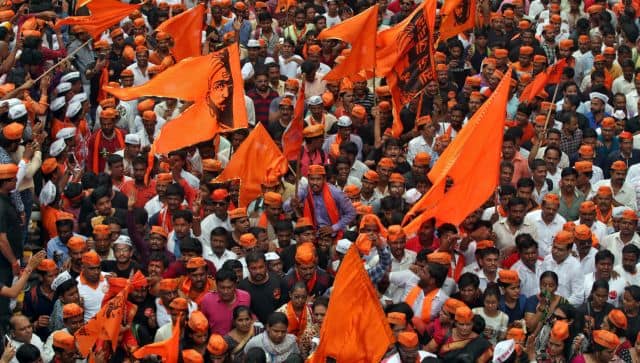 Maharashtra's Maratha community held protests in 2017 demanding quotas in government jobs and education. Reuters File Photo[/caption]Previous attempts to meet demandBefore the 2014 Maharashtra Assembly elections, the then Congress-led government announced an ordinance granting 16 per cent reservation to Marathas in government jobs and education.However, the Congress lost the Assembly polls in 2014 and was replaced by the BJP-Shiv Sena coalition.Outfits such as Maratha Kranti Morcha and Sakal Maratha Samaj spearheaded mass protests in Maharashtra in 2017 and 2018 over the reservation issue, which turned violent.In November 2018, the then Devendra Fadnavis-led government gave 16 per cent reservations to the Marathas under the Socially and Educationally Backward Class (SEBC) Act.The next year, the Bombay High Court upheld the constitutional validity of the Maratha quota under SEBC. However, the court reduced the 16 per cent reservation to 12 per cent in education and 13 per cent in government jobs, as per the Maharashtra State Backward Class Commission’s recommendation, reported Indian Express.However, in 2021, the Supreme Court blocked the Maratha reservation, citing the breach of the 50 per cent cap on total reservations the court had set in its 1992 Indra Sawhney judgement.The top court also noted that only the president can amend the central list of socially and backward classes, while states could only make “suggestions”, according to The Hindu.As per Scroll, the then Uddhav Thackeray-led Maha Vikas Aghadi (MVA) government had sought the Centre and president’s intervention to grant Maratha quota. However, the issue remains unresolved till now.In April this year, the apex court rejected a review petition in the matter.The renewed Maratha quota stirMaratha leader Jarange-Patil was thrown into the limelight after his protest for the Maratha quota took a violent turn on 1 September. As per The Hindu, the police baton charged and fired tear gas shells to disperse a violent mob in the Antarwali Sarathi village which stopped local authorities from shifting Jarange-Patil to a hospital.Several people, including 40 police personnel, were injured in the incident. Over 15 state transport buses were set on fire.The Opposition targeted the state government over the incident, demanding the resignation of deputy chief minister Fadnavis, who holds the home portfolio.It also led to more protests by the Maratha community across other parts of the state. Last week, Fadnavis said the government regretted the use of force against the protesters.Amid pressure, chief minister Shinde said on 4 September that a panel has been set up which will furnish a report within a month exploring how to issue Kunbi caste certificates to Marathas from the Marathwada region.Kunbis come under the Other Backward Classes (OBC) category in Maharashtra.Jarange-Patil, who is a farmer in Jalna, has refused to call off his protest until a government order (GR) is issued granting Maratha reservation.[caption id="attachment_13111392" align="alignnone" width="640"]
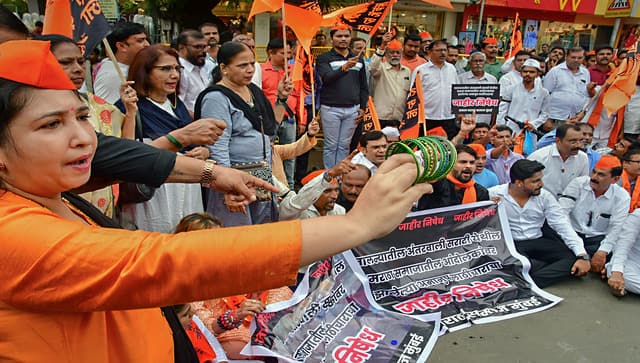 Sakal Maratha Samaj members protest against Jalna administration on 3 September in Mumbai over the lathi-charge on demonstrators demanding Maratha quota. PTI[/caption]“The state government wants to give the Maratha community a reservation that will be foolproof and which will pass legal test. We are not taking any decision in haste. The state does not want to cheat anybody,” Shinde told reporters today ahead of the all-party meet, as per the news agency PTI.Fadnavis has assured the OBCs that “no injustice would be done to them” and the government will not take any decision that will pit them against the Marathas.Meanwhile, Maratha outfit Sakal Maratha Morcha called for a bandh in Thane today to protest against the recent police lathi-charge on agitators in Jalna. Local leaders from the Opposition also declared support for the bandh, reported PTI.Why is the stir politically significant?The current agitation gains prominence as it comes ahead of the crucial Maharashtra Assembly polls and Lok Sabha elections next year. Long overdue municipal elections in several cities, including Mumbai, Nagpur, Pune and Thane, are also in the offing.Political leaders of all hues including Nationalist Congress Party (NCP) supremo Sharad Pawar, Shiv Sena (Uddhav Balasaheb Thackeray) chief Uddhav Thackeray, Congress’ Ashok Chavan, Maharashtra Navnirman Sena (MNS) chief Raj Thackeray, Bharatiya Janata Party (BJP)’s Raosaheb Danve and Shinde faction’s Arjun Khotkar have visited Jarange-Patil in Jalna recently to express solidarity.According to opinion polls, there is a close fight between the ‘Mahayuti’ government, comprising the BJP, Shinde’s Shiv Sena camp and Ajit Pawar’s NCP faction, and the MVA coalition of the Congress, Shiv Sena (UBT) and Sharad Pawar-led NCP.With polls just months away, the issue of the Maratha reservation is expected to play a major role.With inputs from agencies
First Published:Sep 11, 2023, 17:32:23 IST
Advertisement
Advertisement

Delhi Police asks personnel to wear uniform: What the law says on cops in plainclothes during protests
The Delhi Police has instructed all its personnel to wear uniforms when they report for duty at Jantar Mantar for crowd control. This comes after outrage grew over videos of men in civilian clothes or without name tags hitting protesters in the Capital. Is it legal for the police to ditch uniforms during protests?
4 min read
Military drones & police check-ups: How Sri Lanka is fighting against worst dengue outbreak in a decade
Sri Lanka is fighting its most severe dengue outbreak in nearly a decade, with infections rising sharply across the nation. Military drones have been deployed to tackle the outbreak, which has claimed 56 lives. Health officials said the outbreak is being driven primarily by the DENV-2 variant of the virus
3 min read
How Facebook job ad lured 2 Karnataka men into Myanmar cyber scam camp
The Karnataka Cyber Command has rescued two youths from a scam compound in Myanmar operated by Chinese fraudsters. The duo from Karnataka were lured on the pretext of data-entry jobs. They were asked to work for 16 hours a day and were expected to sleep for six hours daily
4 min read
Why is India seeing 95% cloud cover despite a Super El Niño?
India is witnessing nearly 95 per cent cloud cover despite a Super El Niño, a climate event usually linked to weaker monsoons. Regional weather systems, cyclonic circulations, the monsoon trough and moisture from two seas are temporarily overpowering one of the world's strongest climate phenomena
5 min read
What is CJP’s fourth demand to the government as protests in Delhi intensify?
The protest by the Cockroach Janta Party at Delhi’s Jantar Mantar refuses to die down. The group have made a fourth demand to the Centre, asking that no FIRs are filed against the agitators and that no legal action be taken. The government has expressed willingness to speak to the protesters, but refused to accede on the resignation of Education Minister Dharmandra Pradhan
5 min read
Advertisement
Advertisement