
Advertisement


Sections
Malaysia set to end mandatory death penalty: Which serious crimes will be exempted under new reforms?
Malaysia’s lower house of Parliament has approved a bill that would scrap mandatory capital punishment for certain offences such as kidnapping and some firearm crimes. The country put a moratorium on executions in 2018, but courts have continued to hand out death sentences

Malaysia’s lower house of Parliament okayed a bill on Monday (3 April) that would revoke mandatory capital punishment for certain offences.With this, lawmakers aim to limit the death penalty for serious crimes and reshape the criminal justice system.Now, the bill has to be cleared by the upper house and the king to become law, which is widely expected to happen.Let’s take a closer look at Malaysia’s new legal reforms.Malaysia to scrap mandatory death penaltyMalaysia has 34 criminal offences that carry death penalty, out of which 11 – murder, drug trafficking, treason, kidnapping and terrorism – have mandatory capital punishment.Under the new amendment, the Southeast Asian nation will abolish capital punishment for 11 offences that do not cause death, such as kidnapping and certain firearm crimes, reported Associated Press (AP).For these offences, the death penalty will now be replaced with “life imprisonment” with sentences between 30 and 40 years, and corporal punishment like caning at least 12 times.![state executions in 2021]() Graphic: Pranay Bhardwaj[/caption]The then-Mahathir Mohamad government had promised to abolish capital punishment in 2018, but due to political pressure from some parties, the plans were abandoned a year later.However, it allowed courts to replace death sentences with other punishments at their discretion, as per Reuters.Last June, under former prime minister Ismail Sabri Yaakob, Malaysia started the legal process to remove the death penalty as a mandatory punishment.Rights group welcomes Malaysia’s moveA human rights group has hailed Malaysia’s new legal reforms, saying it is an “important step forward” for the country.“This is an important breakthrough that will cause some serious conversations in the halls of upcoming ASEAN meetings,” Human Rights Watch deputy Asia director Phil Robertson told AFP.“Malaysia should show regional leadership by encouraging other governments in ASEAN to re-think their continued use of the death penalty, starting with Singapore which has recently gone on a post-COVID execution spree.”ALSO READ: Rare Saudi execution during Muslim holy monthCountries that still have death penaltyAs per Death Penalty Information Center, more than 70 per cent of the countries around the world have done away with capital punishment in law or practice.
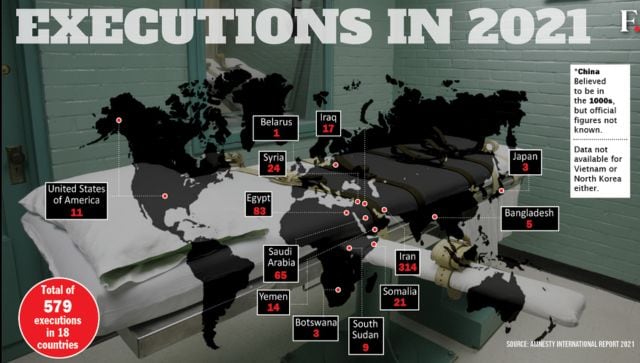
Graphic: Pranay Bhardwaj[/caption]The then-Mahathir Mohamad government had promised to abolish capital punishment in 2018, but due to political pressure from some parties, the plans were abandoned a year later.However, it allowed courts to replace death sentences with other punishments at their discretion, as per Reuters.Last June, under former prime minister Ismail Sabri Yaakob, Malaysia started the legal process to remove the death penalty as a mandatory punishment.Rights group welcomes Malaysia’s moveA human rights group has hailed Malaysia’s new legal reforms, saying it is an “important step forward” for the country.“This is an important breakthrough that will cause some serious conversations in the halls of upcoming ASEAN meetings,” Human Rights Watch deputy Asia director Phil Robertson told AFP.“Malaysia should show regional leadership by encouraging other governments in ASEAN to re-think their continued use of the death penalty, starting with Singapore which has recently gone on a post-COVID execution spree.”ALSO READ: Rare Saudi execution during Muslim holy monthCountries that still have death penaltyAs per Death Penalty Information Center, more than 70 per cent of the countries around the world have done away with capital punishment in law or practice.![countries where death penalty is legal]() Graphic: Pranay Bhardwaj[/caption]According to Amnesty International’s 2021 report a total of 579 executions were carried out in 18 countries. The figures did not include data from China, North Korea and Vietnam due to little or no information.China, which the international organisation believes carried out executions in thousands in 2021, classifies data on the death penalty as a state secret.Iran, Egypt and Saudi Arabia accounted for 80 per cent of all known executions in 2021.The number of known death sentences in 2021 stood at 2,052, a nearly 40 per cent rise from 2020 (1,477).Among the methods of execution in 2021, hanging and firing squads were the most common, Al Jazeera reported citing the Amnesty International report.While lethal injection is the widely used method of execution in the United States China and Vietnam, Saudi Arabia continues beheading with a sword.Last year, Singapore executed 11 people convicted of drug offences, as per the government data.Four pro-democracy activists were hanged by the military government in Myanmar – the country’s first death sentences in decades.Between 1992 and 2023, Malaysia has hanged 1,318 prisoners, BBC reported citing official data.With inputs from agenciesRead all the Latest News, Trending News, Cricket News, Bollywood News,India News and Entertainment News here. Follow us on Facebook, Twitter and Instagram.
Graphic: Pranay Bhardwaj[/caption]According to Amnesty International’s 2021 report a total of 579 executions were carried out in 18 countries. The figures did not include data from China, North Korea and Vietnam due to little or no information.China, which the international organisation believes carried out executions in thousands in 2021, classifies data on the death penalty as a state secret.Iran, Egypt and Saudi Arabia accounted for 80 per cent of all known executions in 2021.The number of known death sentences in 2021 stood at 2,052, a nearly 40 per cent rise from 2020 (1,477).Among the methods of execution in 2021, hanging and firing squads were the most common, Al Jazeera reported citing the Amnesty International report.While lethal injection is the widely used method of execution in the United States China and Vietnam, Saudi Arabia continues beheading with a sword.Last year, Singapore executed 11 people convicted of drug offences, as per the government data.Four pro-democracy activists were hanged by the military government in Myanmar – the country’s first death sentences in decades.Between 1992 and 2023, Malaysia has hanged 1,318 prisoners, BBC reported citing official data.With inputs from agenciesRead all the Latest News, Trending News, Cricket News, Bollywood News,India News and Entertainment News here. Follow us on Facebook, Twitter and Instagram.
Previously, judges had no choice but to order capital punishment by hanging for these 11 offences.As per a South China Morning Post (SCMP) report, presenting the legislation in Parliament on Monday, deputy law minister Ramkarpal Singh said: “Imprisonment for a period of time and caning is seen as the most appropriate alternative punishment for the 11 offences that carries the death penalty”.However, judges can use their discretion to hand out capital punishment in exceptional cases.Moreover, the bill also proposes to scrap “imprisonment for natural life” that put criminals behind bars till their death. This will also be replaced with imprisonment sentences of up to 40 years and caning, reported AP.As per AP, 1,318 people are on death row in the country, out of which 842 have exhausted all other legal appeals.Most of these cases are related to drug trafficking. AP reported citing the Anti-Death Penalty Asia Network that 500 of those on death row in the country are foreigners.These proposed reforms will allow these death row convicts to file a review of their sentences till 90 days after the legislation comes into effect, Malaysia's deputy law minister said.ALSO READ: Why does Idaho want to bring back firing squads for executing prisoners?Why is Malaysia removing mandatory death penalty?Addressing the Parliament, Singh said the death penalty was irreversible and had failed to discourage crimes.“We cannot arbitrarily ignore the existence of the inherent right to life of every individual. The death penalty has not brought the results it was intended to bring,” Singh was quoted as saying by Al Jazeera.Abolishing capital punishment has been a contentious issue in Malaysia for more than a decade now.Malaysia has had a moratorium on executions since 2018, but courts have continued to hand out capital punishment.[caption id="attachment_12404182" align="alignnone" width="640"]
 Graphic: Pranay Bhardwaj[/caption]The then-Mahathir Mohamad government had promised to abolish capital punishment in 2018, but due to political pressure from some parties, the plans were abandoned a year later.However, it allowed courts to replace death sentences with other punishments at their discretion, as per Reuters.Last June, under former prime minister Ismail Sabri Yaakob, Malaysia started the legal process to remove the death penalty as a mandatory punishment.Rights group welcomes Malaysia’s moveA human rights group has hailed Malaysia’s new legal reforms, saying it is an “important step forward” for the country.“This is an important breakthrough that will cause some serious conversations in the halls of upcoming ASEAN meetings,” Human Rights Watch deputy Asia director Phil Robertson told AFP.“Malaysia should show regional leadership by encouraging other governments in ASEAN to re-think their continued use of the death penalty, starting with Singapore which has recently gone on a post-COVID execution spree.”ALSO READ: Rare Saudi execution during Muslim holy monthCountries that still have death penaltyAs per Death Penalty Information Center, more than 70 per cent of the countries around the world have done away with capital punishment in law or practice.
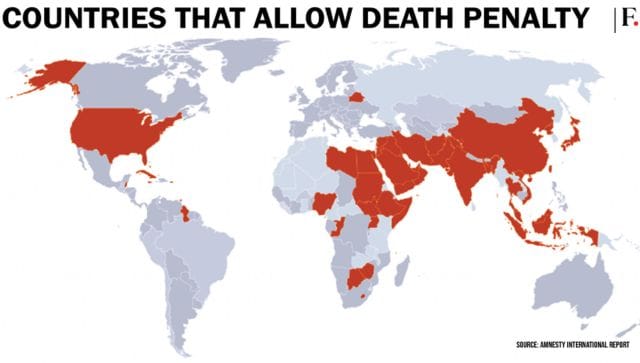
Last year, Kazakhstan and Papua New Guinea joined the list of nations to have abolished the death penalty.However, certain countries continue to order executions. Capital punishment is legal in India, the United States, China, Afghanistan, Bangladesh, Iran, Iraq, Pakistan, Japan, Saudi Arabia, and Thailand among others.[caption id="attachment_12404192" align="alignnone" width="640"]
 Graphic: Pranay Bhardwaj[/caption]According to Amnesty International’s 2021 report a total of 579 executions were carried out in 18 countries. The figures did not include data from China, North Korea and Vietnam due to little or no information.China, which the international organisation believes carried out executions in thousands in 2021, classifies data on the death penalty as a state secret.Iran, Egypt and Saudi Arabia accounted for 80 per cent of all known executions in 2021.The number of known death sentences in 2021 stood at 2,052, a nearly 40 per cent rise from 2020 (1,477).Among the methods of execution in 2021, hanging and firing squads were the most common, Al Jazeera reported citing the Amnesty International report.While lethal injection is the widely used method of execution in the United States China and Vietnam, Saudi Arabia continues beheading with a sword.Last year, Singapore executed 11 people convicted of drug offences, as per the government data.Four pro-democracy activists were hanged by the military government in Myanmar – the country’s first death sentences in decades.Between 1992 and 2023, Malaysia has hanged 1,318 prisoners, BBC reported citing official data.With inputs from agenciesRead all the Latest News, Trending News, Cricket News, Bollywood News,India News and Entertainment News here. Follow us on Facebook, Twitter and Instagram.
First Published:Apr 04, 2023, 14:21:25 IST
Advertisement
Advertisement

Military drones & police check-ups: How Sri Lanka is fighting against worst dengue outbreak in a decade
Sri Lanka is fighting its most severe dengue outbreak in nearly a decade, with infections rising sharply across the nation. Military drones have been deployed to tackle the outbreak, which has claimed 56 lives. Health officials said the outbreak is being driven primarily by the DENV-2 variant of the virus
3 min read
How Facebook job ad lured 2 Karnataka men into Myanmar cyber scam camp
The Karnataka Cyber Command has rescued two youths from a scam compound in Myanmar operated by Chinese fraudsters. The duo from Karnataka were lured on the pretext of data-entry jobs. They were asked to work for 16 hours a day and were expected to sleep for six hours daily
4 min read
Why is India seeing 95% cloud cover despite a Super El Niño?
India is witnessing nearly 95 per cent cloud cover despite a Super El Niño, a climate event usually linked to weaker monsoons. Regional weather systems, cyclonic circulations, the monsoon trough and moisture from two seas are temporarily overpowering one of the world's strongest climate phenomena
5 min read
What is CJP’s fourth demand to the government as protests in Delhi intensify?
The protest by the Cockroach Janta Party at Delhi’s Jantar Mantar refuses to die down. The group have made a fourth demand to the Centre, asking that no FIRs are filed against the agitators and that no legal action be taken. The government has expressed willingness to speak to the protesters, but refused to accede on the resignation of Education Minister Dharmandra Pradhan
5 min read
The new geography of war: Why the Houthis can no longer be ignored
The rise of the Houthis marks the emergence of a new geography of war — one in which influence flows not only from capitals and conventional armies, but also from rugged mountains overlooking vital sea lanes
6 min read
Advertisement
Advertisement