
Advertisement


Sections
Hold. Delay. Go: How ISRO launched Gaganyaan's first test flight after 'anomaly'
ISRO successfully completed the first test flight for India’s ambitious Gaganyaan mission, hours after the planned lift-off was put ‘on hold’. Here’s why the first attempt had to be deferred and how the space agency overcame the ‘anomaly’

The Indian Space Research Organisation (ISRO) successfully launched the first test flight for India’s ambitious Gaganyaan mission in its second attempt today (21 October). The maiden Flight Test Vehicle Abort Mission-1 (TV-D1) took off from the Satish Dhawan Space Centre (SDSC) in Sriharikota, Andhra Pradesh.Earlier in the day, the mission was put "on hold" just seconds before the lift-off. The test flight was initially scheduled for 8 am but had to be postponed for 45 minutes due to the morning showers in Andhra Pradesh’s Sriharikota.The mission director initiated the automatic launch sequence but five seconds before its rescheduled launch time at 8:45 am, the ground support computer halted the launch because of an “anomaly”.Let’s take a look at what delayed the first launch and why the test flight is significant for India’s first human spaceflight project.What happened during the first attempt?According to the Indian space agency, the engine ignition of the TV-D1 rocket did not happen on time.“The lift-off attempt could not happen today. It was initially scheduled at 8 AM. It was postponed to 8.45 AM due to the weather situation. We had a very smooth automatic launch sequence leading up to the command to lift-off. But engine lift-off did not happen. We have to find out what went wrong. The vehicle is safe. We will come back soon after analysing what triggered the hold on the vehicle. The ground checkout computer withheld the launch after observing an anomaly,” ISRO chairman S Somanath said earlier today after the mission was called off.He also said from the Mission Control Center that “we will come back soon after analysing what triggered the Automatic Launch Sequence (ALS) holding the vehicle."Around 9:35 am, the space agency posted on X, “Reason for the launch hold is identified and corrected. The launch is planned at 10:00 Hrs today.”Explaining the cause for the delay and the ultimate resolution of the issue, the ISRO chief said: "I will also like to tell the reason for why we had a hold. After going through the nominal lift-off process, there was a hold issued by the ground computer — called the automatic launch sequence computer — that detected a non-conformance for allowing the engine to continue the thrusting to go further. This happened due to a monitoring anomaly in the system, which is why we could identify it very fast and correct it”.What’s the test mission about?The TV-D1 mission lasted a total of just 532 seconds from its lift-off at 10 am to the crew module splashdown about 10 km from the Sriharikota coast.Its objective was to showcase the performance of the crew escape system. During the test flight, the rocket lifted off to an altitude of almost 17 km before the abort signal was initiated, resulting in the separation of the crew module. The crew module then descended through parachutes with a splashdown in the Bay of Bengal.[caption id="attachment_13279662" align="alignnone" width="640"]![isro gaganyaan mission]()
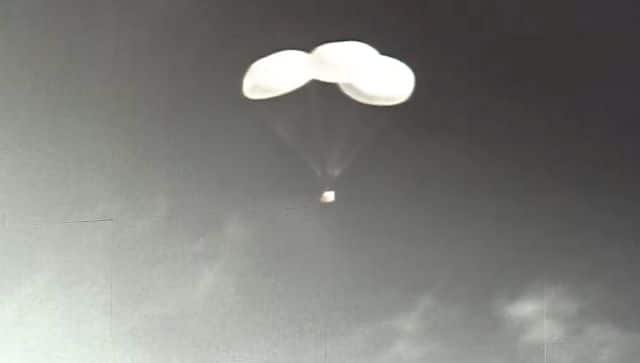
Crew module of TV-D1 test flight descends using parachutes. PTI[/caption]"We are very happy to announce the success of the mission. The purpose of the mission was to demonstrate the crew escape system. The vehicle went slightly above the speed of sound, before it initiated the crew escape system. All the parachutes operated, and touched down at the expected velocity," the ISRO chief announced. He said the agency was working to recover the crew modules from the sea.
A diving team and ship of the Indian Navy have been deployed to retrieve the crew module from the Bay of Bengal.Why is the test flight important?This test flight is among the two abort missions of the ISRO to check the safety mechanisms for the Gaganyaan crew in case of an emergency. The successful separation of the crew module from the launch vehicle ensured that the astronauts could escape during a mid-flight emergency (abort mission), noted Indian Express.The crew module is the capsule inside which the astronauts will be seated during the Gaganyaan mission.“This Test Vehicle mission with this CM (crew module) is a significant milestone for the overall Gaganyaan programme as a near-complete system is integrated for a flight test. The success of this test flight will set the stage for the remaining qualification tests and unmanned missions, leading to the first Gaganyaan mission with Indian astronauts,” the ISRO said earlier, according to the newspaper.The Indian space agency has prioritised the safety of its Gaganyaan astronauts and is building environmental control and life support systems for the crew module. An integrated vehicle health management system that can flag any anomaly that could put the astronauts at risk is also in the pipeline, reported Indian Express.India intends to send a manned Gaganyaan mission to space by 2025.With inputs from agenciesFirst Published:Oct 21, 2023, 11:46:48 IST
Advertisement
Advertisement

Delhi Police asks personnel to wear uniform: What the law says on cops in plainclothes during protests
The Delhi Police has instructed all its personnel to wear uniforms when they report for duty at Jantar Mantar for crowd control. This comes after outrage grew over videos of men in civilian clothes or without name tags hitting protesters in the Capital. Is it legal for the police to ditch uniforms during protests?
4 min read
Military drones & police check-ups: How Sri Lanka is fighting against worst dengue outbreak in a decade
Sri Lanka is fighting its most severe dengue outbreak in nearly a decade, with infections rising sharply across the nation. Military drones have been deployed to tackle the outbreak, which has claimed 56 lives. Health officials said the outbreak is being driven primarily by the DENV-2 variant of the virus
3 min read
How Facebook job ad lured 2 Karnataka men into Myanmar cyber scam camp
The Karnataka Cyber Command has rescued two youths from a scam compound in Myanmar operated by Chinese fraudsters. The duo from Karnataka were lured on the pretext of data-entry jobs. They were asked to work for 16 hours a day and were expected to sleep for six hours daily
4 min read
Why is India seeing 95% cloud cover despite a Super El Niño?
India is witnessing nearly 95 per cent cloud cover despite a Super El Niño, a climate event usually linked to weaker monsoons. Regional weather systems, cyclonic circulations, the monsoon trough and moisture from two seas are temporarily overpowering one of the world's strongest climate phenomena
5 min read
What is CJP’s fourth demand to the government as protests in Delhi intensify?
The protest by the Cockroach Janta Party at Delhi’s Jantar Mantar refuses to die down. The group have made a fourth demand to the Centre, asking that no FIRs are filed against the agitators and that no legal action be taken. The government has expressed willingness to speak to the protesters, but refused to accede on the resignation of Education Minister Dharmandra Pradhan
5 min read
Advertisement
Advertisement