
Advertisement


Sections
How did ISRO bring Chandrayaan-3’s propulsion module to Earth’s orbit?
ISRO has added another feather to its cap by successfully returning the Chandrayaan-3 Propulsion Module (PM) to Earth’s orbit from the Moon’s orbit. This displays the space agency’s capability of planning and carrying out complex manoeuvres and taking care of the issue of space debris

Scientists at Indian Space Research Organisation (ISRO) keep making the country proud. After successfully launching Chandrayaan-3 from Sriharikota on 14 July and it touching down on the Moon – making India the first nation to land on the lunar surface’s south pole – on 23 August, the space agency has now moved the propulsion module of Chandrayaan-3 from an orbit around the Moon to an orbit around the earth.The move, being described as a ‘unique experiment’, is considered significant in space exploration, as it showcases India’s capability of not only landing a man on the Moon, but also successfully bringing him back to earth.We take a closer look at this ‘unique experiment – how it was carried out and why it is special.Bringing the propulsion module backChandrayaan-3’s propulsion module (PM) was to ferry the lander module from the Geostationary Transfer Orbit (GTO) to the final lunar polar circular orbit and separate the lander.On Tuesday, the PM was brought back to an orbit around the Earth, said ISRO.Initially, the PM, with the Spectro-polarimetry of HAbitable Planet Earth (SHAPE) payload, was to operate for about three months. It was later decided to use the available fuel in the PM to derive additional information for future lunar missions and demonstrate the mission operation strategies for a sample return mission.ISRO’s bold plan Once decided that they would attempt this brave experiment, ISRO scientists thought out a bold plan to move the PM from an orbit around the Moon to an orbit around the earth.On 9 October, they carried out the first manoeuvre in which the attitude was raised from 150 km to 5,112 km and they extended the orbital period from 2.1 hours to 7.2 hours.[caption id="attachment_13468572" align="alignnone" width="640"]![]() Rollout of rover of ISRO's Chandrayaan-3 from the lander to the lunar surface, as observed by Lander Imager Camera. FIle image/PTI[/caption]In the next step, on 13 October, a Trans-Earth injection (TEI) manoeuvre was performed. In simple terms, a TEI is a propulsion manoeuvre used to set a spacecraft on a trajectory which will intersect the Earth’s sphere of influence. According to ISRO, after the TEI move, the propulsion module made four Moon fly-bys before departing the Moon’s sphere of influence on 10 November.As of now, the PM is orbiting Earth and crossed its first perigee on 22 November with an altitude of 1.54 lakh km. Additionally, it will remain in orbit around the Earth for a year.Significance of moving the propulsion moduleThere are a number of reasons why ISRO and the country should celebrate the return manoeuvre of the propulsion module.Firstly, it reflects ISRO’s capability of planning and executing manoeuvres to bring a spacecraft back from Moon to Earth. The journey back shows that India has the software to execute such a crucial manoeuvre.[caption id="attachment_13468582" align="alignnone" width="640"]
Rollout of rover of ISRO's Chandrayaan-3 from the lander to the lunar surface, as observed by Lander Imager Camera. FIle image/PTI[/caption]In the next step, on 13 October, a Trans-Earth injection (TEI) manoeuvre was performed. In simple terms, a TEI is a propulsion manoeuvre used to set a spacecraft on a trajectory which will intersect the Earth’s sphere of influence. According to ISRO, after the TEI move, the propulsion module made four Moon fly-bys before departing the Moon’s sphere of influence on 10 November.As of now, the PM is orbiting Earth and crossed its first perigee on 22 November with an altitude of 1.54 lakh km. Additionally, it will remain in orbit around the Earth for a year.Significance of moving the propulsion moduleThere are a number of reasons why ISRO and the country should celebrate the return manoeuvre of the propulsion module.Firstly, it reflects ISRO’s capability of planning and executing manoeuvres to bring a spacecraft back from Moon to Earth. The journey back shows that India has the software to execute such a crucial manoeuvre.[caption id="attachment_13468582" align="alignnone" width="640"]![]() A vehicle moves past a mural depicting 'Chandrayaan-3' made near Nizamuddin in New Delhi. File image/PTI[/caption]The experiment is also the first time that ISRO demonstrated a gravity assist flyby not around Earth but another celestial body. For the layman, a gravity assist flyby is a technique where gravity of a planet or celestial body is used to redirect, speed up, and slingshot a spacecraft towards Earth.Also read: Chandrayaan-3 costs lesser than big films: How India keeps its space missions frugalMoreover, ISRO has been able to prevent the issue of space debris by avoiding the uncontrolled crashing of the propulsion module on to the Moon’s surface at the end of its life.Srimathy Kesan, founder and CEO of Space Kidz India, told The Week, “The successful return of the Chandrayaan-3 PM to earth’s orbit heralds a new chapter in India’s space exploration narrative, marked by technological prowess, meticulous planning, and groundbreaking achievements. This milestone not only amplifies India’s presence in the global space community but also paves the way for innovative advancements in future space missions.”The Chandrayaan-3 missionOn 23 August, India scripted history by successfully landing on the lunar surface, and also became the first to land near the south pole of the Moon. According to ISRO, the mission’s three objectives were to demonstrate a safe and soft landing on the lunar surface, to demonstrate a Rover roving on the Moon and to conduct in-situ scientific experiments.Celebrations broke out across the country when the lander (Vikram) and the 26 kg rover (Pragyan), made the soft landing near the south polar region of the Moon, less than a week after a similar Russian lander crashed.Also read: How India's Moon missions went from Somayaan to ChandrayaanPrime Minister Narendra Modi, who watched the soft-landing live from South Africa where he was attending the Brics summit, said: “India is now on the Moon.”The success of Chandrayaan-3 came 15 years after Chandrayaan-1, the country's first Moon mission in 2008. It was during this mission that the presence of water molecules on the parched lunar surface was discovered and it was also established that the Moon has an atmosphere during daytime.With inputs from agencies
A vehicle moves past a mural depicting 'Chandrayaan-3' made near Nizamuddin in New Delhi. File image/PTI[/caption]The experiment is also the first time that ISRO demonstrated a gravity assist flyby not around Earth but another celestial body. For the layman, a gravity assist flyby is a technique where gravity of a planet or celestial body is used to redirect, speed up, and slingshot a spacecraft towards Earth.Also read: Chandrayaan-3 costs lesser than big films: How India keeps its space missions frugalMoreover, ISRO has been able to prevent the issue of space debris by avoiding the uncontrolled crashing of the propulsion module on to the Moon’s surface at the end of its life.Srimathy Kesan, founder and CEO of Space Kidz India, told The Week, “The successful return of the Chandrayaan-3 PM to earth’s orbit heralds a new chapter in India’s space exploration narrative, marked by technological prowess, meticulous planning, and groundbreaking achievements. This milestone not only amplifies India’s presence in the global space community but also paves the way for innovative advancements in future space missions.”The Chandrayaan-3 missionOn 23 August, India scripted history by successfully landing on the lunar surface, and also became the first to land near the south pole of the Moon. According to ISRO, the mission’s three objectives were to demonstrate a safe and soft landing on the lunar surface, to demonstrate a Rover roving on the Moon and to conduct in-situ scientific experiments.Celebrations broke out across the country when the lander (Vikram) and the 26 kg rover (Pragyan), made the soft landing near the south polar region of the Moon, less than a week after a similar Russian lander crashed.Also read: How India's Moon missions went from Somayaan to ChandrayaanPrime Minister Narendra Modi, who watched the soft-landing live from South Africa where he was attending the Brics summit, said: “India is now on the Moon.”The success of Chandrayaan-3 came 15 years after Chandrayaan-1, the country's first Moon mission in 2008. It was during this mission that the presence of water molecules on the parched lunar surface was discovered and it was also established that the Moon has an atmosphere during daytime.With inputs from agencies
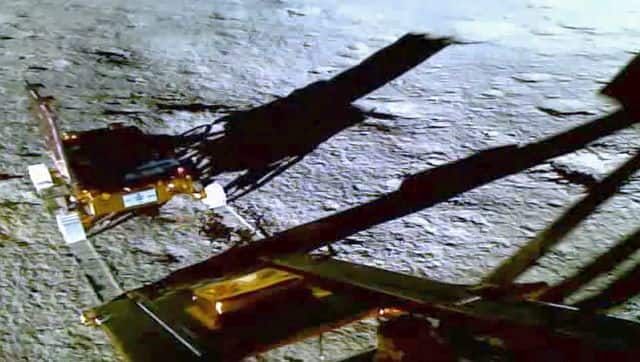 Rollout of rover of ISRO's Chandrayaan-3 from the lander to the lunar surface, as observed by Lander Imager Camera. FIle image/PTI[/caption]In the next step, on 13 October, a Trans-Earth injection (TEI) manoeuvre was performed. In simple terms, a TEI is a propulsion manoeuvre used to set a spacecraft on a trajectory which will intersect the Earth’s sphere of influence. According to ISRO, after the TEI move, the propulsion module made four Moon fly-bys before departing the Moon’s sphere of influence on 10 November.As of now, the PM is orbiting Earth and crossed its first perigee on 22 November with an altitude of 1.54 lakh km. Additionally, it will remain in orbit around the Earth for a year.Significance of moving the propulsion moduleThere are a number of reasons why ISRO and the country should celebrate the return manoeuvre of the propulsion module.Firstly, it reflects ISRO’s capability of planning and executing manoeuvres to bring a spacecraft back from Moon to Earth. The journey back shows that India has the software to execute such a crucial manoeuvre.[caption id="attachment_13468582" align="alignnone" width="640"]
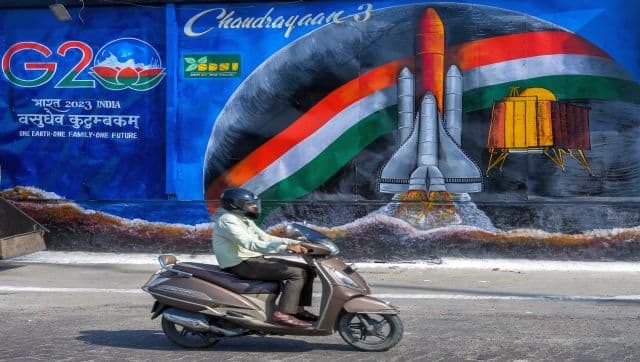 A vehicle moves past a mural depicting 'Chandrayaan-3' made near Nizamuddin in New Delhi. File image/PTI[/caption]The experiment is also the first time that ISRO demonstrated a gravity assist flyby not around Earth but another celestial body. For the layman, a gravity assist flyby is a technique where gravity of a planet or celestial body is used to redirect, speed up, and slingshot a spacecraft towards Earth.Also read: Chandrayaan-3 costs lesser than big films: How India keeps its space missions frugalMoreover, ISRO has been able to prevent the issue of space debris by avoiding the uncontrolled crashing of the propulsion module on to the Moon’s surface at the end of its life.Srimathy Kesan, founder and CEO of Space Kidz India, told The Week, “The successful return of the Chandrayaan-3 PM to earth’s orbit heralds a new chapter in India’s space exploration narrative, marked by technological prowess, meticulous planning, and groundbreaking achievements. This milestone not only amplifies India’s presence in the global space community but also paves the way for innovative advancements in future space missions.”The Chandrayaan-3 missionOn 23 August, India scripted history by successfully landing on the lunar surface, and also became the first to land near the south pole of the Moon. According to ISRO, the mission’s three objectives were to demonstrate a safe and soft landing on the lunar surface, to demonstrate a Rover roving on the Moon and to conduct in-situ scientific experiments.Celebrations broke out across the country when the lander (Vikram) and the 26 kg rover (Pragyan), made the soft landing near the south polar region of the Moon, less than a week after a similar Russian lander crashed.Also read: How India's Moon missions went from Somayaan to ChandrayaanPrime Minister Narendra Modi, who watched the soft-landing live from South Africa where he was attending the Brics summit, said: “India is now on the Moon.”The success of Chandrayaan-3 came 15 years after Chandrayaan-1, the country's first Moon mission in 2008. It was during this mission that the presence of water molecules on the parched lunar surface was discovered and it was also established that the Moon has an atmosphere during daytime.With inputs from agencies
First Published:Dec 05, 2023, 16:31:40 IST
Advertisement
Advertisement

Military drones & police check-ups: How Sri Lanka is fighting against worst dengue outbreak in a decade
Sri Lanka is fighting its most severe dengue outbreak in nearly a decade, with infections rising sharply across the nation. Military drones have been deployed to tackle the outbreak, which has claimed 56 lives. Health officials said the outbreak is being driven primarily by the DENV-2 variant of the virus
3 min read
How Facebook job ad lured 2 Karnataka men into Myanmar cyber scam camp
The Karnataka Cyber Command has rescued two youths from a scam compound in Myanmar operated by Chinese fraudsters. The duo from Karnataka were lured on the pretext of data-entry jobs. They were asked to work for 16 hours a day and were expected to sleep for six hours daily
4 min read
Why is India seeing 95% cloud cover despite a Super El Niño?
India is witnessing nearly 95 per cent cloud cover despite a Super El Niño, a climate event usually linked to weaker monsoons. Regional weather systems, cyclonic circulations, the monsoon trough and moisture from two seas are temporarily overpowering one of the world's strongest climate phenomena
5 min read
What is CJP’s fourth demand to the government as protests in Delhi intensify?
The protest by the Cockroach Janta Party at Delhi’s Jantar Mantar refuses to die down. The group have made a fourth demand to the Centre, asking that no FIRs are filed against the agitators and that no legal action be taken. The government has expressed willingness to speak to the protesters, but refused to accede on the resignation of Education Minister Dharmandra Pradhan
5 min read
The new geography of war: Why the Houthis can no longer be ignored
The rise of the Houthis marks the emergence of a new geography of war — one in which influence flows not only from capitals and conventional armies, but also from rugged mountains overlooking vital sea lanes
6 min read
Advertisement
Advertisement