
Advertisement


Sections
Israel passes judiciary overhaul: A look back at seven-month battle
The Israeli government has repealed the ‘reasonableness’ clause, which empowers the Supreme Court to override government decisions, with a final vote of 64-0 on Monday. Here’s a look back at the seven months of turmoil over judicial reform plan

The Israeli Knesset has passed an essential part of the government's contentious judiciary overhaul. After seven months of turmoil, the government was able to repeal the "reasonableness" clause, which empowers Israel's unelected Supreme Court to override government decisions, with a final vote of 64-0 on Monday. Every coalition member voted in support, as Opposition legislators walked out of the Knesset plenum in protest.Israel's contentious judicial reform plan has provoked some of the country's largest rallies in its history. Legal action, a national strike, and a probable refusal to report for duty by up to 10,000 military reservists are now on the table as Israel's largest-ever domestic crisis enters a new chapter.Here’s a look back at the seven-months-old battle between Prime Minister Benjamin Netanyahu's hard-right government and the demonstrators warning of a grave threat to Israel's democracy.Govt unveils reforms Israel's justice minister Yariv Levin in early January unveils the reforms designed to rein in what the government portrays as a politically-biased and leftist Supreme Court.Also Read: Protests in Israel grow: What to know about Netanyahu's judicial overhaulThe overhaul would give parliament the power to overrule some of the highest court's decisions, and grant the executive a greater say in the appointment of judges.Centrist Opposition leader Yair Lapid, a former premier, warns that the sweeping package "endangers the entire legal system of the State of Israel".Mass protests begin Opponents of the proposed package take to the streets for a mass protest in Tel Aviv on 7 January, the first of what will become weekly demonstrations.On 22 January, some 100,000 people take part, according to media estimates.[caption id="attachment_12910002" align="alignnone" width="640"]![]() Demonstrators protest against plans by Prime Minister Benjamin Netanyahu's government to overhaul the judicial system, in Tel Aviv. AP[/caption]The protest movement spreads to Jerusalem and Haifa.Tech sector workers warn the legislation will drive away investors by undermining the rule of law.President Isaac Herzog, who as head of state has a largely ceremonial role, first attempts to mediate in the standoff.Police crackdown Police in Tel Aviv on 1 March use stun grenades, water cannon and officers on horseback to disperse protesters who attempt to block roads and railways.Netanyahu accuses the demonstrators of crossing "a red line".US president Joe Biden urges Netanyahu to strike a compromise.On 14 March, the Knesset approves in a first reading a clause in the reform package to limit the Supreme Court's ability to overturn laws it deems unconstitutional.Reforms 'paused' In March, Defence Minister Yoav Gallant breaks rank with Netanyahu, calling the legislation "a clear, immediate and tangible threat to Israel's security" as the unrest spreads to security agencies.[caption id="attachment_12910022" align="alignnone" width="640"]
Demonstrators protest against plans by Prime Minister Benjamin Netanyahu's government to overhaul the judicial system, in Tel Aviv. AP[/caption]The protest movement spreads to Jerusalem and Haifa.Tech sector workers warn the legislation will drive away investors by undermining the rule of law.President Isaac Herzog, who as head of state has a largely ceremonial role, first attempts to mediate in the standoff.Police crackdown Police in Tel Aviv on 1 March use stun grenades, water cannon and officers on horseback to disperse protesters who attempt to block roads and railways.Netanyahu accuses the demonstrators of crossing "a red line".US president Joe Biden urges Netanyahu to strike a compromise.On 14 March, the Knesset approves in a first reading a clause in the reform package to limit the Supreme Court's ability to overturn laws it deems unconstitutional.Reforms 'paused' In March, Defence Minister Yoav Gallant breaks rank with Netanyahu, calling the legislation "a clear, immediate and tangible threat to Israel's security" as the unrest spreads to security agencies.[caption id="attachment_12910022" align="alignnone" width="640"]![]() Israel's prime minister Benjamin Netanyahu attends a session of the Knesset, Israel's parliament, in Jerusalem. AP[/caption]Netanyahu fires him but, with a general strike looming on 27 March, decides to pause the legislation to allow for cross-party talks.The protests continue regardless, with opponents demanding the reforms be ditched altogether.Override clause scrapped On 14 June, Israel's two main Opposition leaders, Lapid and Benny Gantz, pull out of talks with the government.Two weeks later Netanyahu announces that he has scrapped a divisive clause which would allow parliament to override Supreme Court rulings with a simple majority — the most contested element of the bill.Govt passes key bill On 10 July, parliament adopts in a first reading a key clause that would curb judges' right to rule on whether a government decision is "reasonable".More than 1,100 air force reservists, including many pilots, threaten to suspend volunteer service if parliament adopts the clause.On 23 July, Biden again urges Israel not to rush the increasingly "divisive" reforms.Herzog, just back from Washington, attempts to broker a compromise in talks with Netanyahu, who is in hospital after having a pacemaker installed.On 24 July, as protests flare again, Netanyahu returns to the Knesset and the government pushes through the key reform clause in a vote boycotted by the Opposition.With inputs from AFP
Israel's prime minister Benjamin Netanyahu attends a session of the Knesset, Israel's parliament, in Jerusalem. AP[/caption]Netanyahu fires him but, with a general strike looming on 27 March, decides to pause the legislation to allow for cross-party talks.The protests continue regardless, with opponents demanding the reforms be ditched altogether.Override clause scrapped On 14 June, Israel's two main Opposition leaders, Lapid and Benny Gantz, pull out of talks with the government.Two weeks later Netanyahu announces that he has scrapped a divisive clause which would allow parliament to override Supreme Court rulings with a simple majority — the most contested element of the bill.Govt passes key bill On 10 July, parliament adopts in a first reading a key clause that would curb judges' right to rule on whether a government decision is "reasonable".More than 1,100 air force reservists, including many pilots, threaten to suspend volunteer service if parliament adopts the clause.On 23 July, Biden again urges Israel not to rush the increasingly "divisive" reforms.Herzog, just back from Washington, attempts to broker a compromise in talks with Netanyahu, who is in hospital after having a pacemaker installed.On 24 July, as protests flare again, Netanyahu returns to the Knesset and the government pushes through the key reform clause in a vote boycotted by the Opposition.With inputs from AFP
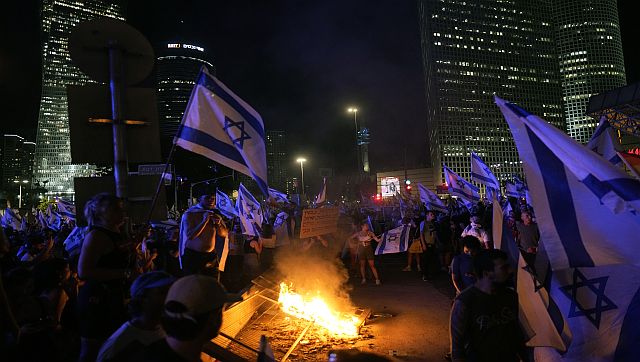 Demonstrators protest against plans by Prime Minister Benjamin Netanyahu's government to overhaul the judicial system, in Tel Aviv. AP[/caption]The protest movement spreads to Jerusalem and Haifa.Tech sector workers warn the legislation will drive away investors by undermining the rule of law.President Isaac Herzog, who as head of state has a largely ceremonial role, first attempts to mediate in the standoff.Police crackdown Police in Tel Aviv on 1 March use stun grenades, water cannon and officers on horseback to disperse protesters who attempt to block roads and railways.Netanyahu accuses the demonstrators of crossing "a red line".US president Joe Biden urges Netanyahu to strike a compromise.On 14 March, the Knesset approves in a first reading a clause in the reform package to limit the Supreme Court's ability to overturn laws it deems unconstitutional.Reforms 'paused' In March, Defence Minister Yoav Gallant breaks rank with Netanyahu, calling the legislation "a clear, immediate and tangible threat to Israel's security" as the unrest spreads to security agencies.[caption id="attachment_12910022" align="alignnone" width="640"]
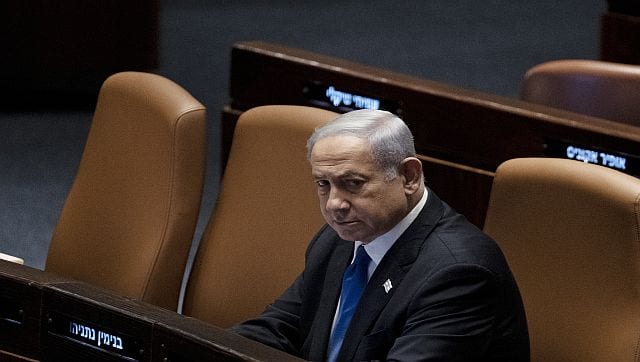 Israel's prime minister Benjamin Netanyahu attends a session of the Knesset, Israel's parliament, in Jerusalem. AP[/caption]Netanyahu fires him but, with a general strike looming on 27 March, decides to pause the legislation to allow for cross-party talks.The protests continue regardless, with opponents demanding the reforms be ditched altogether.Override clause scrapped On 14 June, Israel's two main Opposition leaders, Lapid and Benny Gantz, pull out of talks with the government.Two weeks later Netanyahu announces that he has scrapped a divisive clause which would allow parliament to override Supreme Court rulings with a simple majority — the most contested element of the bill.Govt passes key bill On 10 July, parliament adopts in a first reading a key clause that would curb judges' right to rule on whether a government decision is "reasonable".More than 1,100 air force reservists, including many pilots, threaten to suspend volunteer service if parliament adopts the clause.
First Published:Jul 25, 2023, 08:44:00 IST
Advertisement
Advertisement

Why has Bangladesh’s choice of India spokespersons raised eyebrows?
Bangladesh’s appointment of journalists Md Saidur Rahman and Umme Marufa to media roles in New Delhi and Kolkata has triggered controversy over their past anti-India social media posts, many of which were later deleted, prompting diplomatic scrutiny as India and Bangladesh seek to improve bilateral ties
6 min read
Who is Sandeep Lamba, the Delhi cop removed from protest site duty after slapping female protester?
Sandeep Lamba, an Additional Deputy Commissioner of Police (DCP) (North East District), was seen slapping a female CJP protester in a video on July 20. Lamba has now been removed from the protest site and sent back to his original station. In 2021, Lamba was awarded the Union Home Minister’s medal for excellent investigation
4 min read
Explorers discover wreckage of plane 72 years later. Will this help in finding MH370?
On April 11, 1952, a Pan Am Flight 526A, crashed into the Atlantic Ocean, killing 52 of the 69 people on board. After decades of effort, explorers have found the wreck of the plane at the bottom of the seabed near Puerto Rico. The discovery offers new hope to families who lost loved ones in the Malaysia Airlines Flight 370 crash in 2014
5 min read
Cruise missiles, drones and more... The deadly arsenal of the Houthis
The Houthis have evolved into one of the world's most formidable non-state military forces, deploying anti-ship ballistic missiles, cruise missiles, drones and explosive boats to threaten Red Sea shipping. Their latest attacks on Saudi oil tankers have raised concerns over shipping through the Bab el-Mandeb Strait amid the Strait of Hormuz crisis
10 min read
Why India may not witness a medal rush at 2026 Commonwealth Games
A 125-strong Indian contingent is in Glasgow for the 2026 Commonwealth Games, starting today (July 23), chasing international glory. However, with a roster of sports such as badminton and wrestling being cut from the event, the country’s medal chances have been drastically reduced
4 min read
Advertisement
Advertisement