


Has Israel used white phosphorus in Gaza? What’s this toxic chemical?
Israel has been accused of using white phosphorus munitions in military operations in Gaza and Lebanon. Deployed through bombs, artillery shells or grenades, it is a dangerous chemical substance that burns the skin to the bone and can cause organs to dysfunction

Israel’s relentless attack on Gaza continues. Since the start of the conflict last Saturday after Hamas’s stealth attack, the Israeli military has dropped 6,000 munitions on the enclave, every 30 seconds. The death toll in the strip has climbed to more than 1,400. There has been growing speculation that both sides have committed war crimes. Amid this, a rights group has accused the Israeli forces of using white phosphorus.
On Thursday, Human Rights Watch (HRW) accused Israel of using white phosphorus munitions in its military operations in Gaza and Lebanon, saying the use of such weapons puts civilians at risk of serious and long-term injury, according to a report by Reuters.
While the Israeli military has launched retaliatory airstrikes on Gaza, it is also fighting with Lebanon’s Hezbollah, a militant group backed by Iran.
 More from Explainers
Don’t miss: Our special coverage from Tel Aviv on the Israel-Hamas war
Human Rights Watch claims that verified videos taken in Lebanon on 10 October and Gaza on 11 October show “multiple airbursts of artillery-fired white phosphorus over the Gaza City port and two rural locations along the Israel-Lebanon border”. It provided links to two videos posted on social media that showed “155mm white phosphorus artillery projectiles being used, apparently as smokescreens, marking, or signalling”. Both show scenes near the Israel-Lebanon border, it said. They did not post a video of the use of the munitions in Gaza but Palestinian TV channels have broadcast videos in recent days showing thin plumes of white smoke lining the sky over the Hamas-controlled enclave.
We explain what this dangerous chemical substance is and how it has been used in conflict in the past.
What is white phosphorus?
White phosphorus is a toxic chemical, which burns at more than 800 degrees Celsius, which is high enough to melt metal. Often yellowish or colourless, this wax-like chemical substance, some say, smells like garlic. It is used as a weapon in conflict and is deployed in the form of bombs, grenades, rockets or artillery shells, according to a report by Al-Jazeera.
White phosphorous munitions are made after combining a mixture of white phosphorus and rubber. Since the chemical ignites instantly in contact with oxygen, its function as a weapon is to burn, fast and bright. It is used by militaries around the world, including Israel and the United States, to illuminate targets as part of tracer munitions at night.
White phosphorus weapons are also used to create smokescreens during the day, as they release a huge amount of smoke when burned. The smoke lasts for close to seven minutes. This is why phosphor remains “one of the fastest ways to make highly dense and effective smoke screens”, according to Dan Kaszeta, an associate fellow at the Royal United Services Institute, the UK’s leading security and defence think tank.
Israel-Palestine conflict: Related coverage
What will happen if Israel invades Gaza?
Who can broker peace between Israel, Hamas? Can India help?
Israel-Palestine conflict: Why India can’t afford to take sides
How a drawn-out Israel-Hamas war could hurt the Indian economy
How Sanjeev Singla, India’s envoy in Tel Aviv, is assuring the safety of nationals in Israe
How dangerous are white phosphorus munitions?
White phosphorus burns human skin and disintegrates tissues inside the body. It ignites when exposed to oxygen and continues to burn until it is deprived of oxygen or it is exhausted, reports Al-Jazeera.
The toxic chemicals are absorbed by the body and cause multiple organs like the heart, liver and kidneys to dysfunction.
“The burns have a double effect – they have a local effect because of the burn itself which is generally quite severe and very deep, and then the second effect is metabolic, which can kill the patients,” Roman Hossein Khonsari, professor of maxillofacial surgery and plastic surgery at Necker-Enfants Malades Hospital in Paris told Al-Jazeera.
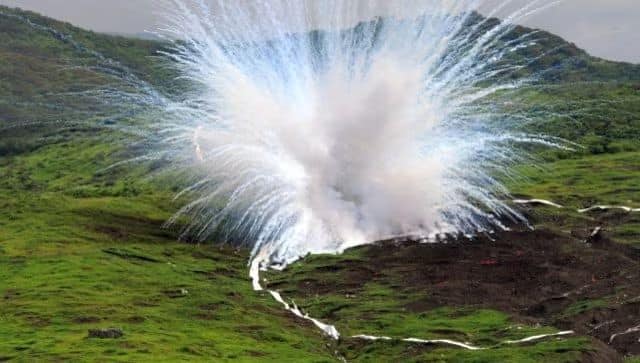
According to Khonsari, who worked during the Armenia-Azerbaijan war, if doctors are unable to identify that burns are caused by white phosphorus and the victim does not receive necessary treatment, they face a risk of organ failure.
Experts say that white phosphorus sticks to many surfaces, including skin and clothing, and is difficult to wash off. Inhaling the fumes can be lethal, leading to severe irritation to the eyes and making them sensitive to light. Exposure to the chemical can also result in facial paralysis and seizures.
Is white phosphorus banned?
White phosphorus is not banned in wars by international conventions. It has been categorised as incendiary weapons “designed to set fire to objects or cause burn or respiratory injury to people through the action of flame, heat, or combination thereof…” under Protocol III in the Convention on Certain Conventional Weapons (CCW), signed in Geneva and enforced from 1983. However, its use as an incendiary weapon has been banned in areas with civil population.
There is one loophole in the restrictions though. Incendiary weapons launched from the ground are governed by less strict guidelines than those dropped from the air.

Israel and the US are not signatories to Protocol III. They claimed to use white phosphorus in line with international regulations.
Has Israel used white phosphorous in Gaza?
Israel’s military said it was “currently not aware of the use of weapons containing white phosphorus in Gaza”. It did not comment on allegations of their use in Lebanon.
However, this is not the first time Israel has been accused of using the highly combustible substance in Gaza.
According to HRW, the Israeli Defense Forces used white phosphorus during a 22-day conflict, Operation Lead Cast, in Gaza, which lasted from 27 December 2008 to 18 January 2009. The Israeli military “repeatedly exploded white phosphorus munitions in the air over populated areas, killing and injuring civilians, and damaging civilian structures, including a school, a market, a humanitarian aid warehouse and a hospital,” HRW said in its 2009 report.
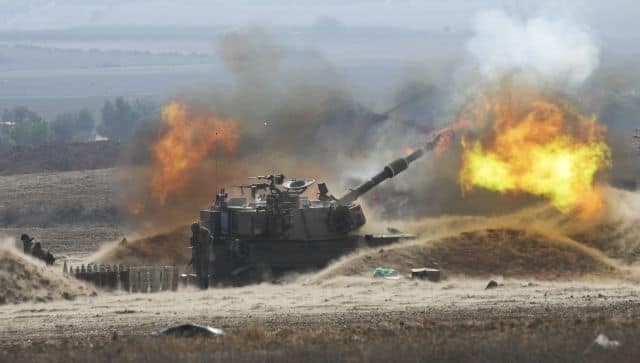
Back then, the Israeli military first said that it used white phosphorus to mark targets but later denied using it.
Israel said it had launched its investigation which proved that the use of white phosphorus was for “operational needs only”. “Based on the findings at this stage, it is already possible to conclude that the [army’s] use of smoke shells was in accordance with international law… These shells were used for specific operational needs only and in accord with international humanitarian law,” the Israeli army had said in a statement.
With inputs from agencies
Tags

Why India may not witness a medal rush at 2026 Commonwealth Games
Delhi Police asks personnel to wear uniform: What the law says on cops in plainclothes during protests
Military drones & police check-ups: How Sri Lanka is fighting against worst dengue outbreak in a decade
How Facebook job ad lured 2 Karnataka men into Myanmar cyber scam camp
Why is India seeing 95% cloud cover despite a Super El Niño?