


How doctors in Israel rejoined 12-year-old boy’s head after road accident
Doctors at a hospital in Jerusalem reattached a 12-year-old Palestinian boy’s head to his neck in a rare surgery last month. He was hit by a car while riding his bicycle, leading to ‘internal decapitation’. But what is this injury?

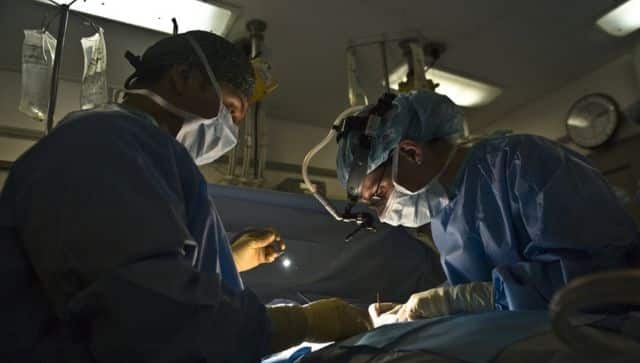
Doctors use rods, wires or screws to restore the link between the skull and the spine. Pixabay (Representational Image)[/caption]According to a review study in 2015, this injury is three times more common in children than in adults. This study says internal decapitation "is an essentially ligamentous injury and, as such, is unlikely to spontaneously heal well over time, even after prolonged external immobilisation."Dr Toba Niazi, a pediatric neurosurgeon in the United States, told CBS News in 2016 that children are “more prone to these types of injuries because of the sheer weight of their head" as compared to the rest of their body.What happened in Israel?Hassan was hit by a car when he was riding his bicycle. After the accident, he was admitted to Hadassah Hospital’s trauma unit in Ein Kerem, a historic mountain village, as per The Times of Israel report.According to the doctors, the ligaments connecting the posterior skull base got detached from the top vertebrae of the young boy’s spine due to the accident.Dr Ohad Einav, the orthopedic specialist who operated on the 12-year-old, told The Times of Israel, “The procedure itself is very complicated and took several hours. While in the operating room, we used new plates and fixations in the damaged area… Our ability to save the child was thanks to our knowledge and the most innovative technology in the operating room”.
Einav, who returned to Israel from Toronto a year back, had to perform this surgery on adults during his fellowship at trauma centers in Canada, as per The Times of Israel.“This is not a common surgery at all, and especially not on children and teens. A surgeon needs knowledge and experience to do this,” he explained.“The injury is extremely rare, but we do know that because children between ages four and 10 have heads that are large in relation to their bodies, they are more susceptible than adults,” Einav added.Hassan dischargedHassan was recently sent home with a cervical splint and his health is being monitored by the Hadassah staff.According to Einav and his team, Hassan's survival rate was estimated to be 50 per cent, thus his recovery is seen as nothing less than a "miracle", reported Israel's i24 News.According to Israel's TPS news agency, Hassan’s father continued to stay by his son's bedside during the recovery process. Expressing gratitude for the medical staff, he said, "Thanks to you, he regained his life even when the odds were low and the danger was obvious.""What saved him were professionalism, technology and quick decision-making by the trauma and orthopedics team," TPS quoted the father as saying.Speaking to Fox News Digital, Dr Marc Siegel, Clinical Professor of Medicine and a practicing internist at NYU Langone Medical Center, told that the "amazing" surgery is possible only if major blood vessels remain intact."The key is preserving blood flow to the brain," Siegel said. "It sounds like — from the story — that the major blood vessels were likely not severed and that this involved an orthopedic rebuilding — probably using rods and reattaching ligaments and possibly bone grafts and implants."With inputs from agencies
Why India may not witness a medal rush at 2026 Commonwealth Games
Delhi Police asks personnel to wear uniform: What the law says on cops in plainclothes during protests
Military drones & police check-ups: How Sri Lanka is fighting against worst dengue outbreak in a decade
How Facebook job ad lured 2 Karnataka men into Myanmar cyber scam camp
Why is India seeing 95% cloud cover despite a Super El Niño?