


How Iran war has left rich Gulf nations like Qatar, Kuwait economically vulnerable
The US-Israel war in Iran is at an impasse. Since the war began in February, energy infrastructure across West Asia has come under attack. As the Strait of Hormuz remains effectively shut, countries like Qatar and Kuwait’s oil and gas exports have been seriously disrupted

The stalemate between the United States and Iran to reach a deal continues. Tensions in West Asia remain high after a drone attack was reported at a nuclear power plant in the United Arab Emirates (UAE) on Sunday (May 17), causing fire.
Saudi Arabia also said it intercepted three drones. While hostilities have subsided in the region since a ceasefire between the US and Iran came into force in April, drone attacks on Gulf countries, including Saudi Arabia and Kuwait, have been launched from Iraq.
The Gulf countries have faced economic setbacks since the US-Israel launched a war against Iran on February 28. However, not all economies in the region have been impacted similarly.
Let’s take a closer look.
Iran war grips Gulf countries
After the conflict began, Iran retaliated by targeting Gulf countries housing US military bases. It has since hit several sites, including civilian and energy infrastructure.
 More from Explainers
Iranian missiles and drones have targeted about 80 energy facilities, including production plants, refineries and pipelines, as per The Conversation report.
The damage, estimated at $58 billion, could take months or even years, in some cases, to repair once the conflict ends.
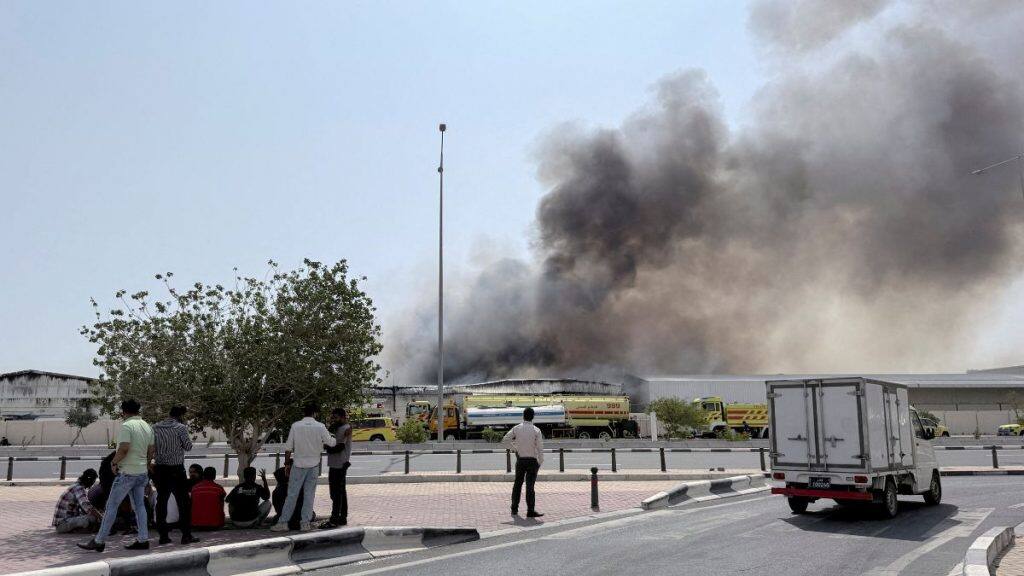
On Sunday, a drone struck an electrical generator outside the inner perimeter of the Barakah Nuclear Power Plant in the UAE. The country’s defence ministry said two other drones had been "successfully" dealt with, adding that these attacks came from the "western border,” reported Reuters.
Earlier this month, Iran escalated attacks on the UAE after Trump announced a US military operation to move stranded ships out of the Strait of Hormuz, which was suspended 48 hours later.
How UAE, Saudi Arabia are faring
The UAE and Saudi Arabia have been able to bypass the Strait of Hormuz, a critical waterway between Iran and Oman that has remained effectively shut since the war.
Saudi Arabia’s east-west pipeline has enabled it to export oil from Yanbu on the Red Sea. It has diverted seven million barrels of crude oil per day through this pipeline to avoid the Strait of Hormuz.
The UAE has a pipeline from Habshan to Fujairah, which has allowed it to export up to 1.8 million barrels of oil a day from the Gulf of Oman.
The closure of the Strait has caused the biggest oil supply crisis in history, pushing up prices.
These Gulf countries have been able to utilise their infrastructure to capitalise on the soaring global oil prices. Saudi Aramco, Saudi Arabia’s state oil company, witnessed a 26 per cent rise in profits in the first quarter of 2026.
However, the war has shattered the Gulf’s image as a “safe haven”. The Gulf Cooperation Council (GCC), which comprises the UAE, Bahrain, Kuwait, Oman, Qatar and Saudi Arabia, has tried to diversify its economy by banking on tourism and aviation.
According to the financial analysis firm, Moody’s, the hotel occupancy in Dubai is set to plunge to 10 per cent in the second quarter of 2026 from 80 per cent before the war.
The war in West Asia has disrupted air travel, increasing jet fuel prices. Gulf airlines such as Emirates, Etihad and Qatar Airways have come under financial strain.
Over 30,000 flights to West Asia were cancelled in the first month of the war. Jet fuel prices, the biggest variable cost to airlines, have surged 90 per cent on the annual average, as per The Conversation piece.
The logistics sector in the Gulf region has also been affected due to the war.
The UAE’s Jebel Ali Port, one of the world’s largest container ports, has reported a 40 per cent fall in vessels due to the conflict. Container carriers have to be rerouted to alternatives such as Salalah in Oman and Colombo in Sri Lanka.
Is Qatar the worst affected?
Unlike the UAE and Saudi Arabia, Qatar does not have the geographic advantage to bypass the Strait of Hormuz.
Qatar's oil and gas exports have been majorly disrupted by the closure of the Strait of Hormuz. The state derives more than 60 per cent of its revenue from gas and gas-related exports.
Qatar’s liquified natural gas (LNG) industry has been rocked by the war. QatarEnergy, the state-owned energy company, said it will take up to five years to repair its Ras Laffan industrial hub alone.
Earlier during the conflict, Iranian missiles and drones struck the Ras Laffan plant, damaging critical equipment. The attack led to a 17 per cent dip in Qatar’s production capacity.
For Qatar, gas exports “are nothing short of foundational,” Ahmed Helal, a managing director at the Asia Group, a strategic advisory firm, was quoted as saying by New York Times (NYT). “Nothing you see here would have been possible without the wealth of energy. That is why Qatar is quickly falling into a very challenging fiscal situation,” he added.
As per the NYT report, analysts forecast that QatarEnergy has already lost billions of dollars since the war began. Each day that the Strait remains shut, the Gulf nation is losing hundreds of millions more due to the lack of sales and shipping charter fees.
The International Monetary Fund (IMF) has predicted that Qatar’s economy will shrink 8.6 per cent this year before reviving in 2027.
Tourism has also been hit in Qatar due to tensions in West Asia. The number of international visitors to Qatar has plunged amid travel advisories from the US and other countries.
In March, the World Travel & Tourism Council estimated that West Asia was losing $600 million a day in tourism revenue.
For Qatar, like many of its neighbours, the diversification plan relies on sustained foreign capital, a steady supply of expatriate labour, as well as the perception of stability, NYT reported, citing a recent report by Frédéric Schneider, a nonresident senior fellow at the Middle East Council on Global Affairs.
Visuals of Qatar’s airport under air raid warnings and Ras Laffan under missile attack, broadcast worldwide, are “incompatible with that perception in ways that are slow to reverse,” Schneider wrote. In that sense, he said, “the war has harmed Qatar’s hydrocarbon and post-hydrocarbon economic foundations simultaneously.”
What about other Gulf nations?
Kuwait’s oil and gas exports have also been significantly affected by the war in West Asia.
Since the war began, the World Bank has downgraded its 2026 GDP growth forecast for West Asia from 4.4 per cent to just 1.3 per cent.
Kuwait’s economy has been projected to decline by 6.4 per cent due to disruptions to oil exports and the closure of the Strait of Hormuz.
Some thinktanks, including Oxford Economics, even warn that some GCC economies will enter recession in the second half of the year.
Moody’s has downgraded its outlook on Bahrain from “stable” to “negative”. This will increase Bahrain's financial woes, depriving its access to much-needed capital and raising future borrowing costs, as per The Conversation.
The long-term economic impact of the war on the Gulf economies will depend on how quickly the war ends and its political outcome. However, the fiscal outlook for some GCC states is worsening, with many seeing government spending exceeding revenue.
With inputs from agencies

Why has Bangladesh’s choice of India spokespersons raised eyebrows?
Who is Sandeep Lamba, the Delhi cop removed from protest site duty after slapping female protester?
Explorers discover wreckage of plane 72 years later. Will this help in finding MH370?
Cruise missiles, drones and more... The deadly arsenal of the Houthis
Why India may not witness a medal rush at 2026 Commonwealth Games