
Advertisement


Sections
Why the commissioning of INS Vagir is one big step forward for the Indian Navy
The fifth submarine of the Kalvari class, INS Vagir, was commissioned into the Indian Navy in Mumbai on Monday. These Scorpene-class vessels are designed to target and sink enemy ships and are of importance as China attempts to expand its presence in the Indian Ocean

The Indian Navy continues to scale up amid growing threats from China. The latest to be added to its underwater fleet is the fifth Scorpene-class submarine, INS Vagir. Commissioned at the Naval Dockyard in Mumbai, the vessel is expected to boost India’s maritime capabilities in the Indian Ocean Region and beyond.The Kalvari-class submarine, which was delivered to the Indian Navy on 20 December last year, has been built indigenously at Mumbai’s Mazagon Dock Shipbuilders Limited. Its construction started in July 2009. The diesel electric-attack submarine is designed by the French defence major, Naval Group (formerly DCNS), and Spanish state-owned entity Navantia.The lowest build time Launched on 12 November 2020, the submarine has had the lowest build time among all made-in-India submarines until now. INS Vagir undertook her maiden sortie in February last year, commencing demanding sea trials. She has gone through comprehensive acceptance checks before being commissioned.The submarine has “superior stealth features” like an advanced acoustic absorption technique. It can undertake diverse missions including anti-surface warfare, anti-submarine warfare, intelligence gathering, mine laying and surveillance missions. It can reportedly stay underwater for 50 to 60 days.[caption id="attachment_12031892" align="alignnone" width="640"]![INS Vagir]() INS Vagir is also Sand Shark and it represents 'stealth and fearlessness', according to the Indian Navy. Image courtesy: @DefPROMumbai?Twitter[/caption]It's all about “stealth and fearlessness”The vessel got its name from the erstwhile Vagir, a Vela-class submarine from Russia that served in the Indian Navy from 1973 to 2001. The original Vagir was commissioned on 1 Nov 1973 and undertook numerous operational missions including deterrent patrols. It was decommissioned on 7 Jan 2001 after serving the nation for about three decades.The new Vagir is also called “Sand Shark”. It represents “stealth and fearlessness”, two qualities that are synonymous with the ethos of a submariner, says a government release.INS Vagir can be deployed closer to the shore and mid-ocean, an Indian Navy official told ANI. “It will be ready to meet all the requirements of the Navy and the country. It is a big step towards becoming Atmanirbhar Bharat, ” he added.“Vagir is a lethal platform with a formidable weapon package. Vagir is the third submarine inducted into Navy in a span of 24 months. It is also a shining testimony to expertise of our shipyards to construct complex and complicated platforms,” said Admiral R Hari Kumar, Chief of Naval Staff.The Kalvari class The main focus of the Indian Navy is the Kalvari Class submarines. Under Project 75, six submarines are being built.Other submarines of the Kalvari class are INS Kalvari, INS Khanderi, INS Karanj, and INS Vela which have been commissioned into the Navy. INS Vagsheer was launched in April 2022 and is under construction. It is expected to be inducted in early 2024. All of these are attack submarines, also known as the “hunter-killer” type – they are designed to target and sink enemy vessels.The Kalvari-class submarines are 220 feet long with a height of 40 feet. They can reach the highest speed of 11 knots when surfaced and 20 knots when submerged, according to a report in The Indian Express.[caption id="attachment_12031922" align="alignnone" width="640"]
INS Vagir is also Sand Shark and it represents 'stealth and fearlessness', according to the Indian Navy. Image courtesy: @DefPROMumbai?Twitter[/caption]It's all about “stealth and fearlessness”The vessel got its name from the erstwhile Vagir, a Vela-class submarine from Russia that served in the Indian Navy from 1973 to 2001. The original Vagir was commissioned on 1 Nov 1973 and undertook numerous operational missions including deterrent patrols. It was decommissioned on 7 Jan 2001 after serving the nation for about three decades.The new Vagir is also called “Sand Shark”. It represents “stealth and fearlessness”, two qualities that are synonymous with the ethos of a submariner, says a government release.INS Vagir can be deployed closer to the shore and mid-ocean, an Indian Navy official told ANI. “It will be ready to meet all the requirements of the Navy and the country. It is a big step towards becoming Atmanirbhar Bharat, ” he added.“Vagir is a lethal platform with a formidable weapon package. Vagir is the third submarine inducted into Navy in a span of 24 months. It is also a shining testimony to expertise of our shipyards to construct complex and complicated platforms,” said Admiral R Hari Kumar, Chief of Naval Staff.The Kalvari class The main focus of the Indian Navy is the Kalvari Class submarines. Under Project 75, six submarines are being built.Other submarines of the Kalvari class are INS Kalvari, INS Khanderi, INS Karanj, and INS Vela which have been commissioned into the Navy. INS Vagsheer was launched in April 2022 and is under construction. It is expected to be inducted in early 2024. All of these are attack submarines, also known as the “hunter-killer” type – they are designed to target and sink enemy vessels.The Kalvari-class submarines are 220 feet long with a height of 40 feet. They can reach the highest speed of 11 knots when surfaced and 20 knots when submerged, according to a report in The Indian Express.[caption id="attachment_12031922" align="alignnone" width="640"]![]() Graphic: Pranay Bhardwaj[/caption]These modern Scorpene class of submarines have Air Independent Propulsion (AIP) which enables non-nuclear submarines to operate for a long time without access to surface oxygen. They can launch various torpedoes and missiles and come with a range of surveillance and intelligence-gathering mechanism, the report says.The submarines in the Kalvari class get their names from now-decommissioned classes of submarines. The older Kalvari class included Kalvari, Khanderi and Karanj, and Vela class included Vela, Vagir, and Vagsheer. These vessels, which belonged to the Soviet-origin Foxtrot class, were among the first to serve India post-Independence.Like Kalvari, which means Tiger Shark, Vagir is named after a Sand Fish. Vagsheer gets its name from a deadly deep-sea predator sandfish of the Indian Ocean and Vela from a stingray species. Khanderi has been named after an island fort built by Chhatrapati Shivaji, which played a key role in his navy, and Karanj after an island located south of Mumbai.The need for submarines and the threat from ChinaIndia has lesser submarines than what is needed. It operates one submarine in the nuclear-powered classes, Chakra and Arihant, and 14 from the diesel-electric category, from three classes, Kalvari, Shishumar and Sindhughosh.It needs 24 submarines to meet its three-decade submarine-building plan, which was okayed in the late 1990s at the time of the Kargil War. The plan was to induct 12 diesel-powered submarines by 2012 and another 12 by 2030, reports India Today. But now that has been rejigged with 18 diesel-powered submarines and six nuclear-powered ones.[caption id="attachment_12031952" align="alignnone" width="640"]
Graphic: Pranay Bhardwaj[/caption]These modern Scorpene class of submarines have Air Independent Propulsion (AIP) which enables non-nuclear submarines to operate for a long time without access to surface oxygen. They can launch various torpedoes and missiles and come with a range of surveillance and intelligence-gathering mechanism, the report says.The submarines in the Kalvari class get their names from now-decommissioned classes of submarines. The older Kalvari class included Kalvari, Khanderi and Karanj, and Vela class included Vela, Vagir, and Vagsheer. These vessels, which belonged to the Soviet-origin Foxtrot class, were among the first to serve India post-Independence.Like Kalvari, which means Tiger Shark, Vagir is named after a Sand Fish. Vagsheer gets its name from a deadly deep-sea predator sandfish of the Indian Ocean and Vela from a stingray species. Khanderi has been named after an island fort built by Chhatrapati Shivaji, which played a key role in his navy, and Karanj after an island located south of Mumbai.The need for submarines and the threat from ChinaIndia has lesser submarines than what is needed. It operates one submarine in the nuclear-powered classes, Chakra and Arihant, and 14 from the diesel-electric category, from three classes, Kalvari, Shishumar and Sindhughosh.It needs 24 submarines to meet its three-decade submarine-building plan, which was okayed in the late 1990s at the time of the Kargil War. The plan was to induct 12 diesel-powered submarines by 2012 and another 12 by 2030, reports India Today. But now that has been rejigged with 18 diesel-powered submarines and six nuclear-powered ones.[caption id="attachment_12031952" align="alignnone" width="640"]![]() INS Kalvari was commissioned in 2017. The Kalvari-class submarines are used for anti-warship and anti-submarine operations, intelligence gathering and surveillance and naval mine laying.[/caption]Project 75, which includes the construction of six Scorpene-class-developed submarines, aims to boost the Navy's strength. It has been marred by delays. The first submarine was scheduled to be delivered by 2012 but the project was delayed. The first Scorpene class submarine INS Kalvari joined the fleet in 2017.The focus on modernising the submarine arm is vital as China attempts to expand its naval presence in the Indian Ocean.“Indian analysts are particularly worried that Chinese undersea drones, seen recently in Indonesia’s near-seas, could be deployed in the waters around India’s Andaman and Nicobar Islands in the Eastern Indian Ocean. Consequently, India’s naval leadership is focusing on diesel-electric submarines that have the capability to patrol the littoral,” a report published by Observer Research Foundation says.China has the biggest maritime force in the world with around 340 warships, according to the Pentagon’s 2022 China Military Power Report, released in November 2022. Its fleet is expected to grow to 400 ships in the next two years, the report says.With inputs from agencies Read all the Latest News, Trending News, Cricket News, Bollywood News,India News and Entertainment News here. Follow us on Facebook, Twitter and Instagram.
INS Kalvari was commissioned in 2017. The Kalvari-class submarines are used for anti-warship and anti-submarine operations, intelligence gathering and surveillance and naval mine laying.[/caption]Project 75, which includes the construction of six Scorpene-class-developed submarines, aims to boost the Navy's strength. It has been marred by delays. The first submarine was scheduled to be delivered by 2012 but the project was delayed. The first Scorpene class submarine INS Kalvari joined the fleet in 2017.The focus on modernising the submarine arm is vital as China attempts to expand its naval presence in the Indian Ocean.“Indian analysts are particularly worried that Chinese undersea drones, seen recently in Indonesia’s near-seas, could be deployed in the waters around India’s Andaman and Nicobar Islands in the Eastern Indian Ocean. Consequently, India’s naval leadership is focusing on diesel-electric submarines that have the capability to patrol the littoral,” a report published by Observer Research Foundation says.China has the biggest maritime force in the world with around 340 warships, according to the Pentagon’s 2022 China Military Power Report, released in November 2022. Its fleet is expected to grow to 400 ships in the next two years, the report says.With inputs from agencies Read all the Latest News, Trending News, Cricket News, Bollywood News,India News and Entertainment News here. Follow us on Facebook, Twitter and Instagram.
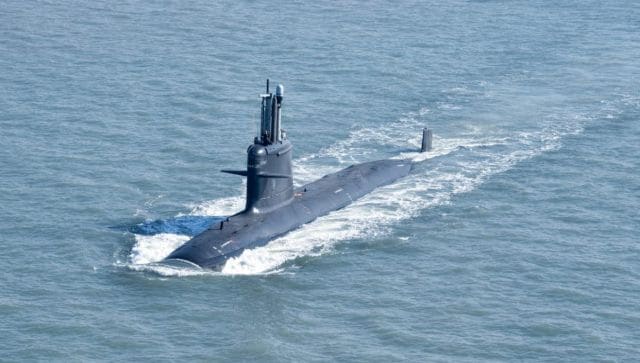 INS Vagir is also Sand Shark and it represents 'stealth and fearlessness', according to the Indian Navy. Image courtesy: @DefPROMumbai?Twitter[/caption]It's all about “stealth and fearlessness”The vessel got its name from the erstwhile Vagir, a Vela-class submarine from Russia that served in the Indian Navy from 1973 to 2001. The original Vagir was commissioned on 1 Nov 1973 and undertook numerous operational missions including deterrent patrols. It was decommissioned on 7 Jan 2001 after serving the nation for about three decades.The new Vagir is also called “Sand Shark”. It represents “stealth and fearlessness”, two qualities that are synonymous with the ethos of a submariner, says a government release.INS Vagir can be deployed closer to the shore and mid-ocean, an Indian Navy official told ANI. “It will be ready to meet all the requirements of the Navy and the country. It is a big step towards becoming Atmanirbhar Bharat, ” he added.“Vagir is a lethal platform with a formidable weapon package. Vagir is the third submarine inducted into Navy in a span of 24 months. It is also a shining testimony to expertise of our shipyards to construct complex and complicated platforms,” said Admiral R Hari Kumar, Chief of Naval Staff.The Kalvari class The main focus of the Indian Navy is the Kalvari Class submarines. Under Project 75, six submarines are being built.Other submarines of the Kalvari class are INS Kalvari, INS Khanderi, INS Karanj, and INS Vela which have been commissioned into the Navy. INS Vagsheer was launched in April 2022 and is under construction. It is expected to be inducted in early 2024. All of these are attack submarines, also known as the “hunter-killer” type – they are designed to target and sink enemy vessels.The Kalvari-class submarines are 220 feet long with a height of 40 feet. They can reach the highest speed of 11 knots when surfaced and 20 knots when submerged, according to a report in The Indian Express.[caption id="attachment_12031922" align="alignnone" width="640"]
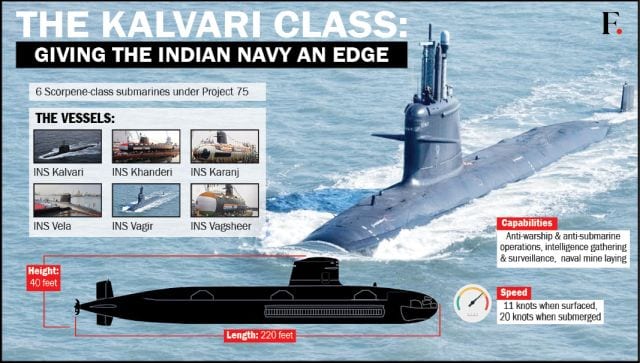 Graphic: Pranay Bhardwaj[/caption]These modern Scorpene class of submarines have Air Independent Propulsion (AIP) which enables non-nuclear submarines to operate for a long time without access to surface oxygen. They can launch various torpedoes and missiles and come with a range of surveillance and intelligence-gathering mechanism, the report says.The submarines in the Kalvari class get their names from now-decommissioned classes of submarines. The older Kalvari class included Kalvari, Khanderi and Karanj, and Vela class included Vela, Vagir, and Vagsheer. These vessels, which belonged to the Soviet-origin Foxtrot class, were among the first to serve India post-Independence.Like Kalvari, which means Tiger Shark, Vagir is named after a Sand Fish. Vagsheer gets its name from a deadly deep-sea predator sandfish of the Indian Ocean and Vela from a stingray species. Khanderi has been named after an island fort built by Chhatrapati Shivaji, which played a key role in his navy, and Karanj after an island located south of Mumbai.The need for submarines and the threat from ChinaIndia has lesser submarines than what is needed. It operates one submarine in the nuclear-powered classes, Chakra and Arihant, and 14 from the diesel-electric category, from three classes, Kalvari, Shishumar and Sindhughosh.It needs 24 submarines to meet its three-decade submarine-building plan, which was okayed in the late 1990s at the time of the Kargil War. The plan was to induct 12 diesel-powered submarines by 2012 and another 12 by 2030, reports India Today. But now that has been rejigged with 18 diesel-powered submarines and six nuclear-powered ones.[caption id="attachment_12031952" align="alignnone" width="640"]
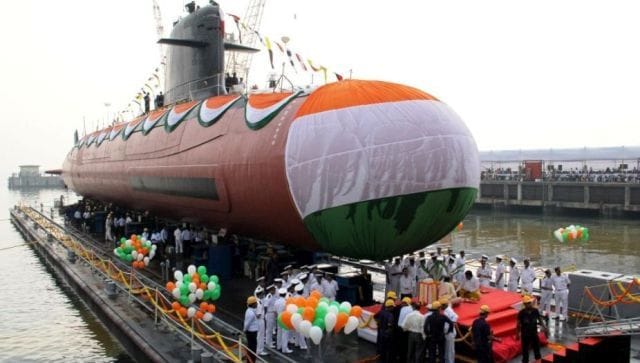 INS Kalvari was commissioned in 2017. The Kalvari-class submarines are used for anti-warship and anti-submarine operations, intelligence gathering and surveillance and naval mine laying.[/caption]Project 75, which includes the construction of six Scorpene-class-developed submarines, aims to boost the Navy's strength. It has been marred by delays. The first submarine was scheduled to be delivered by 2012 but the project was delayed. The first Scorpene class submarine INS Kalvari joined the fleet in 2017.The focus on modernising the submarine arm is vital as China attempts to expand its naval presence in the Indian Ocean.“Indian analysts are particularly worried that Chinese undersea drones, seen recently in Indonesia’s near-seas, could be deployed in the waters around India’s Andaman and Nicobar Islands in the Eastern Indian Ocean. Consequently, India’s naval leadership is focusing on diesel-electric submarines that have the capability to patrol the littoral,” a report published by Observer Research Foundation says.China has the biggest maritime force in the world with around 340 warships, according to the Pentagon’s 2022 China Military Power Report, released in November 2022. Its fleet is expected to grow to 400 ships in the next two years, the report says.With inputs from agencies Read all the Latest News, Trending News, Cricket News, Bollywood News,India News and Entertainment News here. Follow us on Facebook, Twitter and Instagram.
First Published:Jan 23, 2023, 12:50:10 IST
Advertisement
Advertisement

Military drones & police check-ups: How Sri Lanka is fighting against worst dengue outbreak in a decade
Sri Lanka is fighting its most severe dengue outbreak in nearly a decade, with infections rising sharply across the nation. Military drones have been deployed to tackle the outbreak, which has claimed 56 lives. Health officials said the outbreak is being driven primarily by the DENV-2 variant of the virus
3 min read
How Facebook job ad lured 2 Karnataka men into Myanmar cyber scam camp
The Karnataka Cyber Command has rescued two youths from a scam compound in Myanmar operated by Chinese fraudsters. The duo from Karnataka were lured on the pretext of data-entry jobs. They were asked to work for 16 hours a day and were expected to sleep for six hours daily
4 min read
Why is India seeing 95% cloud cover despite a Super El Niño?
India is witnessing nearly 95 per cent cloud cover despite a Super El Niño, a climate event usually linked to weaker monsoons. Regional weather systems, cyclonic circulations, the monsoon trough and moisture from two seas are temporarily overpowering one of the world's strongest climate phenomena
5 min read
What is CJP’s fourth demand to the government as protests in Delhi intensify?
The protest by the Cockroach Janta Party at Delhi’s Jantar Mantar refuses to die down. The group have made a fourth demand to the Centre, asking that no FIRs are filed against the agitators and that no legal action be taken. The government has expressed willingness to speak to the protesters, but refused to accede on the resignation of Education Minister Dharmandra Pradhan
5 min read
The new geography of war: Why the Houthis can no longer be ignored
The rise of the Houthis marks the emergence of a new geography of war — one in which influence flows not only from capitals and conventional armies, but also from rugged mountains overlooking vital sea lanes
6 min read
Advertisement
Advertisement