


A 'Naxal-free' nation: How India delivered a fatal blow to ‘Red Terror’
India has dismantled the decades-long Maoist movement. On Monday, a day before the government’s March 31 deadline for stamping out Left-Wing Extremist violence, Union Home Minister Amit Shah told the Lok Sabha that the country has become ‘Naxal-free’. From killings to surrenders, here's how the State brought the collapse of the Red Corridor

India has become “Naxal-free”, Union Home Minister Amit Shah announced in Lok Sabha on Monday (March 30), a day before the Central government’s March 31 deadline for eliminating Left-Wing Extremist (LWE) violence from the country. He also took on the Congress, accusing the party of doing "nothing" to end the communist insurgency during its rule.
“We had set a target of March 31 for becoming Naxal-free. I will inform the nation after the final arrangements have been made, but I can say, without hesitation, that we have become Naxal-free; I have no problem in saying so,” Shah told the lower house. Reports say there has been a fall of nearly 82 per cent in the number of Left Wing Extremism (LWE)-related incidents since 2010.
 More from Explainers
We take a closer look.
How Maoist insurgency gripped India
The Maoist movement in India traces its origin to the 1967-1971 Naxalbari uprising, an armed peasant revolt led by a splintered group of the Communist Party of India (Marxist) in West Bengal.
While the government crackdown gradually weakened the movement in Bengal over the following years, the movement spread to other parts of the country, which came to be known as the “Red Corridor”.
The Maoist movement split and the groups mushroomed, expanding to undivided Andhra Pradesh, present-day Chhattisgarh and Jharkhand, Maharashtra, Odisha and Bihar.
The movement was dominated by Telugu speakers, who influenced and shaped the ideology, raised funds and worked to recruit lakhs of young men and women, as per an Indian Express report.
The left-wing insurgency reached its highest point in the 2000s.
The People’s Liberation Guerrilla Army, the armed wing of the Maoists, emerged in 2000. In 2004, two of the largest Maoist groups, the People’s War Group (PWG), which commanded southern India, and the Maoist Communist Center (MCC), which was present in northern India, came together to form the Communist Party of India (Maoist).
The CPI (Maoist), which has since been banned as a terrorist group, dominated the Maoist movement for over two decades, describing India as “backward, semi-colonial, and semi-feudal”.
By the late 2000s, left-wing extremism impacted nearly 180 districts across an area of 92,000 square km.
PV Ramana, the author of The Naxal Challenge, told The Diplomat last October that the Maoists attracted masses by making them politically aware, focusing on government failures, such as the lack of “basic needs of the people for roti (food), kapda (clothing), makaan (housing), education, healthcare, and basic infrastructure.”
Then, they organised the cadres into “compact armed squads to fight the class enemy — landlords, corrupt government officials, political leaders and the police. Gradually, they create “liberated areas” and set up their own form of “self-government” known as the “janatana sarkar,”” he added.
As per a press release by the Ministry of Home Affairs (MHA), over the years, the Maoists were responsible for “armed violence (against civilians and the state), extortion (mostly of rich landowners or businesses), destruction of infrastructure, and recruitment of children and civilians.”
They were behind several fatal attacks on security forces and even politicians, including the 2010 Dantewada massacre in which 76 Central Reserve Police Force (CRPF) personnel were killed and the 2013 Jhiram Ghati attack, which wiped out the Congress leadership in Chhattisgarh.
How Maoist insurgency has declined
India has been cracking down on the deadly Maoist movement for years.
In 2006, the Manmohan Singh-led Central government identified Maoist violence as the country’s single biggest internal security threat. The Home Ministry under P Chidambaram then came up with a broad strategy that included greater inclusion of central armed police forces into Maoist-affected districts, funds for training and modernising state police, and a phased “clear, hold and develop” approach, as per Indian Express.
Security forces were told to go into Maoist strongholds to push guerrillas out, build camps to hold territory, and enable civil administration to construct roads, schools and hospitals.
The government also took a hard stance against urban sympathisers of the movement. The Indian Express report noted that the Narendra Modi government followed the same policy with “minor tweaks, but greater vigour”.
Speaking at an event in New Delhi last year, Home Minister Shah said that in 2025 alone, 270 Naxalites were killed and 680 arrested, with 1,225 others surrendering to authorities. He said, “The Modi government promotes a policy of surrender, but a bullet will be met with a bullet”.
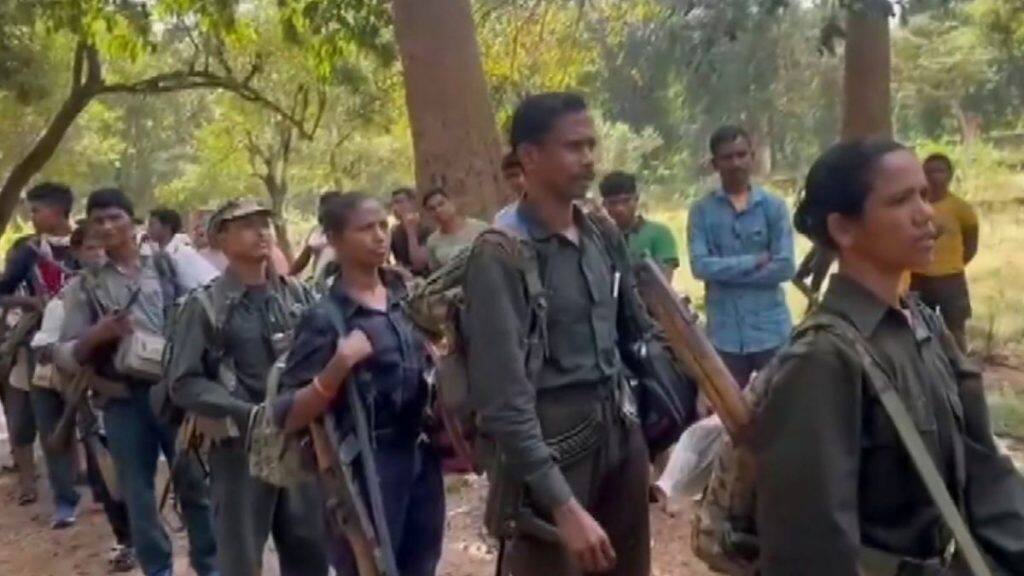
Over the years, more than 15,000 km of roads have been built to help security forces enter the deep forested region of central India. Over 9,000 mobile towers have been installed and 656 police stations have been set up in Maoist areas. About 200 new security force camps have been erected in the main Maoist zones, especially across Chhattisgarh and the Andhra-Odisha border region.
Most of the top Maoist leadership, including former General Secretary Nambala Keshav Rao alias Basvaraj, and Central Committee members Katta Ramachandra Reddy, Kadari Satyanarayana Reddy, Sahdev Soren, Chalpathi, Gajarla Ravi, Balkrishna, and Narasimha, and Chalam, and Maoists Peoples Liberation Guerrilla Army (PLGA) Battalion 1 commander Madvi Hidma, have been killed in recent months.
The state's crackdown against the Maoists has led to a sharp decline in Left Wing Extremism-related incidents and deaths, falling roughly four-fifths since 2010.
Over the decades, there have been various offensives and operations to contain the Maoist insurgency. These operations have borne results.
Maoist violence, which peaked at 2,213 incidents in 2010, reduced to 401 in 2025, a fall of nearly 82 per cent, NDTV reported, citing government data.
The total number of deaths of civilians and security forces dropped from 1,005 in 2010 to 100 in 2025, a significant dip of about 90 per cent.
This year, until March 24, 2026, about 42 incidents of LWE violence and six deaths, including five civilians and one security personnel, have been reported. Fifty-two Maoists were killed in operations.
Is this an end to 'Red Terror' in India?
Home Minister Amit Shah told the Lok Sabha on Monday, while replying to a debate on ‘Efforts to free the country from Left Wing Extremism (LWE)’, that all members of Maoist state committees of Madhya Pradesh, Maharashtra, and Chhattisgarh have surrendered. Of the four remaining in Odisha, one has surrendered while three have been killed, he added.
According to Shah, in Telangana, six have surrendered and three have been killed, with not a single Maoist there.
"Their Politburo and central structure have been almost completely dismantled. Our goal was a Naxal-free India by March 31. The country will be informed once the entire process is formally completed, but I can say that we have become Naxal-free," he said in Parliament.
The surrender of Thippiri Tirupathi, alias Devuji or Devji, in February was seen as the unpreventable end of the communist insurgency in India. While the movement is breathing its last breath, the political ideology continues to sustain.
Speaking to The Diplomat, Ramana, a keen observer of India’s Maoist movement, said: "The Maoist ideology has not lost traction. It will not lose traction. The ideology will hold immense value and remain attractive to the masses as long as inequities exist in society."
"Development is not reaching the people. Even where it does, it is not sufficient. It must be borne in mind that decades of neglect of tribal areas cannot be corrected overnight with a magic wand. The people should be given hope and incremental change should be showcased. Even this small change will help restore public faith in the state and its apparatus," he added.
A former MHA bureaucrat involved in anti-Maoist policy suggests that security forces should not be entirely withdrawn from insurgency-affected areas, but there should be a phased transition, reported Indian Express.
The official called for recruiting locals into the police and administration, opening new police stations and making everyday governance visible. The aim is to replace the camps erected in the areas with "rooted institutions" such as functional health centres and schools, comprising people who reside in these forests and are not on temporary postings.
With inputs from agencies
Senior Sub-Editor at Firstpost. She writes explainers on myriad subjects without the limitation of beats.

Military drones & police check-ups: How Sri Lanka is fighting against worst dengue outbreak in a decade
How Facebook job ad lured 2 Karnataka men into Myanmar cyber scam camp
Why is India seeing 95% cloud cover despite a Super El Niño?
What is CJP’s fourth demand to the government as protests in Delhi intensify?
The new geography of war: Why the Houthis can no longer be ignored