
Advertisement


Sections
Explained: How India shed colonial past at Republic Day parade through its gun salute
At the 74th Republic Day celebrations, the British-era ’25 pounder artillery was replaced by 105 mm Indian field guns for the 21-gun salute. The move is in line with the Centre’s push for ‘Make in India’ and a step towards an ‘Aatmanirbhar Bharat’

This Republic Day parade is a spectacle unlike any other. It is the first time that tanks, weaponry and soldiers will march down Kartavya Path — the new name for the ceremonial boulevard Rajpath.It is also the first time that the 21-gun salute accorded to the President prior to the beginning of the parade is given by Indian guns, rather than British guns — as an attempt by the government to step away from the vestiges of the colonial era.Chief of Staff Delhi Area Maj Gen Bhavnish Kumar said the move was taken in accordance with the Centre’s ‘Make in India’ push. “We are transitioning towards indigenisation and the time is not far when all are equipment will be ‘swadeshi’. All equipment from the Army that will be showcased during the 74th Republic Day celebrations is made-in-India.”Let’s take a closer look at the Indian guns which will replace the British ones and the history of the 21-gun salute itself.The guns usedBefore today, the 21-gun salute was accorded by the World War II vintage ’25-pounders designed and made in the 1940s by the British. The howitzer was introduced into the British forces right before World War II and remained as the British Army’s primary artillery field piece well into the 1960s.The guns were put into use by India in the 1965 and 1971 wars with Pakistan. The guns acquired popularity among the Indian forces for their ability to be used in extreme weather conditions and barely stall. They were considered versatile and accurate and were well-regarded by the Indian Army. They were decommissioned only in the early 1990s and since then used for ceremonial purposes such as the 21-gun salute on Republic Day and Independence Day.However, this R-Day, the Centre announced that the 105 mm Indian field guns (IFG) would replace the ’25 pounders.[caption id="attachment_12039582" align="alignnone" width="640"]![]() The 105 mm Indian field guns are compact and light and a good replacement for the British '25 pounders. File image/AFP[/caption]These guns have been designed and developed by the Armament Research and Development Establishment (ARDE) in 1972 and have been produced at the Gun Carriage Factory (GCF), Jabalpur, since 1984. Talking about the IFG, Maj Gen Kumar said that they were compact, light and could also be airdropped.“Since the 105 mm Indian Field Gun is an indigenised gun, so we want to use this to replace the 25-pounder guns used earlier for the 21-gun salute. And, it is a matter of pride that we are showcasing our indigenous gun for this too,” added Maj Gen Kumar.Also read: Navy's IL 38 in R-Day flypast for first and last time: All about Soviet-made aircraftThe gun salute explainedAt the Republic Day parade, the 21-gun salute begins when the sword of the Commandant of President’s Body Guards (PBG) comes down at the shout of ‘Rashtriya Salute’ for the President and is carried out through the duration the National Anthem is played.The tradition, the highest honour given to an individual, has been adopted from the British. In fact, all the Commonwealth nations adopted this tradition from the British Empire.But how did the tradition come into being in the first place?[caption id="attachment_12039662" align="alignnone" width="640"]
The 105 mm Indian field guns are compact and light and a good replacement for the British '25 pounders. File image/AFP[/caption]These guns have been designed and developed by the Armament Research and Development Establishment (ARDE) in 1972 and have been produced at the Gun Carriage Factory (GCF), Jabalpur, since 1984. Talking about the IFG, Maj Gen Kumar said that they were compact, light and could also be airdropped.“Since the 105 mm Indian Field Gun is an indigenised gun, so we want to use this to replace the 25-pounder guns used earlier for the 21-gun salute. And, it is a matter of pride that we are showcasing our indigenous gun for this too,” added Maj Gen Kumar.Also read: Navy's IL 38 in R-Day flypast for first and last time: All about Soviet-made aircraftThe gun salute explainedAt the Republic Day parade, the 21-gun salute begins when the sword of the Commandant of President’s Body Guards (PBG) comes down at the shout of ‘Rashtriya Salute’ for the President and is carried out through the duration the National Anthem is played.The tradition, the highest honour given to an individual, has been adopted from the British. In fact, all the Commonwealth nations adopted this tradition from the British Empire.But how did the tradition come into being in the first place?[caption id="attachment_12039662" align="alignnone" width="640"]![]() The 21-gun salute tradition, the highest honour given to an individual, has been adopted from the British. File image/AFP[/caption]This highest honour traces its roots back to the 14th Century and has evolved since. According to the Arlington National Cemetery website, it was a naval custom that when a warship wanted to signal it wasn’t seeking a confrontation it would fire its cannons out to sea until all ammunition was spent.The website added that the British navy developed the custom of a seven-gun salute because its ships typically had seven guns. And maybe the number seven also has Biblical significance. Since forts were on land they could store greater amounts of gunpowder so they could only fire three rounds for every one fired at sea. The number 21 became the worldwide benchmark.As gunpowder improved over time naval honours likewise rose to 21.India’s tryst with the 21-gun saluteToday, in a 21-gun salute, seven artillery guns are fired in three rounds at intervals of 2.25 seconds, covering the 52-second duration of the national anthem.However, it was not always the case.The gun salute in India was first instituted during the time of the East India Company in the late 18th Century and continued under direct Crown rule from 1858. During the durbar of 1877, the Viceroy, on the advice of the British government, issued a new order through which the gun salute for the British monarch was fixed at 101, 31 for the Viceroy of India and Indian rulers — based on their hierarchies — would be accorded 21-, 19-, 17-, 15-, 11- and 9-gun salutes.Interestingly, when Dr Rajendra Prasad became India’s first president of India in 1950 and he drove down Rajpath in his gold buggy on 26 January, he was accorded a 31-gun salute.[caption id="attachment_12039732" align="alignnone" width="640"]
The 21-gun salute tradition, the highest honour given to an individual, has been adopted from the British. File image/AFP[/caption]This highest honour traces its roots back to the 14th Century and has evolved since. According to the Arlington National Cemetery website, it was a naval custom that when a warship wanted to signal it wasn’t seeking a confrontation it would fire its cannons out to sea until all ammunition was spent.The website added that the British navy developed the custom of a seven-gun salute because its ships typically had seven guns. And maybe the number seven also has Biblical significance. Since forts were on land they could store greater amounts of gunpowder so they could only fire three rounds for every one fired at sea. The number 21 became the worldwide benchmark.As gunpowder improved over time naval honours likewise rose to 21.India’s tryst with the 21-gun saluteToday, in a 21-gun salute, seven artillery guns are fired in three rounds at intervals of 2.25 seconds, covering the 52-second duration of the national anthem.However, it was not always the case.The gun salute in India was first instituted during the time of the East India Company in the late 18th Century and continued under direct Crown rule from 1858. During the durbar of 1877, the Viceroy, on the advice of the British government, issued a new order through which the gun salute for the British monarch was fixed at 101, 31 for the Viceroy of India and Indian rulers — based on their hierarchies — would be accorded 21-, 19-, 17-, 15-, 11- and 9-gun salutes.Interestingly, when Dr Rajendra Prasad became India’s first president of India in 1950 and he drove down Rajpath in his gold buggy on 26 January, he was accorded a 31-gun salute.[caption id="attachment_12039732" align="alignnone" width="640"]![]() Besides Republic Day, a 21-gun salute is given during Independence Day, Army Day, Martyrs’ Day and for welcoming head of states of other countries at Rashtrapati Bhavan. Image Courtesy: @DDNews/Twitter[/caption]However, the 21-gun salute became the norm in India and since then it has been in practice.Today, receiving a 21-gun salute is the highest honour. Every new President is honoured with this after their swearing-in ceremony as well as on Republic Day.Besides Republic Day, a 21-gun salute is given on Independence Day — 15 August, Army Day — 15 January, Martyrs’ Day — 30 January and for welcoming heads of state of other countries at Rashtrapati Bhavan.With inputs from agenciesRead all the Latest News, Trending News, Cricket News, Bollywood News,India News and Entertainment News here. Follow us on Facebook, Twitter and Instagram.
Besides Republic Day, a 21-gun salute is given during Independence Day, Army Day, Martyrs’ Day and for welcoming head of states of other countries at Rashtrapati Bhavan. Image Courtesy: @DDNews/Twitter[/caption]However, the 21-gun salute became the norm in India and since then it has been in practice.Today, receiving a 21-gun salute is the highest honour. Every new President is honoured with this after their swearing-in ceremony as well as on Republic Day.Besides Republic Day, a 21-gun salute is given on Independence Day — 15 August, Army Day — 15 January, Martyrs’ Day — 30 January and for welcoming heads of state of other countries at Rashtrapati Bhavan.With inputs from agenciesRead all the Latest News, Trending News, Cricket News, Bollywood News,India News and Entertainment News here. Follow us on Facebook, Twitter and Instagram.
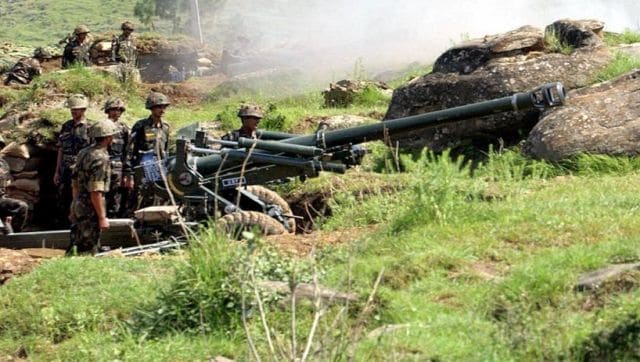 The 105 mm Indian field guns are compact and light and a good replacement for the British '25 pounders. File image/AFP[/caption]These guns have been designed and developed by the Armament Research and Development Establishment (ARDE) in 1972 and have been produced at the Gun Carriage Factory (GCF), Jabalpur, since 1984. Talking about the IFG, Maj Gen Kumar said that they were compact, light and could also be airdropped.“Since the 105 mm Indian Field Gun is an indigenised gun, so we want to use this to replace the 25-pounder guns used earlier for the 21-gun salute. And, it is a matter of pride that we are showcasing our indigenous gun for this too,” added Maj Gen Kumar.Also read: Navy's IL 38 in R-Day flypast for first and last time: All about Soviet-made aircraftThe gun salute explainedAt the Republic Day parade, the 21-gun salute begins when the sword of the Commandant of President’s Body Guards (PBG) comes down at the shout of ‘Rashtriya Salute’ for the President and is carried out through the duration the National Anthem is played.The tradition, the highest honour given to an individual, has been adopted from the British. In fact, all the Commonwealth nations adopted this tradition from the British Empire.But how did the tradition come into being in the first place?[caption id="attachment_12039662" align="alignnone" width="640"]
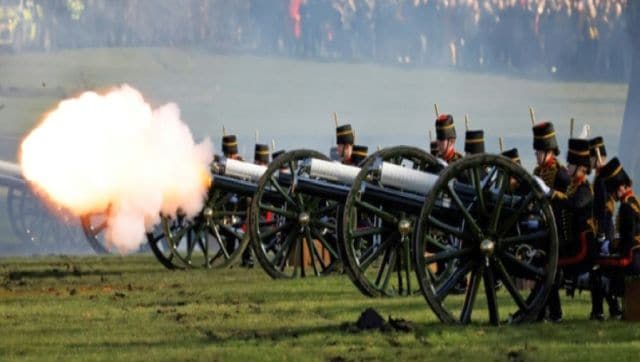 The 21-gun salute tradition, the highest honour given to an individual, has been adopted from the British. File image/AFP[/caption]This highest honour traces its roots back to the 14th Century and has evolved since. According to the Arlington National Cemetery website, it was a naval custom that when a warship wanted to signal it wasn’t seeking a confrontation it would fire its cannons out to sea until all ammunition was spent.The website added that the British navy developed the custom of a seven-gun salute because its ships typically had seven guns. And maybe the number seven also has Biblical significance. Since forts were on land they could store greater amounts of gunpowder so they could only fire three rounds for every one fired at sea. The number 21 became the worldwide benchmark.As gunpowder improved over time naval honours likewise rose to 21.India’s tryst with the 21-gun saluteToday, in a 21-gun salute, seven artillery guns are fired in three rounds at intervals of 2.25 seconds, covering the 52-second duration of the national anthem.However, it was not always the case.The gun salute in India was first instituted during the time of the East India Company in the late 18th Century and continued under direct Crown rule from 1858. During the durbar of 1877, the Viceroy, on the advice of the British government, issued a new order through which the gun salute for the British monarch was fixed at 101, 31 for the Viceroy of India and Indian rulers — based on their hierarchies — would be accorded 21-, 19-, 17-, 15-, 11- and 9-gun salutes.Interestingly, when Dr Rajendra Prasad became India’s first president of India in 1950 and he drove down Rajpath in his gold buggy on 26 January, he was accorded a 31-gun salute.[caption id="attachment_12039732" align="alignnone" width="640"]
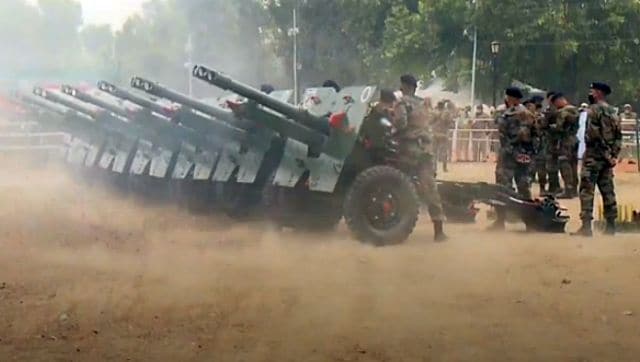 Besides Republic Day, a 21-gun salute is given during Independence Day, Army Day, Martyrs’ Day and for welcoming head of states of other countries at Rashtrapati Bhavan. Image Courtesy: @DDNews/Twitter[/caption]However, the 21-gun salute became the norm in India and since then it has been in practice.Today, receiving a 21-gun salute is the highest honour. Every new President is honoured with this after their swearing-in ceremony as well as on Republic Day.Besides Republic Day, a 21-gun salute is given on Independence Day — 15 August, Army Day — 15 January, Martyrs’ Day — 30 January and for welcoming heads of state of other countries at Rashtrapati Bhavan.With inputs from agenciesRead all the Latest News, Trending News, Cricket News, Bollywood News,India News and Entertainment News here. Follow us on Facebook, Twitter and Instagram.
First Published:Jan 26, 2023, 10:39:02 IST
Advertisement
Advertisement

Delhi Police asks personnel to wear uniform: What the law says on cops in plainclothes during protests
The Delhi Police has instructed all its personnel to wear uniforms when they report for duty at Jantar Mantar for crowd control. This comes after outrage grew over videos of men in civilian clothes or without name tags hitting protesters in the Capital. Is it legal for the police to ditch uniforms during protests?
4 min read
Military drones & police check-ups: How Sri Lanka is fighting against worst dengue outbreak in a decade
Sri Lanka is fighting its most severe dengue outbreak in nearly a decade, with infections rising sharply across the nation. Military drones have been deployed to tackle the outbreak, which has claimed 56 lives. Health officials said the outbreak is being driven primarily by the DENV-2 variant of the virus
3 min read
How Facebook job ad lured 2 Karnataka men into Myanmar cyber scam camp
The Karnataka Cyber Command has rescued two youths from a scam compound in Myanmar operated by Chinese fraudsters. The duo from Karnataka were lured on the pretext of data-entry jobs. They were asked to work for 16 hours a day and were expected to sleep for six hours daily
4 min read
Why is India seeing 95% cloud cover despite a Super El Niño?
India is witnessing nearly 95 per cent cloud cover despite a Super El Niño, a climate event usually linked to weaker monsoons. Regional weather systems, cyclonic circulations, the monsoon trough and moisture from two seas are temporarily overpowering one of the world's strongest climate phenomena
5 min read
What is CJP’s fourth demand to the government as protests in Delhi intensify?
The protest by the Cockroach Janta Party at Delhi’s Jantar Mantar refuses to die down. The group have made a fourth demand to the Centre, asking that no FIRs are filed against the agitators and that no legal action be taken. The government has expressed willingness to speak to the protesters, but refused to accede on the resignation of Education Minister Dharmandra Pradhan
5 min read
Advertisement
Advertisement