


In Hungary's Gyor, dark Christmas becomes symbol of economic pain
Since Russia invaded Ukraine in February, countries across Europe and beyond have been jolted by soaring energy costs. But the shock has been particularly acute in Hungary with even relatively rich areas like Gyor running short of money

And that is not all that has changed.In October, Gyor shuttered museums, libraries, art galleries and an aquatic center, saying that high energy prices made them too expensive to operate. Schools and kindergartens have been ordered to keep their thermostats turned down.The city, despite its relative wealth, is running low on money, as are municipal authorities in many other parts of Hungary.[caption id="attachment_11851591" align="alignnone" width="640"]
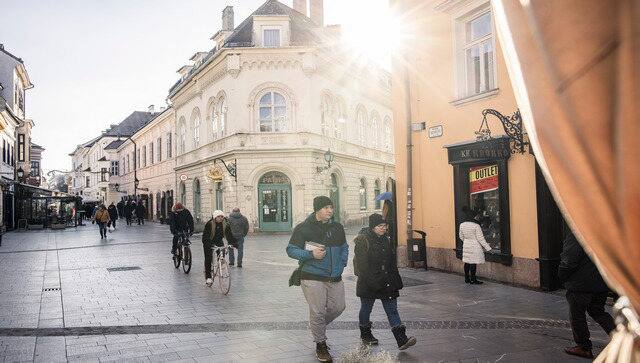 The Christmas market in Gyor, Hungary. The New York Times[/caption]Since Russia invaded Ukraine in February, countries across Europe and beyond have been jolted by soaring energy costs. But the shock has been particularly acute in Hungary, whose right-wing government has often balked at supporting Ukraine, has cozied up to Moscow in pursuit of what it hoped would be cheap and reliable supplies of natural gas and has told its people that any problems they faced were the fault of the European Union, despite being a member of the bloc.Now, with inflation soaring at 22 per cent, the economy tipping toward recession and even relatively rich areas like Gyor running short of money, economic reality has hit Hungary hard. The governor of the country’s central bank, usually a stalwart Fidesz ally, warned this month that “we have to face the fact that the Hungarian economy is in a near-critical situation,” largely as a result, he said, of the government’s own inflationary policies, not just the war in Ukraine.At his annual year-end news conference in Budapest on Wednesday, Orban conceded that his country faced problems, describing 2022 as “probably the most difficult year in Hungary since the fall of communism.”But, echoing Russia’s refrain that it is a victim of “Russophobia,” Orban accused his critics of “Hungarophobia” and said “Brussels and international liberals” were ganging up against his government.[caption id="attachment_11851571" align="alignnone" width="640"]
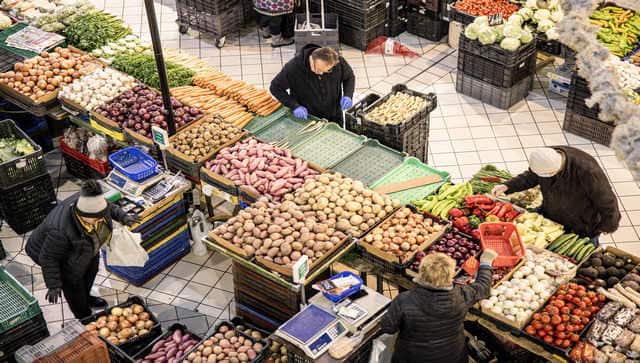 Vegetables at the Lehel Market Hall in Budapest, Hungary,
Reality has also dawned in Gyor.Tibor Lorincz, a forklift operator at a subsidiary of the German plant and a former Fidesz voter, said he was appalled by the decision to cut the festive lighting. “We all need some light in our lives at Christmas,” he said. Using social media, he rallied hundreds of fellow residents behind a plan to string up their own lights in the center of the city.Embarrassed, the city government, run by Fidesz, suddenly announced it had found extra money and began decorating — not much, but enough to lift the darkness. “We won a small battle,” Lorincz said, “but not the war.”Gyor’s mayor, Csaba Andras Dezsi, declined to be interviewed but, in response to written questions, said that “the armed conflict taking place in our neighbourhood and the related energy crisis” had put “a heavy burden on all of us” and forced “more modest decorations.”Roland Kosa, who runs a film company in Gyor, said the city’s scrimping on festive lighting was a “tipping point.”“The core of our identity is that we are a rich city, and this hit our core,” Kosa said. “Everyone was asking: ‘Can we really not even afford to have even Christmas lights anymore?’”Skeptical that the reason for this was a Europe-wide energy crisis, he blamed Fidesz and the city’s mayor, Dezsi, an eccentric, parrot-loving cardiologist who took over after the previous mayor, Zsolt Borkai, also from Fidesz, became entangled in a sex scandal and resigned in 2019.The scandal did little to dent the city’s overwhelming support for Fidesz, partly because it was largely ignored by Hungarian media outlets loyal to Orban. Bad economic news has been similarly obscured, presented as “fake news” ginned up by political opponents, or blamed on European sanctions on Russia.To rally the public behind its narrative, not dissimilar from that of the Kremlin, Orban’s government is now holding what it calls a “national consultation” — a vote on a series of leading questions intended to show that “sanctions are destroying the economies of Europe.”The EU Union has imposed no sanctions on Russian natural gas, and Russia’s energy giant, Gazprom, has itself driven up the price by cutting supplies to many customers. Hungary, which sent its foreign minister to Moscow this summer to beg Russia to keep gas flowing, has not been hit by these cuts, but still has to pay more because the price Gazprom charges is largely set by market rates.“The power and effect of propaganda is tremendous,” said Bulcsu Hunyadi, a senior analyst at Political Capital, a Budapest research group that is often critical of Orban. Hungary, he said, has created a system of “informational autocracy” that allows the government to “create an alternative reality.”A recent Political Capital study found that a majority of Hungarians think sanctions over Ukraine have hurt Europe more than Russia and that half of Fidesz voters believe that Hungary has not endorsed them. In reality, Hungary has voted for each of nine sets of EU sanctions since February, including a new round approved by Orban and other leaders on Dec. 15 in Brussels.Denying economic problems or blaming them on Brussels became much more difficult this month when Gyorgy Matolcsy, the head of Hungary’s central bank, told legislators that “our financial and macroeconomic indicators are in the first- or second-worst place in the European Union” and predicted that “next year will be worse” without an abrupt change of course.[caption id="attachment_11851581" align="alignnone" width="640"]
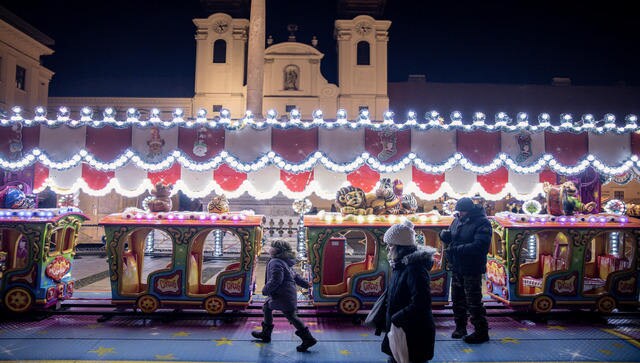
The Christmas market in Gyor, Hungary. The New York Times[/caption]Peter Virovacz, an economist with ING Bank in Budapest, said “it was quite a shock” to hear such stark warnings from the central bank. “Markets have been thinking about all these mistakes for some time, but it was a revelation for locals,” he said.Amid severe shortages of gasoline and diesel because of technical problems at Hungary’s biggest refinery and price caps that made it unprofitable to sell, a surge early this month in panic-buying at gas stations across the country forced Orban to abandon his signature policy of setting pump prices by administrative fiat.In Gyor, the mayor has also struggled to keep a lid on unpleasant news through Gyor Plusz, a local government-friendly media company controlling a television station, a radio station, a website and a print publication.Balazs Pollreisz, one of a handful of Opposition party members on the Fidesz-dominated Gyor City Council, said the furore over Christmas lights had obscured more important issues like steep rent increases for residents of public housing.On Thursday, he organised a small protest in front of City Hall.“Christmas lights are not our biggest problem,” he said. “But they have become a symbol of how things have gone wrong. There has been a huge debate on social media and in cafes with everyone wondering why a rich city like this is so short of money.”The mayor, in his written answers to questions, said: “I would like to draw your attention to the fact that although many localities in Hungary have more modest financial opportunities, the claim that Gyor is the richest city in Hungary is not true.”Andrew Higgins c.2022 The New York Times CompanyWith inputs from agenciesRead all the Latest News, Trending News, Cricket News, Bollywood News,India News and Entertainment News here. Follow us on Facebook, Twitter and Instagram.

Why India may not witness a medal rush at 2026 Commonwealth Games
Delhi Police asks personnel to wear uniform: What the law says on cops in plainclothes during protests
Military drones & police check-ups: How Sri Lanka is fighting against worst dengue outbreak in a decade
How Facebook job ad lured 2 Karnataka men into Myanmar cyber scam camp
Why is India seeing 95% cloud cover despite a Super El Niño?