
Advertisement


Sections
How did the Greece wildfires start? Where are they spreading?
Thousands are fleeing fires in Greece’s Rhodes and Corfu as Prime Minister Kyriakos Mitsotaki warned that his country is ‘at war’ with the flames. While the cause is yet to be determined, some suspected arsonists are being questioned. Experts say extreme weather is making wildfires more likely

In Greece, thousands of tourists are fleeing fires in Rhodes and Corfu.Monday saw authorities evacuate nearly 2,500 people from the Greek island of Corfu.This, after tens of thousands of people had already fled blazes on the island of Rhodes with many frightened tourists scrambling to get home on evacuation flights.Meanwhile, Prime Minister Kyriakos Mitsotakis warned that Greece is "at war" with the flames.But how did the Greece fires start? And where are they spreading?Let’s take a closer look:What happened?As of Monday, 82 fires are burning across Greece – which has been gripped by a heatwave that has seen temperatures soaring above 40C – including in Rhodes, Corfu and Evia.Meteorologists have warned it could be the longest hot spell the country has ever seenOf these, 64 began on Monday – the hottest day of the summer so far.![]() Men help a firefighter as they try to extinguish a wildfire burning near the village Vlyhada, near Athens, Greece. Reuters[/caption]“Fires are not sparked on their own,” Artopios said. “They are triggered by the human hand, be it intentionally or not. We currently have several people being questioned in connection with their probable involvement.”But as temperature records tumble, experts have pointed to climate change driven by the burning of fossil fuels, arguing that global warming is playing a key role in the devastating heat.
Men help a firefighter as they try to extinguish a wildfire burning near the village Vlyhada, near Athens, Greece. Reuters[/caption]“Fires are not sparked on their own,” Artopios said. “They are triggered by the human hand, be it intentionally or not. We currently have several people being questioned in connection with their probable involvement.”But as temperature records tumble, experts have pointed to climate change driven by the burning of fossil fuels, arguing that global warming is playing a key role in the devastating heat.![europe heatwaves]() Countries across the Mediterranean, including tourist hotspots like Spain, Italy, Greece and Croatia are the worst hit. Reuters[/caption]Other countries battling blazesItalyFires were burning in woods and vegetation in various parts of Calabria, the southernmost part of the Italian mainland, while Palermo's airport reopened on Tuesday after wildfires in Sicily forced its closure for a few hours.On Tuesday, Italy put 16 cities on red alert because of the high temperatures. These include Palermo and Catania, where power and water supply cuts that local officials blamed in part on the heat have been frequent in recent days.In Palermo, holidaymaker Jonas Roggan told BBC he woke up to a wildfire near their hotel.“As my three friends and I woke up at our B&B the fire was on the hill above us," Roggan told BBC. “It’s not unusual for that region in this time of the year, so we started breakfast. But then the fire came down the hill and was directly at the road where we were staying."Sicily's civil protection agency said the temperature in some areas in eastern Sicily rose to 47 Celsius (116.6 Fahrenheit) on Sunday, close to the record European high of 48.8 Celsius from two years ago. Properties on the island suffered blackouts because of the heat wave.TurkeyWildfires started in Turkey's southeastern Hatay and Mersin provinces and Canakkale province in the northwest on 16 July, the Turkish General Directorate of Forestry said on its Twitter account.CroatiaA bushfire near the coastal town of Sibenik quickly spread on 13 July, fuelled by strong southerly winds. The fire was difficult to control, despite the efforts of 56 firefighters, along with 20 vehicles and three aircraft. The village of Grebastica suffered significant damage, including the destruction of cars and homes.FranceAbout six small-scale blazes have been recorded in the regions of Nouvelle-Aquitaine, Occitanie, Grand Est, Bouches-Du-Rhone and Corsica island. Mid-April, the French geological service BRGM said that very low groundwater levels had put France on course for a worse summer drought than last year, mainly in the southern part of the country.MaltaMalta has been suffering from a week-long heat wave that has caused widespread power cuts across the island. State-owned power company Enemalta said near record temperatures of between 40 and 42.7 degrees Celsius made underground distribution cables overheat and fail while electricity demand spiked.Malta Airport's meteorological office said it expected the heatwave to break by Wednesday morning when a north-westerly wind would bring down the temperature to around 34 degrees.PortugalPortugal has requested help in the management of wildfires from the European Union civil protection mechanism, Finland's Interior ministry said on Tuesday, adding the country would send 48 rescue workers to help Portugal.Mainland Portugal is facing widespread drought, with some 90 per cent of the country affected. The drought expanded during an abnormally hot and dry April, as reported by the meteorology agency IPMA in May.RussiaIn central Russia's Urals region, in the small village of Shaidurikha near Yekaterinburg, wildfires spread on 12 July and caused significant damage. One woman died, two people were hospitalised with burns and 41 houses were burned down as the fire rapidly spread. Dry and windy weather conditions contributed to the fire's intensity.SpainA wildfire started on 15 July on the island of La Palma, leading to the evacuation of more than 4,000 people. The fire has been contained, Spanish newspaper El Pais reported on 19 July, after burning 2,900 hectares of the island, including 200 hectares of the Caldera de Taburiente National Park.Spain has been enduring a prolonged period of drought, with the first four months of 2023 being the driest on record.SwitzerlandSwiss police issued evacuation orders on 17 July for several mountain villages due to the spread of a fire on the forested flank of a mountain in Bitsch in the Valais canton near the Italian border. More than 200 people were forced to evacuate. Although the situation was "stable", the fires were still not completely under control on 22 July, a local official said according to Swiss media RTS.With inputs from agencies
Countries across the Mediterranean, including tourist hotspots like Spain, Italy, Greece and Croatia are the worst hit. Reuters[/caption]Other countries battling blazesItalyFires were burning in woods and vegetation in various parts of Calabria, the southernmost part of the Italian mainland, while Palermo's airport reopened on Tuesday after wildfires in Sicily forced its closure for a few hours.On Tuesday, Italy put 16 cities on red alert because of the high temperatures. These include Palermo and Catania, where power and water supply cuts that local officials blamed in part on the heat have been frequent in recent days.In Palermo, holidaymaker Jonas Roggan told BBC he woke up to a wildfire near their hotel.“As my three friends and I woke up at our B&B the fire was on the hill above us," Roggan told BBC. “It’s not unusual for that region in this time of the year, so we started breakfast. But then the fire came down the hill and was directly at the road where we were staying."Sicily's civil protection agency said the temperature in some areas in eastern Sicily rose to 47 Celsius (116.6 Fahrenheit) on Sunday, close to the record European high of 48.8 Celsius from two years ago. Properties on the island suffered blackouts because of the heat wave.TurkeyWildfires started in Turkey's southeastern Hatay and Mersin provinces and Canakkale province in the northwest on 16 July, the Turkish General Directorate of Forestry said on its Twitter account.CroatiaA bushfire near the coastal town of Sibenik quickly spread on 13 July, fuelled by strong southerly winds. The fire was difficult to control, despite the efforts of 56 firefighters, along with 20 vehicles and three aircraft. The village of Grebastica suffered significant damage, including the destruction of cars and homes.FranceAbout six small-scale blazes have been recorded in the regions of Nouvelle-Aquitaine, Occitanie, Grand Est, Bouches-Du-Rhone and Corsica island. Mid-April, the French geological service BRGM said that very low groundwater levels had put France on course for a worse summer drought than last year, mainly in the southern part of the country.MaltaMalta has been suffering from a week-long heat wave that has caused widespread power cuts across the island. State-owned power company Enemalta said near record temperatures of between 40 and 42.7 degrees Celsius made underground distribution cables overheat and fail while electricity demand spiked.Malta Airport's meteorological office said it expected the heatwave to break by Wednesday morning when a north-westerly wind would bring down the temperature to around 34 degrees.PortugalPortugal has requested help in the management of wildfires from the European Union civil protection mechanism, Finland's Interior ministry said on Tuesday, adding the country would send 48 rescue workers to help Portugal.Mainland Portugal is facing widespread drought, with some 90 per cent of the country affected. The drought expanded during an abnormally hot and dry April, as reported by the meteorology agency IPMA in May.RussiaIn central Russia's Urals region, in the small village of Shaidurikha near Yekaterinburg, wildfires spread on 12 July and caused significant damage. One woman died, two people were hospitalised with burns and 41 houses were burned down as the fire rapidly spread. Dry and windy weather conditions contributed to the fire's intensity.SpainA wildfire started on 15 July on the island of La Palma, leading to the evacuation of more than 4,000 people. The fire has been contained, Spanish newspaper El Pais reported on 19 July, after burning 2,900 hectares of the island, including 200 hectares of the Caldera de Taburiente National Park.Spain has been enduring a prolonged period of drought, with the first four months of 2023 being the driest on record.SwitzerlandSwiss police issued evacuation orders on 17 July for several mountain villages due to the spread of a fire on the forested flank of a mountain in Bitsch in the Valais canton near the Italian border. More than 200 people were forced to evacuate. Although the situation was "stable", the fires were still not completely under control on 22 July, a local official said according to Swiss media RTS.With inputs from agencies
The most serious fire was on the island of Rhodes – one of the most popular vacation spots.Greek fire service spokesman Vassilis Varthakogiannis told Skai TV: “This is not a fire that will be over tomorrow or the day after tomorrow. It’ll be troubling us for days.”More than 260 firefighters were still battling flames for an eighth consecutive day on Rhodes, supported by two helicopters and two planes.British citizen Cathy Holloway told BBC she has been evacuated three separate times.Speaking to BBC, Holloway, who has a flat in Rhodes said, “I had to get out in a hurry yesterday afternoon and as I drove up the hill away from my apartment, I could see the flames in the distance.“The family I'm staying with [have] taken me into their home, they've made me one of their family.How did the fires start?The cause of the fires is yet to be determined.Inews quoted fire service spokesperson Yiannis Artopios as saying that some suspected arsonists are being questioned.[caption id="attachment_12890252" align="alignnone" width="640"]
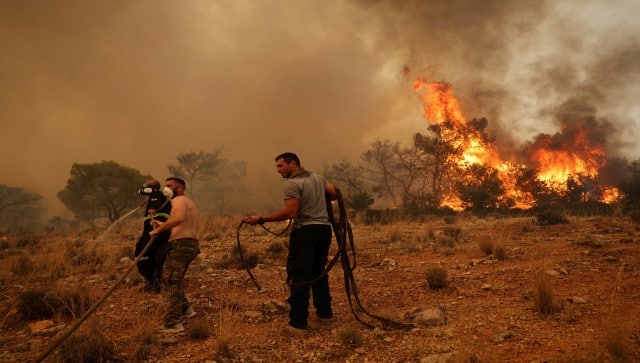 Men help a firefighter as they try to extinguish a wildfire burning near the village Vlyhada, near Athens, Greece. Reuters[/caption]“Fires are not sparked on their own,” Artopios said. “They are triggered by the human hand, be it intentionally or not. We currently have several people being questioned in connection with their probable involvement.”But as temperature records tumble, experts have pointed to climate change driven by the burning of fossil fuels, arguing that global warming is playing a key role in the devastating heat.
Dr Thomas Smith told BBC extreme weather is responsible for making wildfires far more likely.“Wildfires are becoming more intense and more frequent, ravaging communities and ecosystems in their path. Recent years have seen record-breaking wildfire seasons across the world from Australia to the Arctic to North and South America. With global temperatures on the rise, the need to reduce wildfire risk is more critical than ever,” a report published by the United Nations last year stated.Where are they spreading?Hundreds of firefighters, helped by forces from Turkey and Slovakia, battled to tame the blazes close to the villages of Gennadi and Vati in the southeast of Rhodes.Officials have said the threat of further fires was high in almost every region of the country.Emergency services were also dealing with fires on the island of Evia, east of Athens, and Aigio, southwest of Athens.In Evia, Greece's second largest island, civil protection authorities issued an overnight evacuation order in one northern locality.Northern Evia was devastated by wildfires in August 2021.A wildfire west of Athens has been burning since 17 July. More than 100 houses and businesses have been damaged by this fire and another near Athens that was put out last week. Flames were supported by strong wind and heat waves, several media reported.In the village of Vati, in the southeast of the island, local mayor Vassilis Kalabodakis said that the impact on the region was "tragic"."The village has been ordered to evacuate but we can't abandon it," he said.
"We are leading the fight to protect our home".Greece is just one of many countries battling a prolonged spell of extreme heat around the globe in recent days.[caption id="attachment_12886102" align="alignnone" width="640"]
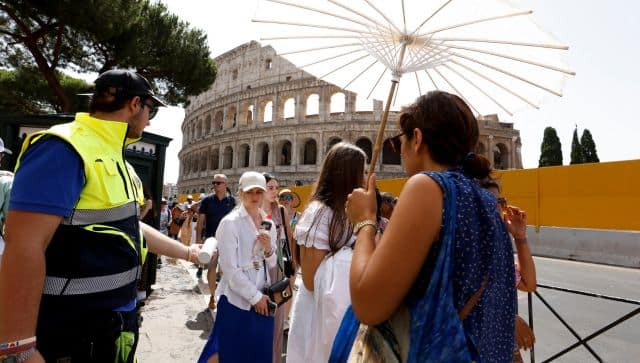 Countries across the Mediterranean, including tourist hotspots like Spain, Italy, Greece and Croatia are the worst hit. Reuters[/caption]Other countries battling blazesItalyFires were burning in woods and vegetation in various parts of Calabria, the southernmost part of the Italian mainland, while Palermo's airport reopened on Tuesday after wildfires in Sicily forced its closure for a few hours.On Tuesday, Italy put 16 cities on red alert because of the high temperatures. These include Palermo and Catania, where power and water supply cuts that local officials blamed in part on the heat have been frequent in recent days.In Palermo, holidaymaker Jonas Roggan told BBC he woke up to a wildfire near their hotel.“As my three friends and I woke up at our B&B the fire was on the hill above us," Roggan told BBC. “It’s not unusual for that region in this time of the year, so we started breakfast. But then the fire came down the hill and was directly at the road where we were staying."Sicily's civil protection agency said the temperature in some areas in eastern Sicily rose to 47 Celsius (116.6 Fahrenheit) on Sunday, close to the record European high of 48.8 Celsius from two years ago. Properties on the island suffered blackouts because of the heat wave.TurkeyWildfires started in Turkey's southeastern Hatay and Mersin provinces and Canakkale province in the northwest on 16 July, the Turkish General Directorate of Forestry said on its Twitter account.CroatiaA bushfire near the coastal town of Sibenik quickly spread on 13 July, fuelled by strong southerly winds. The fire was difficult to control, despite the efforts of 56 firefighters, along with 20 vehicles and three aircraft. The village of Grebastica suffered significant damage, including the destruction of cars and homes.FranceAbout six small-scale blazes have been recorded in the regions of Nouvelle-Aquitaine, Occitanie, Grand Est, Bouches-Du-Rhone and Corsica island. Mid-April, the French geological service BRGM said that very low groundwater levels had put France on course for a worse summer drought than last year, mainly in the southern part of the country.MaltaMalta has been suffering from a week-long heat wave that has caused widespread power cuts across the island. State-owned power company Enemalta said near record temperatures of between 40 and 42.7 degrees Celsius made underground distribution cables overheat and fail while electricity demand spiked.Malta Airport's meteorological office said it expected the heatwave to break by Wednesday morning when a north-westerly wind would bring down the temperature to around 34 degrees.PortugalPortugal has requested help in the management of wildfires from the European Union civil protection mechanism, Finland's Interior ministry said on Tuesday, adding the country would send 48 rescue workers to help Portugal.Mainland Portugal is facing widespread drought, with some 90 per cent of the country affected. The drought expanded during an abnormally hot and dry April, as reported by the meteorology agency IPMA in May.RussiaIn central Russia's Urals region, in the small village of Shaidurikha near Yekaterinburg, wildfires spread on 12 July and caused significant damage. One woman died, two people were hospitalised with burns and 41 houses were burned down as the fire rapidly spread. Dry and windy weather conditions contributed to the fire's intensity.SpainA wildfire started on 15 July on the island of La Palma, leading to the evacuation of more than 4,000 people. The fire has been contained, Spanish newspaper El Pais reported on 19 July, after burning 2,900 hectares of the island, including 200 hectares of the Caldera de Taburiente National Park.Spain has been enduring a prolonged period of drought, with the first four months of 2023 being the driest on record.SwitzerlandSwiss police issued evacuation orders on 17 July for several mountain villages due to the spread of a fire on the forested flank of a mountain in Bitsch in the Valais canton near the Italian border. More than 200 people were forced to evacuate. Although the situation was "stable", the fires were still not completely under control on 22 July, a local official said according to Swiss media RTS.With inputs from agencies
 First Published:Jul 25, 2023, 19:26:30 IST
Advertisement
Advertisement

Why has Bangladesh’s choice of India spokespersons raised eyebrows?
Bangladesh’s appointment of journalists Md Saidur Rahman and Umme Marufa to media roles in New Delhi and Kolkata has triggered controversy over their past anti-India social media posts, many of which were later deleted, prompting diplomatic scrutiny as India and Bangladesh seek to improve bilateral ties
6 min read
Who is Sandeep Lamba, the Delhi cop removed from protest site duty after slapping female protester?
Sandeep Lamba, an Additional Deputy Commissioner of Police (DCP) (North East District), was seen slapping a female CJP protester in a video on July 20. Lamba has now been removed from the protest site and sent back to his original station. In 2021, Lamba was awarded the Union Home Minister’s medal for excellent investigation
4 min read
Explorers discover wreckage of plane 72 years later. Will this help in finding MH370?
On April 11, 1952, a Pan Am Flight 526A, crashed into the Atlantic Ocean, killing 52 of the 69 people on board. After decades of effort, explorers have found the wreck of the plane at the bottom of the seabed near Puerto Rico. The discovery offers new hope to families who lost loved ones in the Malaysia Airlines Flight 370 crash in 2014
5 min read
Cruise missiles, drones and more... The deadly arsenal of the Houthis
The Houthis have evolved into one of the world's most formidable non-state military forces, deploying anti-ship ballistic missiles, cruise missiles, drones and explosive boats to threaten Red Sea shipping. Their latest attacks on Saudi oil tankers have raised concerns over shipping through the Bab el-Mandeb Strait amid the Strait of Hormuz crisis
10 min read
Why India may not witness a medal rush at 2026 Commonwealth Games
A 125-strong Indian contingent is in Glasgow for the 2026 Commonwealth Games, starting today (July 23), chasing international glory. However, with a roster of sports such as badminton and wrestling being cut from the event, the country’s medal chances have been drastically reduced
4 min read
Advertisement
Advertisement