


How Chandrayaan-3 will leave an imprint of the national emblem on the Moon
The rover Pragyan's wheels have been imprinted with the ISRO logo and the national emblem. It will descend from the lander's belly onto the Moon's surface using one of its side panels which will act as a ramp

The Pragyan rover will thus leave India’s imprint on the Moon.This comes a decade and a half after a Moon Impact Probe in 2008 with the Tricolour painted on it crash-landed on the Moon.What happens next?Pragyan will then begin studying the surface of the Moon.This will be done through its payloads APXS – Alpha Particle X-Ray Spectrometer – to derive the chemical composition and infer mineralogical composition to further enhance understanding of lunar surface.The rover, which has a mission life of 1 lunar day (14 Earth days), also has another payload Laser Induced Breakdown Spectroscope (LIBS) to determine the elemental composition of lunar soil and rocks around the lunar landing site, ISRO said.“After powered descent on to the landing site, there will be deployment of ramp and rover coming out. After this all the experiments will take place one after the other – all of which have to be completed in just one day on the moon, which is 14 days,” Somanath earlier explained.[caption id="attachment_13029802" align="alignnone" width="640"]
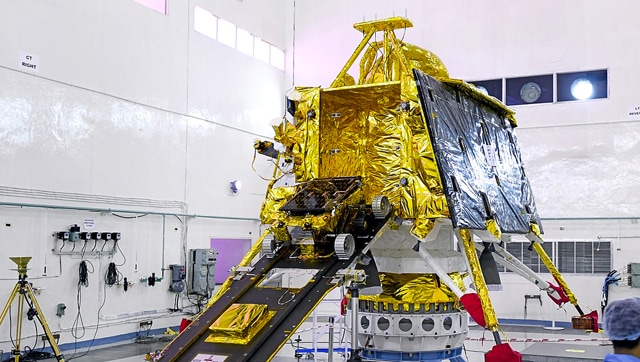
Chandrayaan-3's Vikram Lander and Pragyan Rover are carrying a ton of equipment and sensors as payloads.[/caption]Noting that as long as the sun shines all the systems will have its power, Somanath added, "The moment the sun sets, everything will be in pitch darkness, temperature will go as down as low as minus 180 degree Celsius; so it is not possible for the systems to survive, and if it survives further, then we should be happy that once again it has come to life and we will be able to work on the system once again, and we hope like that to happen.".Polar regions of the moon are a very different terrain due to the environment and the difficulties they present and therefore have remained unexplored. All the previous spacecraft to have reached the Moon landed in the equatorial region, a few degrees latitude north or south of the lunar equator.The Moon's south pole region is also being explored because there could be a possibility of presence of water in permanently shadowed areas around it.Meanwhile, the Propulsion Module, whose main function was to carry the Lander Module from launch vehicle injection till lander separation orbit, will continue its journey in the current orbit for months/years, the space agency said.Apart from this, the Propulsion Module also has one scientific payload as a value addition. The SHAPE (Spectro-polarimetry of Habitable Planet Earth) payload onboard it, whose future discoveries of smaller planets in reflected light would allow us to probe into a variety of Exo-planets which would qualify for habitability (or for presence of life).Noting that this is the work of a generation of ISRO's leadership and scientists, ISRO chief S Somanath paid tribute to a generation of leadership and scientists of the country's space agency."This is the journey we started with Chandrayaan-1, continued in Chandrayaan-2 and Chandrayaan-2 craft is still working and doing lot of communication work with us-- and all the team that contributed to building Chandrayaan-1 and 2 should be remembered and thanked, while we celebrate Chandrayaan-3."With inputs from agencies

Delhi Police asks personnel to wear uniform: What the law says on cops in plainclothes during protests
Military drones & police check-ups: How Sri Lanka is fighting against worst dengue outbreak in a decade
How Facebook job ad lured 2 Karnataka men into Myanmar cyber scam camp
Why is India seeing 95% cloud cover despite a Super El Niño?
What is CJP’s fourth demand to the government as protests in Delhi intensify?