


Delhi’s temperature was 40.9 degrees Celsius but felt like 45. Understanding the heat index
On Sunday, Delhi’s mercury levels rose to 40.9 degrees Celsius. But the Indian Meteorological Department said it felt more like 45. This is because of the heat index. It' s a value that tells us what the weather actually feels like taking into account the temperature and the humidity

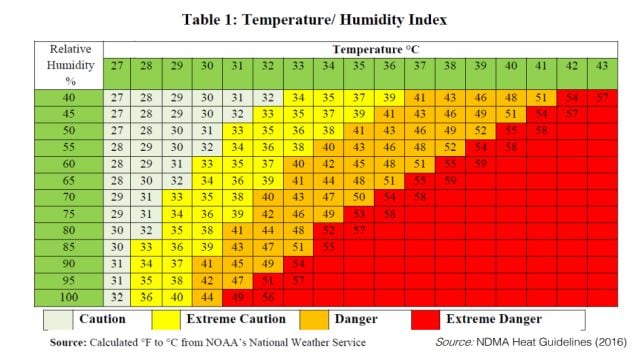
This table shows what the heat index looks like based on temperature and relative humidity.
Image Courtesy: Indian Meteorological Department[/caption]One thing important to note is that the heat index assumes that a person is standing in the shade: this is because it is natural for a person to stay in the shade rather out in the sun. The body will feel differently if standing in direct sunlight.The National Weather Service has said that full exposure to sunlight can make it feel even hotter by as much as 15 degrees.Heat index in IndiaWhile the practice of issuing a heat index has been in play in the US for long, it was on 27 March that the IMD began issuing a heat index. Speaking to Times of India, IMD officials said that it would be calculated on factors such as relative humidity, minimum and maximum temperatures, wind speed and the duration of a heatwave spell.Also: It’s not only India: How Asia is battling the ‘worst April heatwave’And based on this heat index, the officials would decide the warning levels – red, yellow, or orange and issue precautions that people can take to avoid heat strokes, heat exhaustion and heat-related sicknesses.[caption id="attachment_12597432" align="alignnone" width="640"]
Men rest beneath a tree during a hot summer day in Uttar Pradesh's Prayagraj. AFP[/caption]Importance of heat indexA study by IMD scientists have found that the number of heatwaves have increased by about 24 per cent during 2010-2019 as compared to 2000-2009 with associated mortality rates also increasing by about 27 per cent.Even the World Bank in a report titled “Climate Investment Opportunities in India’s Cooling Sector” which was released last year said that the country is experiencing higher temperatures that arrive earlier and stay far longer. It also said that the country could become one of the first places in the world to experience heat waves that break the human survivability limit.With the release of a heat index, officials will be able to issue warnings that could help prevent people from contracting a heatstroke or other heat-related illnesses.Presently, the temperatures are soaring across central India and parts of the north, affecting tens of millions. The weatherman has also stated that Odisha will experience hot and uncomfortable weather for the next five days.Moreover, heatwave conditions are likely over parts of Gujarat, Maharashtra, Bihar and West Bengal after 12 May. The highest maximum temperature in India this week was 44.8 degrees Celsius at Jalgaon in Maharashtra.India also logged its hottest February this year since record-keeping began in 1901, according to the Indian Meteorological Department.With inputs from agenciesRead all the Latest News, Trending News, Cricket News, Bollywood News,India News and Entertainment News here. Follow us on Facebook, Twitter and Instagram.

Delhi Police asks personnel to wear uniform: What the law says on cops in plainclothes during protests
Military drones & police check-ups: How Sri Lanka is fighting against worst dengue outbreak in a decade
How Facebook job ad lured 2 Karnataka men into Myanmar cyber scam camp
Why is India seeing 95% cloud cover despite a Super El Niño?
What is CJP’s fourth demand to the government as protests in Delhi intensify?