
Advertisement


Sections
Hawaii wildfires: What is the environmental impact of deadly blaze?
The fires, Hawaii’s worst natural disaster in decades and the deadliest US blazes of the past century, were fuelled by a dry summer and strong winds from a passing hurricane. Experts say while the full extent of the damage won’t be felt for some time, the coral reefs are in danger and drinking water

The toll in the Hawaii wildfires climbed to 96 on Sunday.The fires, Hawaii’s worst natural disaster in decades and the deadliest US blazes of the past century, were fuelled by a dry summer and strong winds from a passing hurricane.At least 2,200 buildings have been damaged or destroyed – of which 86 per cent are residential and the damage estimated at close to $6 billion.But what about the environmental impact?Let’s take a closer look:Corals in dangerExperts say the full extent of the damage to the environment won’t be felt for some time yet.The Washington Post quoted experts as saying that the fire would leave behind toxic chemicals that could seep into creeks and the ocean.![]() This photo provided by the Hawaii Department of Land and Natural Resources shows burnt areas in Lahaina on the Maui island, Hawaii, Friday, Aug. 11, 2023, following a wildfire. (Hawaii Department of Land and Natural Resources via AP)[/caption]“Coral reefs provide coastal protection, they provide fisheries, they support cultural practices in Hawaii,” Gove said. “And the loss of reefs just has such detrimental consequences to the ecosystem.”The Washington Post quoted experts as saying that any reefs near land burned were at risk but the reefs near Lahaina, such as the Olowalu Reef, which is home to some of the oldest reef structures in the Hawaiian islands were of particular concern.While runoff and land debris are the primary worries, ash falling into the ocean could block the reefs getting sunlight – and thus halt photosynthesis.Coral expert Jennifer Smith called the result of the blaze a “massive wasteland of chemicals and toxic substances.”Smith warned that these could flow into the ocean after a downpour.“Think about people’s garages and what they were storing in there,” she said. “That’s all been turned to ash.”Drinking waterAndrew Whelton, a professor of civil engineering and environmental and ecological engineering at Purdue University, said the wildfires can contaminate private wells and water systems and even municipal water systems.The private wells, which can be shallow and sometimes have little more protection than a board or well house, are easily overcome by fire and contaminated, Whelton said.Municipal systems also can be affected when fire damages distribution systems. Whelton described a scenario in which pressure drops could lead to contaminated water backing up, sucking in smoke, soot, ash and vapors that penetrate plastics, gaskets and other materials to create a future problem.
This photo provided by the Hawaii Department of Land and Natural Resources shows burnt areas in Lahaina on the Maui island, Hawaii, Friday, Aug. 11, 2023, following a wildfire. (Hawaii Department of Land and Natural Resources via AP)[/caption]“Coral reefs provide coastal protection, they provide fisheries, they support cultural practices in Hawaii,” Gove said. “And the loss of reefs just has such detrimental consequences to the ecosystem.”The Washington Post quoted experts as saying that any reefs near land burned were at risk but the reefs near Lahaina, such as the Olowalu Reef, which is home to some of the oldest reef structures in the Hawaiian islands were of particular concern.While runoff and land debris are the primary worries, ash falling into the ocean could block the reefs getting sunlight – and thus halt photosynthesis.Coral expert Jennifer Smith called the result of the blaze a “massive wasteland of chemicals and toxic substances.”Smith warned that these could flow into the ocean after a downpour.“Think about people’s garages and what they were storing in there,” she said. “That’s all been turned to ash.”Drinking waterAndrew Whelton, a professor of civil engineering and environmental and ecological engineering at Purdue University, said the wildfires can contaminate private wells and water systems and even municipal water systems.The private wells, which can be shallow and sometimes have little more protection than a board or well house, are easily overcome by fire and contaminated, Whelton said.Municipal systems also can be affected when fire damages distribution systems. Whelton described a scenario in which pressure drops could lead to contaminated water backing up, sucking in smoke, soot, ash and vapors that penetrate plastics, gaskets and other materials to create a future problem.![Hawaii wildfires]() A trail of destruction left by a blaze in Hawaii's Lahaina town. AP[/caption]Elizabeth Pickett, co-executive director of the Hawaii Wildfire Management Organization, a nonprofit working with communities to prevent and mitigate fires, lamented the changes wrought by fire.Invasive and fire-prone grass species have moved in over time and during a fire they can burn into native forests, which means the forests are replaced by more grass, Pickett said. The soil burns and sloughs off, leading to massive post-fire erosion that smothers coral, impacts fisheries and reduces the quality of the ocean water, she said.
A trail of destruction left by a blaze in Hawaii's Lahaina town. AP[/caption]Elizabeth Pickett, co-executive director of the Hawaii Wildfire Management Organization, a nonprofit working with communities to prevent and mitigate fires, lamented the changes wrought by fire.Invasive and fire-prone grass species have moved in over time and during a fire they can burn into native forests, which means the forests are replaced by more grass, Pickett said. The soil burns and sloughs off, leading to massive post-fire erosion that smothers coral, impacts fisheries and reduces the quality of the ocean water, she said.
They predicted that flora and fauna will find it difficult to survive in such an atmosphere.“When a fire like this comes through, and everything is destroyed, it hurts your soul,” Kimberly Thayer, a program associate at Mauna Kahalawai Watershed Partnership, told the newspaper.The wildfires struck Hawaii just as Jamison Gove, a Honolulu-based oceanographer with the National Oceanic and Atmospheric Administration, was publishing research in Nature on Hawaii coral reefs’ recovering from a 2015 marine heat wave. That work highlighted the threat to coral from land-based contaminants running off into the ocean.Gove said Thursday that burning homes, commercial structures and cars and trucks would make any runoff worse by concentrating synthetic materials in the stream.“It’s not a major leap to suggest when all that material is even more heavily concentrated in a small area, that the consequences would undoubtedly be more severe if and when it’s in the ocean,” Gove said. He noted that Lahaina’s coastal location meant “a minimal distance” for the materials to reach the ocean.[caption id="attachment_12990902" align="alignnone" width="640"]
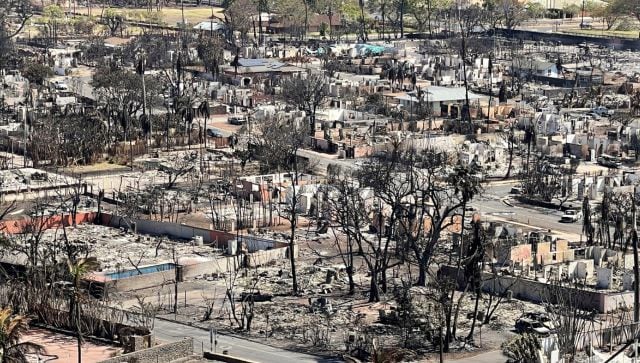 This photo provided by the Hawaii Department of Land and Natural Resources shows burnt areas in Lahaina on the Maui island, Hawaii, Friday, Aug. 11, 2023, following a wildfire. (Hawaii Department of Land and Natural Resources via AP)[/caption]“Coral reefs provide coastal protection, they provide fisheries, they support cultural practices in Hawaii,” Gove said. “And the loss of reefs just has such detrimental consequences to the ecosystem.”The Washington Post quoted experts as saying that any reefs near land burned were at risk but the reefs near Lahaina, such as the Olowalu Reef, which is home to some of the oldest reef structures in the Hawaiian islands were of particular concern.While runoff and land debris are the primary worries, ash falling into the ocean could block the reefs getting sunlight – and thus halt photosynthesis.Coral expert Jennifer Smith called the result of the blaze a “massive wasteland of chemicals and toxic substances.”Smith warned that these could flow into the ocean after a downpour.“Think about people’s garages and what they were storing in there,” she said. “That’s all been turned to ash.”Drinking waterAndrew Whelton, a professor of civil engineering and environmental and ecological engineering at Purdue University, said the wildfires can contaminate private wells and water systems and even municipal water systems.The private wells, which can be shallow and sometimes have little more protection than a board or well house, are easily overcome by fire and contaminated, Whelton said.Municipal systems also can be affected when fire damages distribution systems. Whelton described a scenario in which pressure drops could lead to contaminated water backing up, sucking in smoke, soot, ash and vapors that penetrate plastics, gaskets and other materials to create a future problem.
“They leach out slowly into the clean water you’ve just put in, making that clean water unsafe,” Whelton said.Maui water officials warned Lahaina and Kula residents not to drink running water, which may be contaminated even after boiling, and to only take short, lukewarm showers in well-ventilated rooms to avoid possible chemical vapor exposure.Landscape and soil changesThayer, speaking to The Washington Post, warned of the damage to the soil seed bank.She said each passing fire only brings down the chances of a viable seed bank remaining within the soil.[caption id="attachment_12986202" align="alignnone" width="640"]
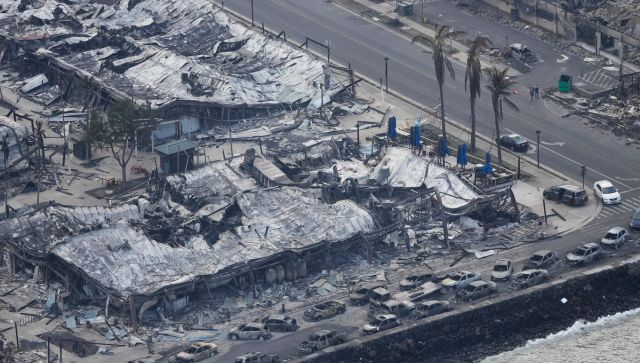 A trail of destruction left by a blaze in Hawaii's Lahaina town. AP[/caption]Elizabeth Pickett, co-executive director of the Hawaii Wildfire Management Organization, a nonprofit working with communities to prevent and mitigate fires, lamented the changes wrought by fire.Invasive and fire-prone grass species have moved in over time and during a fire they can burn into native forests, which means the forests are replaced by more grass, Pickett said. The soil burns and sloughs off, leading to massive post-fire erosion that smothers coral, impacts fisheries and reduces the quality of the ocean water, she said.
The state is windy and the dust blows for years, harming human health, she added.“When you lose your soil, it’s really hard to restore and replant. And then the only thing that can really handle living there in many cases are more of those invasive species,” Pickett said. “It’s systemic. Air, land and water are all impacted.”Paul Steblein, the wildland fire science coordinator for the US Geological Survey, said there are a number of fire-adapted invasive species. If that is what grows back following a wildfire, then fires can become more common.Those invasive grasses are also growing faster during the periods that are wetter due to climate change and become easy to burn when it dries out, Steblein said.With inputs from agencies
First Published:Aug 14, 2023, 18:31:39 IST
Advertisement
Advertisement

Delhi Police asks personnel to wear uniform: What the law says on cops in plainclothes during protests
The Delhi Police has instructed all its personnel to wear uniforms when they report for duty at Jantar Mantar for crowd control. This comes after outrage grew over videos of men in civilian clothes or without name tags hitting protesters in the Capital. Is it legal for the police to ditch uniforms during protests?
4 min read
Military drones & police check-ups: How Sri Lanka is fighting against worst dengue outbreak in a decade
Sri Lanka is fighting its most severe dengue outbreak in nearly a decade, with infections rising sharply across the nation. Military drones have been deployed to tackle the outbreak, which has claimed 56 lives. Health officials said the outbreak is being driven primarily by the DENV-2 variant of the virus
3 min read
How Facebook job ad lured 2 Karnataka men into Myanmar cyber scam camp
The Karnataka Cyber Command has rescued two youths from a scam compound in Myanmar operated by Chinese fraudsters. The duo from Karnataka were lured on the pretext of data-entry jobs. They were asked to work for 16 hours a day and were expected to sleep for six hours daily
4 min read
Why is India seeing 95% cloud cover despite a Super El Niño?
India is witnessing nearly 95 per cent cloud cover despite a Super El Niño, a climate event usually linked to weaker monsoons. Regional weather systems, cyclonic circulations, the monsoon trough and moisture from two seas are temporarily overpowering one of the world's strongest climate phenomena
5 min read
What is CJP’s fourth demand to the government as protests in Delhi intensify?
The protest by the Cockroach Janta Party at Delhi’s Jantar Mantar refuses to die down. The group have made a fourth demand to the Centre, asking that no FIRs are filed against the agitators and that no legal action be taken. The government has expressed willingness to speak to the protesters, but refused to accede on the resignation of Education Minister Dharmandra Pradhan
5 min read
Advertisement
Advertisement