
Advertisement


Sections
G20: Why India-Middle East-Europe economic corridor is touted as ‘game changer’
India, the US, Saudi Arabia and the EU unveiled the India-Middle East-Europe economic corridor pact on the sidelines of the G20 Summit. Not only would the project improve trade and energy connectivity between the Middle East, Europe and South Asia, but it also has wider geopolitical implications

 A major rail and shipping corridor connecting India with the Middle East and Europe was announced today (9 September) on the sidelines of the G20 Summit in New Delhi. Prime Minister Narendra Modi called the India-Middle East-Europe economic corridor a “beacon of cooperation, innovation, and shared progress.”"As history unfolds, may this corridor be a testament to human endeavour and unity across continents,” he wrote on X, formerly Twitter.India, the United States, Saudi Arabia, the United Arab Emirates (UAE), the European Union (EU), and others unveiled the ambitious initiative, which American president Joe Biden called a “really big deal”. He said it would link across two continents and lead to a "more stable, more prosperous and integrated Middle East”.What will the project entail? Why has it been touted as a “game changer”? We explain.What’s the India-Middle East-Europe Economic Corridor?The multinational rail and ports initiative aims to link India with the Middle East and eventually Europe.The project would include developing railways, ports, electricity and data networks, as per AFP.It will enhance trade, provide energy resources and improve digital connectivity, reported Associated Press (AP).As per Jake Sullivan, US national security adviser, India, Saudi Arabia, the UAE, Jordan, Israel and the EU will be part of the mega connectivity project.The initiative would entail constructing a railway line across the Arabian Peninsula via the UAE and Saudi Arabia and building port connectivity to India and Europe, according to Indian Express.The rail and shipping corridor also intends to enhance trade among countries as well as build infrastructure to aid the production and transport of "green hydrogen", noted AFP. ALSO READ: India-Middle East-Europe corridor, African Union in G20: The big hits of G20 Summit Day 1Reactions to the trade planPM Modi said that "enhancing connectivity" with other regions has been a "key priority for India".“We believe that connectivity is a means to not only increase mutual trade between different countries but also increase mutual trust," he was quoted as saying by AP. European Commission president Ursula von der Leyen said the economic corridor was "much more than just a railway or a cable"."It is a green and digital bridge across continents and civilisations," AFP quoted her as saying.Saudi Arabia's Crown Prince Mohammed bin Salman bin Abdulaziz Al Saud said, “We forward to the integration of the initiative and the economic corridor project... I would like to thank those who worked with us to reach this founding step to establish this important economic corridor.”French president Emmanuel Macron said now they need to work to make the plan "real".Why the trade-tech corridor is a big dealThe rail and shipping corridor will not just advance economic growth but it has wider geopolitical implications.The project could include Israel, which may thaw its strained relations with rival Saudi Arabia. The US has been trying to forge a wider diplomatic deal in the Middle East which would entail Saudi Arabia officially recognise Israel, as per Reuters.“The deal will benefit low and middle-income countries in the region, and enable a critical role for the Middle East in global commerce,” Jon Finer, the US deputy national security adviser said earlier. For the US, he said, the deal helps "turn the temperature down across the region" and "address a conflict where we see it", reported Reuters. According to AFP, the deal could include developing railway and port facilities across the Middle East, including the UAE, Saudi Arabia, Jordan and Israel, which may accelerate trade between India and Europe by up to 40 per cent.[caption id="attachment_13104992" align="alignnone" width="640"]
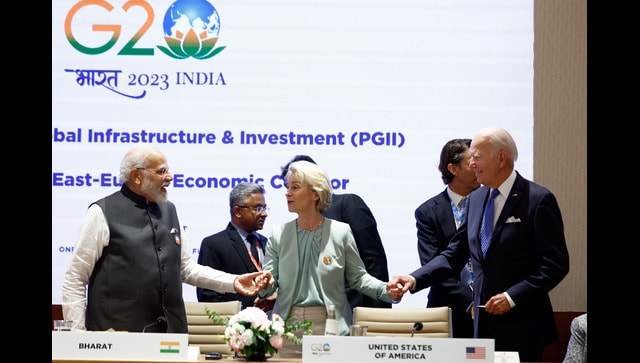 PM Narendra Modi, US president Joe Biden and European Union president Ursula von der Leyen attend Partnership for Global Infrastructure and Investment event on the sidelines of the G20 summit in New Delhi. Reuters[/caption]C Raja Mohan, a senior fellow with the Asia Society Policy Institute, wrote for Indian Express that the deal stops “Pakistan’s veto over India’s overland connectivity to the West.” Further, he said that the project will “deepen India’s strategic engagement with the Arabian peninsula. The Modi government, which had rapidly elevated political and strategic links with the United Arab Emirates and Saudi Arabia in the last few years, now has an opportunity to build enduring connectivity between India and Arabia.”Most importantly, the project could be a counter to China’s Belt and Road – a vast infrastructure programme that has spread Beijing's investments and clout across Europe, Africa, Asia and Latin America.The US is making efforts to emerge as an alternative partner and investor for developing countries. However, much depends on the timeline of this corridor's completion and other logistics, which are yet to be known.Michael Kugelman, South Asia Institute director at The Wilson Center, said the plan could be an important reply to the Belt and Road Initiative. "If finalised, it would be a game changer that strengthens connectivity between India and the Middle East and would aim to counter BRI," Kugelman wrote on X.With inputs from agencies
First Published:Sep 09, 2023, 21:35:05 IST
Advertisement
Advertisement

Delhi Police asks personnel to wear uniform: What the law says on cops in plainclothes during protests
The Delhi Police has instructed all its personnel to wear uniforms when they report for duty at Jantar Mantar for crowd control. This comes after outrage grew over videos of men in civilian clothes or without name tags hitting protesters in the Capital. Is it legal for the police to ditch uniforms during protests?
4 min read
Military drones & police check-ups: How Sri Lanka is fighting against worst dengue outbreak in a decade
Sri Lanka is fighting its most severe dengue outbreak in nearly a decade, with infections rising sharply across the nation. Military drones have been deployed to tackle the outbreak, which has claimed 56 lives. Health officials said the outbreak is being driven primarily by the DENV-2 variant of the virus
3 min read
How Facebook job ad lured 2 Karnataka men into Myanmar cyber scam camp
The Karnataka Cyber Command has rescued two youths from a scam compound in Myanmar operated by Chinese fraudsters. The duo from Karnataka were lured on the pretext of data-entry jobs. They were asked to work for 16 hours a day and were expected to sleep for six hours daily
4 min read
Why is India seeing 95% cloud cover despite a Super El Niño?
India is witnessing nearly 95 per cent cloud cover despite a Super El Niño, a climate event usually linked to weaker monsoons. Regional weather systems, cyclonic circulations, the monsoon trough and moisture from two seas are temporarily overpowering one of the world's strongest climate phenomena
5 min read
What is CJP’s fourth demand to the government as protests in Delhi intensify?
The protest by the Cockroach Janta Party at Delhi’s Jantar Mantar refuses to die down. The group have made a fourth demand to the Centre, asking that no FIRs are filed against the agitators and that no legal action be taken. The government has expressed willingness to speak to the protesters, but refused to accede on the resignation of Education Minister Dharmandra Pradhan
5 min read
Advertisement
Advertisement