
Advertisement


Sections
From Darwin’s theory of evolution to Periodic Table, subjects you won’t find in Indian textbooks
The National Council of Educational Research and Training (NCERT) on 1 June dropped a slew of topics from the Class 10 textbooks including chapters on the Periodic Table, contribution of agriculture to the national economy, challenges to democracy and sustainable management of natural resources

Indian textbooks and controversy seem to be linked inextricably.The National Council of Educational Research and Training (NCERT) on 1 June dropped a slew of topics from the Class 10 textbooks including chapters on the Periodic Table, contribution of agriculture to the national economy, challenges to democracy and sustainable management of natural resources.The NCERT says it carried out this “rationalisation exercise” on the basis of expert recommendations.The NCERT in a note on the changes in the textbooks last year said, “In view of the COVID-19 pandemic, it is imperative to reduce content load on students. The National Education Policy 2020, also emphasises reducing the content load and providing opportunities for experiential learning with creative mindset.”“In this background, NCERT has undertaken the exercise to rationalise the textbooks across all classes. Learning Outcomes already developed by the NCERT across classes have been taken into consideration in this exercise,” it said.This isn’t the first time subjects have been dropped from textbooks.Let’s take a closer look at all the things you won’t find in Indian textbooks:Bye-bye Periodic Table, DarwinAs per India Today, the NCERT has permanently deleted the periodic classification of elements from the Class 10 textbooks.It must be noted that the Periodic Table remains part of the syllabus for Class 11.[caption id="attachment_5989981" align="alignnone" width="1280"]![]() The tail end of the periodic table.[/caption]Experts have raised an alarm over the elimination of the Periodic Table, saying it ‘forms the foundation’ of chemistry education and provides a comprehensive understanding of elements and their properties.
The tail end of the periodic table.[/caption]Experts have raised an alarm over the elimination of the Periodic Table, saying it ‘forms the foundation’ of chemistry education and provides a comprehensive understanding of elements and their properties.![]() Shah Jahan at a Durbar. Wikimedia Commons[/caption]He said that even today students are studying the history of the Mughals in NCERT’s class 7th book.“Along with this, the history of Mughals is being taught in Empires in section-2 of the 11th class book. And in the class 12th book there were 2 chapters on the history of the Mughals, out of which theme nine was removed last year, while theme eight is still being taught to the students. This year no chapter has been removed from any book,” Saklani further said.“We are working as per NEP (National Education Policy) 2020. This is a transition phase. NEP 2020 speaks of reducing the content load. We are implementing it. NCF (National Curriculum Framework) for school education is being formed, it will be finalised soon. Textbooks will be printed in 2024 as per NEP. We have not dropped anything right now,” the NCERT chief said while stressing the National Education Policy.Urdu poet Muhammad IqbalDelhi University’s Academic Council dropped a chapter on renowned Urdu poet Muhammad Iqbal who composed the song composition ‘Sare Jahan Se Achha’ from its political science syllabus.Iqbal, the national poet of Pakistan, also known as Allama Iqbal, was dropped from the Political Science syllabus during a discussion on the undergraduate course in the 1014th Academic Council meeting of Delhi University.
Shah Jahan at a Durbar. Wikimedia Commons[/caption]He said that even today students are studying the history of the Mughals in NCERT’s class 7th book.“Along with this, the history of Mughals is being taught in Empires in section-2 of the 11th class book. And in the class 12th book there were 2 chapters on the history of the Mughals, out of which theme nine was removed last year, while theme eight is still being taught to the students. This year no chapter has been removed from any book,” Saklani further said.“We are working as per NEP (National Education Policy) 2020. This is a transition phase. NEP 2020 speaks of reducing the content load. We are implementing it. NCF (National Curriculum Framework) for school education is being formed, it will be finalised soon. Textbooks will be printed in 2024 as per NEP. We have not dropped anything right now,” the NCERT chief said while stressing the National Education Policy.Urdu poet Muhammad IqbalDelhi University’s Academic Council dropped a chapter on renowned Urdu poet Muhammad Iqbal who composed the song composition ‘Sare Jahan Se Achha’ from its political science syllabus.Iqbal, the national poet of Pakistan, also known as Allama Iqbal, was dropped from the Political Science syllabus during a discussion on the undergraduate course in the 1014th Academic Council meeting of Delhi University.
 The tail end of the periodic table.[/caption]Experts have raised an alarm over the elimination of the Periodic Table, saying it ‘forms the foundation’ of chemistry education and provides a comprehensive understanding of elements and their properties.
They warned that such an omission could thwart students' grasp of essential chemical principles, as per India Today.Emphasising the importance of the topic, a text by American chemist Glenn T Seaborg cited in the Class 11 Chemistry textbook reads, “The Periodic Table is arguably the most important concept in chemistry, both in principle and in practice…. An awareness of the Periodic Table is essential to anyone who wishes to disentangle the world and see how it is built up from the fundamental building blocks of chemistry, the chemical elements.”Also gone from the Class 10 textbooks?Charles Darwin’s theory of evolution, the origins of life, and heredity.This move caused a furor in April with over 1,800 educationists and researchers sending the body an open letter criticising the move.The letter, entitled 'An Appeal Against Exclusion of Evolution from Curriculum' was signed by representatives of esteemed institutions such as the Indian Institute of Science, Tata Institute of Fundamental Research, and Indian Institute of Technology."The country's scientific community is seriously dismayed to see that the theory of biological evolution, which was an integral part of the science syllabus at the 10th standard, has been dropped. It was first dropped as an interim measure for syllabus reduction during the Corona pandemic. But the NCERT document states that it is dropped permanently as a step in 'content rationalisation'!" the letter reads, as per India Today.According to India Today, experts said the theory of evolution is a concept that is central to biology.This, as it allows students to comprehend the connection between all life on Earth and all its diversity. Experts warned that removing the theory of evolution may hinder the ability of students to understand the natural world.Topics that have been struck off the science textbooks include chapters on Fibre and Fabrics in Classes 6, 7 and 8.One deletion that stands out is that of the “Why do we fall ill” chapter from the Class 9 Science textbook.Mughal EmpireThe Indian Express in April reported that topics about the Mughal and the Delhi Sultanate were removed from textbooks.A two-page table listing the triumphs of Mughal emperors Humayun, Shah Jahan, Akbar, Jahangir and Aurangzeb were removed from the Class 7 textbook.Passages on the hereditary nature of varnas, classification of people as untouchables and rejection of the varna system were removed from the chapter "Kingdom, Kings and Early Republic" from the Class 6 history book.However, NCERT director in April insisted that chapters on Mughals had not been ‘dropped’ from CBSE books.“It’s a lie. (Chapters on) Mughals have not been dropped. There was a rationalisation process last year because due to COVID, there was pressure on students everywhere,” the NCERT director told ANI.
The NCERT chief further said that expert committees examined the books from standards 6-12.“They recommended that if this chapter is dropped, it won’t affect the knowledge of the children and an unnecessary burden can be removed…The debate is unnecessary. Those who don’t know can check the textbooks…,” Saklani said.[caption id="attachment_12679852" align="alignnone" width="640"]
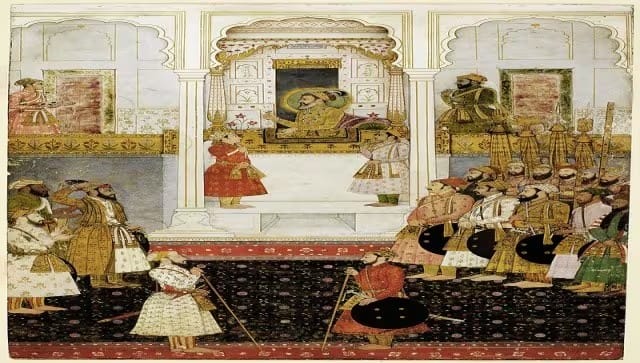 Shah Jahan at a Durbar. Wikimedia Commons[/caption]He said that even today students are studying the history of the Mughals in NCERT’s class 7th book.“Along with this, the history of Mughals is being taught in Empires in section-2 of the 11th class book. And in the class 12th book there were 2 chapters on the history of the Mughals, out of which theme nine was removed last year, while theme eight is still being taught to the students. This year no chapter has been removed from any book,” Saklani further said.“We are working as per NEP (National Education Policy) 2020. This is a transition phase. NEP 2020 speaks of reducing the content load. We are implementing it. NCF (National Curriculum Framework) for school education is being formed, it will be finalised soon. Textbooks will be printed in 2024 as per NEP. We have not dropped anything right now,” the NCERT chief said while stressing the National Education Policy.Urdu poet Muhammad IqbalDelhi University’s Academic Council dropped a chapter on renowned Urdu poet Muhammad Iqbal who composed the song composition ‘Sare Jahan Se Achha’ from its political science syllabus.Iqbal, the national poet of Pakistan, also known as Allama Iqbal, was dropped from the Political Science syllabus during a discussion on the undergraduate course in the 1014th Academic Council meeting of Delhi University.
Vice-Chancellor Yogesh Singh on Wednesday sparked a row when he said Iqbal may have penned the song but ‘never believed in it.’“I don’t know why we were teaching his (Muhammad Iqbal’s) part in the syllabus for the past 75 years. I agree that he served India by composing the popular song ‘Sare Jahan Se Acha’ but never believed in that.”“Iqbal wrote songs supporting the ‘Muslim League’ and the ‘Pakistan Movement’. He was the first to raise the idea of the partition of India and the establishment of Pakistan. Instead of teaching our students about such people, we should impart lessons on our national heroes,” Singh added.Singh earlier presiding over the meeting of the Academic Council said that those who laid the foundation to break India should not be included in the varsity’s syllabus.Singh’s proposal was unanimously passed by the House.According to Business Today, chapters on the Cold War and US hegemony in world politics were removed, while chapters on Central Islamic lands, Confrontation of Cultures and ‘The Industrial revolution’ were deleted.‘Whitewashing with vengeance’Dropping several topics and portions from the NCERT textbooks last month triggered a controversy, with the Opposition blaming the Centre for “whitewashing with vengeance”.At the heart of the row was the fact that while the changes made as part of the rationalisation exercise were notified, some of these controversial deletions were not mentioned. This led to allegations about a bid to delete these portions surreptitiously.The NCERT had described the omissions as a possible oversight but refused to undo the deletions, saying they were based on the recommendations of experts. It also said the textbooks are anyway headed for revision in 2024 when the National Curriculum Framework kicks in.However, the NCERT later changed its stand and said “minor changes need not be notified”.With inputs from agenciesRead all the Latest News, Trending News, Cricket News, Bollywood News, India News and Entertainment News here. Follow us on Facebook, Twitter and Instagram.
First Published:Jun 01, 2023, 22:31:10 IST
Advertisement
Advertisement

Why India may not witness a medal rush at 2026 Commonwealth Games
A 125-strong Indian contingent is in Glasgow for the 2026 Commonwealth Games, starting today (July 23), chasing international glory. However, with a roster of sports such as badminton and wrestling being cut from the event, the country’s medal chances have been drastically reduced
4 min read
Delhi Police asks personnel to wear uniform: What the law says on cops in plainclothes during protests
The Delhi Police has instructed all its personnel to wear uniforms when they report for duty at Jantar Mantar for crowd control. This comes after outrage grew over videos of men in civilian clothes or without name tags hitting protesters in the Capital. Is it legal for the police to ditch uniforms during protests?
4 min read
Military drones & police check-ups: How Sri Lanka is fighting against worst dengue outbreak in a decade
Sri Lanka is fighting its most severe dengue outbreak in nearly a decade, with infections rising sharply across the nation. Military drones have been deployed to tackle the outbreak, which has claimed 56 lives. Health officials said the outbreak is being driven primarily by the DENV-2 variant of the virus
3 min read
How Facebook job ad lured 2 Karnataka men into Myanmar cyber scam camp
The Karnataka Cyber Command has rescued two youths from a scam compound in Myanmar operated by Chinese fraudsters. The duo from Karnataka were lured on the pretext of data-entry jobs. They were asked to work for 16 hours a day and were expected to sleep for six hours daily
4 min read
Why is India seeing 95% cloud cover despite a Super El Niño?
India is witnessing nearly 95 per cent cloud cover despite a Super El Niño, a climate event usually linked to weaker monsoons. Regional weather systems, cyclonic circulations, the monsoon trough and moisture from two seas are temporarily overpowering one of the world's strongest climate phenomena
5 min read
Advertisement
Advertisement