


Fragmented and uncertain: How the oil market has changed a year after the Russia-Ukraine war
In some ways, the oil market has changed dramatically since Russia's invasion of Ukraine. It has become more fragmented and uncertain, which is expected to drive up crude prices in the long run

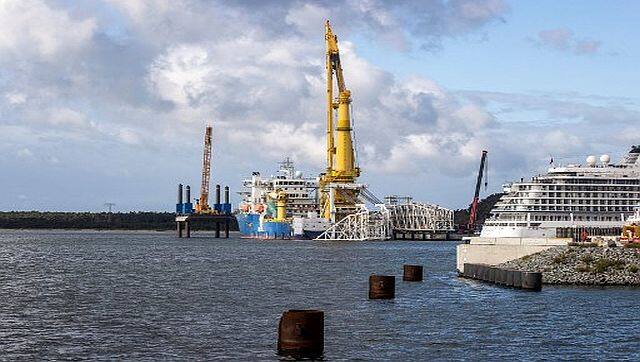
The Russian pipe laying vessel Akademik Cherskiy to complete the Nord Stream 2 gas pipeline project is moored in the port of Mukran on the island of Rügen, northeastern Germany. File image/AFP[/caption]Many expect lasting changes."What I think will last very long is the fundamental distrust and the fundamental decision to not depend on Russian energy for a very long time in Europe," said Eirik Waerness, chief economist at Equinor. "That will have long-term implications."A 'tight' marketThe flux in the wake of the Russian invasion has also strengthened the position of the Organisation of the Petroleum Exporting Countries.Burkhard said Saudi Arabia's spare capacity continues to give the exporters group unique clout.But the situation has changed significantly compared with late 2016 when the Vienna-based cartel began coordinating policy with Russia."Russia today cannot really manage its production because it faces sanctions," leading to production below Russia's quota under the "OPEC+" policy, Burkhard said."OPEC is still very important, but OPEC+ right now is not what it was before the war," he said.The United States' role on international markets has also been reinforced.The world's biggest oil producer, the United States last week set a new record for crude exports of 5.6 million barrels per day, almost twice the level in 2021.Still, US production has not returned to its pre-pandemic level. Key factors that have weighed on output include the strategy of US shale producers to use excess cash to bolster balance sheets rather than increase capital spending; and shortages of key oilfield materials and personnel."The volumes continue to increase, but they could probably have increased even more," Waerness said of the United States.Globally, markets continue to feel the effects of the decision by OPEC in October to trim production by two million barrels per day."The fundamentals are relatively tight," Waerness said. "The extra capacity to deliver new supplies into markets, whether we're talking about gas or oil, is very low."Waerness said there are also questions about the sustainability of Russian production given the exodus of Western oilfield suppliers and service companies."We don't know how long Russia can continue to produce 11 million barrel and 12 million barrels a day," Waerness said. "Will they be able to replace that type of competence?"The situation is further complicated by the focus on the energy transition, which experts believe exacerbates under-investment in conventional petroleum.The upshot, according to Burkhard, is a higher baseline for crude prices."We will have cycles, but the centre of gravity for oil prices we think will be around $70 (Rs 5,728) or $80 (Rs 6,546)," he said. "That's higher than what we've typically seen over the last 20-30 years."Read all the Latest News, Trending News, Cricket News, Bollywood News,India News and Entertainment News here. Follow us on Facebook, Twitter and Instagram.

Delhi Police asks personnel to wear uniform: What the law says on cops in plainclothes during protests
Military drones & police check-ups: How Sri Lanka is fighting against worst dengue outbreak in a decade
How Facebook job ad lured 2 Karnataka men into Myanmar cyber scam camp
Why is India seeing 95% cloud cover despite a Super El Niño?
What is CJP’s fourth demand to the government as protests in Delhi intensify?